Dorob National Park
Dorob National Park – Namibia’s Vast Coastal Desert, Fog Oasis, Marine Biodiversity Haven, and Gateway to the Skeleton Coast
Dorob National Park is one of Namibia’s most extraordinary protected landscapes—an immense stretch of coastline where the Namib Desert meets the cold, nutrient-rich waters of the Atlantic Ocean. Covering more than 805,000 hectares (8,050 km²)—not 160,000 hectares as often mistakenly cited—Dorob forms a critical ecological link between Namib-Naukluft National Park and the Skeleton Coast National Park, creating a nearly continuous belt of conservation land along Namibia’s western frontier. Its unique combination of marine upwelling systems, fog deserts, ancient gravel plains, massive dunes, fragile lichen fields, RAMSAR wetlands, and internationally important bird habitats makes it one of the most biologically and geologically significant coastal ecosystems in Africa.
The park’s name—Dorob, meaning “dry land” in the Damara language—reflects its stark desert identity. Yet beneath its austere beauty lies a thriving world shaped by fog, ocean currents, Benguela upwelling systems, and thousands of years of desert evolution. Proclaimed in 2010, Dorob National Park was established to protect fragile ecological corridors, globally important breeding sites, archaeological treasures, and coastal habitats that are easily damaged but extraordinarily slow to recover. Today, it is one of the most visited and ecologically important parks in Namibia, containing several urban centers within its boundaries—an extremely rare feature for a national park.
Location, Boundaries, and Ecological Connectivity
Dorob National Park stretches from the Swakop River in the south to the Ugab River in the north, encompassing entire towns such as Walvis Bay, Swakopmund, Henties Bay, and Wlotzkasbaken. It also includes the Cape Cross region and the shoreline northwards toward the Skeleton Coast. This unusual configuration—urban areas legally situated inside a national park—makes Dorob one of the only conservation areas on Earth where towns and a major port (Walvis Bay) fall within protected boundaries.
Dorob ensures uninterrupted ecological connectivity along Namibia’s dramatic coastline. Wildlife—especially birds, seals, jackals, brown hyenas, foxes, and migratory species—move freely across its beaches, dunes, gravel plains, and marine ecosystems. The park protects multiple RAMSAR wetlands, including the Walvis Bay Lagoon, Sandwich Harbour, and the Swakopmund Salt Works Important Bird Area, which collectively support over 200,000 birds during peak seasons.
Geological Features and Desert Landforms
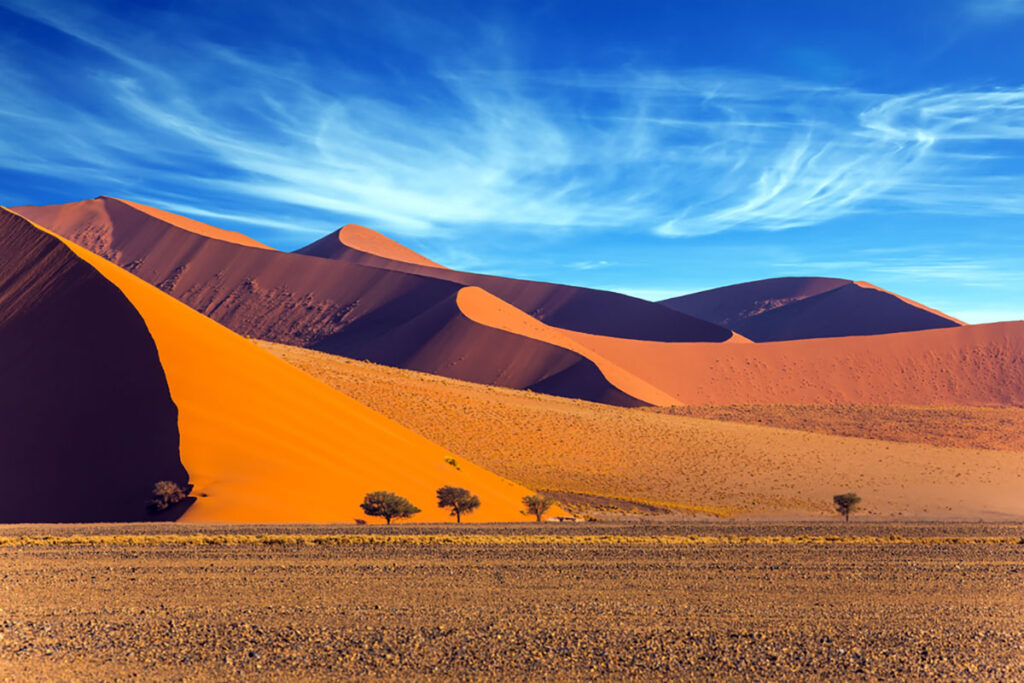
Dorob National Park conserves some of the oldest exposed landscapes on Earth. Its desert pavements have been shaped by wind abrasion for thousands of years, while its towering dunes belong to the oldest desert dune system known.
Key geological features include:
- Petrified dunes containing ancient wind-blown sands cemented over millennia.
- Marine terraces created by fluctuations in sea levels during past climatic cycles.
- Desert varnish plains coated with iron and manganese oxides, forming over thousands of years.
- Fossil river channels beneath shifting dune fields, evidence of wetter prehistoric climates.
- Inselbergs and rocky outcrops providing microhabitats for reptiles and endemic desert insects.
Climate, Fog Systems, and Atmospheric Phenomena
Dorob lies within the fog belt of the Namib Desert, receiving less than 20 mm of rainfall annually. Its ecosystems rely almost entirely on fog generated when the cold Benguela Current meets warm inland air. Fog blankets the desert for more than 200 days a year, drifting up to 60 km inland.
Additional climatic features include:
- Benguela Niño events that temporarily warm coastal waters and reduce marine productivity.
- Berg winds—hot, dry winds from the interior that cause sudden temperature spikes along the coast.
- Persistent temperature inversions that trap fog and moisture close to the ground.
Temperatures generally range from 10°C–25°C year-round, with occasional heatwaves during Berg wind conditions.
Vegetation, Lichen Fields, and Desert Flora
Dorob’s vegetation is sparse but ecologically critical. The park is especially renowned for its lichen fields, which blanket gravel plains in striking hues. These lichens grow only a few millimeters per decade and are destroyed instantly by off-road tracks.
Other important flora include:
- Halophytes in saline wetlands and lagoon margins.
- Dune grasses stabilizing sand and supporting beetle and reptile communities.
- Semi-woody shrubs adapted to extreme aridity.
- Nara melon plants in southern zones—a key food source for wildlife and local communities.
- Succulents that absorb fog moisture directly through leaves.
Wildlife of Dorob National Park
Marine Mammals
Dorob’s coastline is part of one of the world’s richest marine ecosystems due to the Benguela upwelling. Key species include:
- Cape fur seals, especially at the world-famous Cape Cross colony.
- Heaviside’s dolphins, bottlenose dolphins, and dusky dolphins.
- Humpback and southern right whales, with occasional orcas.
- Marine invertebrates such as cuttlefish, jellyfish, mussels, starfish, and sea urchins.
- Sunfish (Mola mola) during upwelling seasons.
- Rare appearances of leatherback turtles.
Birdlife
Dorob is an internationally recognized Important Bird Area (IBA). Highlights include:
- Damara tern – Dorob protects most of the world’s breeding population.
- Greater and lesser flamingos – spectacular numbers at Walvis Bay Lagoon and Sandwich Harbour.
- Palearctic migrants – curlew sandpipers, turnstones, sanderlings, plovers.
- Pelicans, oystercatchers, gulls, cormorants.
- Up to 200,000 birds can be present at peak seasons.
Terrestrial Wildlife
Despite its aridity, Dorob hosts several desert-adapted species:
- Black-backed jackal and brown hyena.
- Oryx and springbok in dune-fringe areas.
- Caracal, bat-eared fox, African wildcat.
- Sidewinder snakes, geckos, dune lizards.
- Fog-basking beetles, Tok-Tokkie beetles, and Namib dune antlions.
- Endemic velvet spiders and other rare invertebrates.
Archaeology, Cultural Heritage, and Human History
Dorob is rich in archaeological sites, including:
- Stone Age tools from ancient coastal hunter-gatherers.
- Shell middens documenting early foraging and fishing.
- Rock engravings near inland inselbergs.
- Historical whaling stations at Walvis Bay and Cape Cross.
- Shipwrecks including the Zeila, Shawnee, and Sir Charles Elliot.
Tourism, Activities, and Scenic Highlights
Popular experiences include:
- Seal viewing at Cape Cross.
- Birdwatching at Walvis Bay Lagoon and Sandwich Harbour.
- Dune photography near Swakopmund and Walvis Bay.
- 4×4 tours to Sandwich Harbour (specialist operators only).
- Kayaking with dolphins at Walvis Bay.
- Sandboarding and quad biking in designated adventure zones.
- Shore fishing along Henties Bay and Mile 108.
Tourism Zones and Regulations
Dorob operates under a detailed zoning system:
- Core conservation zones (red) – strict no-go areas protecting lichens and breeding birds.
- Damara tern zones (Oct–Apr) – restricted access.
- No off-road driving zones – violations carry heavy fines.
- Adventure sport zones – sandboarding, quad biking, guided 4×4 only.
- Fishing zones – require permits from MFMR.
- Urban zones – Walvis Bay, Swakopmund, Henties Bay inside the park boundaries.
Additional regulations:
- No drones near breeding colonies.
- No collecting of shells, lichens, bones, or rocks.
- No fires anywhere in the park.
- Strict speed limits near seal and bird colonies.
Threats and Conservation Challenges
Dorob faces ongoing environmental pressures:
- Off-road driving destroying irreplaceable lichen fields.
- Disturbance of breeding colonies by drones and uncontrolled tourism.
- Plastic waste and marine debris.
- Overfishing impacting marine food chains.
- Climate change reducing fog frequency.
- Coastal development pressure in urban zones.
Conservation Partners and Management
Dorob is managed primarily by:
- Namibia’s Ministry of Environment, Forestry & Tourism (MEFT)
- NACOMA – Namibia Coast Conservation & Management
- BirdLife Namibia
- Benguela Current Commission
- NARREC – Namibia Animal Rehabilitation & Research Centre
- Local municipalities and the Namibia Police Force
Best Time to Visit Dorob National Park
- October–February – peak birdwatching and flamingos.
- March–August – clear skies, calm seas, ideal fog photography.
- Winter – excellent for dune adventures and wildlife.
Why Visit Dorob National Park?
Dorob National Park is a breathtaking place where the world’s oldest desert meets a powerful ocean ecosystem. Its dramatic dune-ocean landscapes, fog-fed biodiversity, seal colonies, flamingo-filled lagoons, archaeological sites, and rare lichen plains create an experience found nowhere else in Africa. Whether exploring Sandwich Harbour, photographing fog rolling over dunes, or visiting Cape Cross, Dorob offers one of Namibia’s most unforgettable wilderness adventures.
Conclusion
Dorob National Park stands as a guardian of Namibia’s coastal heritage—a landscape of immense beauty, fragile ecosystems, and extraordinary biodiversity. Its combination of fog deserts, rich marine life, RAMSAR wetlands, archaeological treasures, and dramatic ocean–desert scenery make it a global conservation priority and a must-visit destination. As part of Namibia’s vast coastal conservation corridor, Dorob protects some of the world’s most irreplaceable natural environments for generations to come.