
Dungonab Bay–Mukkawar Island Marine National Park
Dungonab Bay–Mukkawar Island Marine National Park – Sudan’s UNESCO-Protected Red Sea Sanctuary of Whale Sharks, Dugongs, Coral Reefs, and Exceptional Marine Biodiversity
Dungonab Bay–Mukkawar Island Marine National Park is one of the most biologically important and visually stunning marine protected areas in the entire Red Sea region. Covering over 200,000 hectares of coral reefs, deep-water channels, sandy islands, mangroves, and expansive seagrass meadows, this UNESCO World Heritage Site represents a rare combination of ecological purity, marine wildlife abundance, and cultural heritage. Situated approximately 125 kilometers north of Port Sudan in Africa, the park remains remarkably untouched by modern development, allowing visitors to experience the Red Sea in its most natural state—vibrant, raw, and thriving with marine life.
This region is internationally recognized for its seasonal whale shark gatherings, significant dugong populations, high coral reef resilience, and outstanding water clarity. The striking contrast between the stark desert landscape and the bright turquoise waters creates a breathtaking setting for explorers, scientists, divers, photographers, and eco-tourists. With minimal tourism pressure and strict conservation protections, Dungonab Bay–Mukkawar Island Marine National Park offers an unparalleled opportunity to immerse oneself in one of the Red Sea’s last truly pristine marine ecosystems.
Location, Geography, and UNESCO World Heritage Significance
The park lies within Sudan’s northern Red Sea coastline, encompassing Dungonab Bay, Mukkawar Island, and several isolated offshore islets. This section of the Red Sea is shaped by the Red Sea Rift System—a major tectonic boundary responsible for forming the region’s dramatic coastlines, deep underwater basins, and fossilized coral terraces. The combination of tectonic uplift, low sedimentation, and nutrient-rich waters creates a dynamic marine environment that supports exceptional biodiversity.
In 2016, UNESCO recognized the site for its “outstanding universal value” due to the richness of its coral reefs, the global importance of its whale shark and dugong populations, and the area’s high level of ecological intactness. Many coral reefs worldwide are threatened by bleaching and development pressures, but the ecosystems within Dungonab Bay remain remarkably resilient. This resilience has made the park a key reference site for marine scientists studying coral adaptation and climate change.
Geology and Physical Landscape
The geological story of Dungonab Bay–Mukkawar Island Marine National Park is deeply intertwined with the formation of the Red Sea Rift. As the Arabian and African plates slowly separated over millions of years, undersea volcanic ridges and deep linear valleys formed, shaping the region’s distinctive underwater topography. Mukkawar Island is primarily composed of uplifted coral limestone, showcasing ancient fossil reefs that reveal historical sea level fluctuations over thousands of years.
The shallow sandy seabed—composed mostly of calcium carbonate from coral erosion—keeps the water exceptionally clear. This clarity enhances coral photosynthesis and creates ideal conditions for diving and underwater photography. Deep channels within the bay act as nutrient conduits, drawing plankton-rich waters that support whale sharks, filter-feeding rays, and dense fish populations.
Climate and Weather Patterns
The northern Red Sea coast experiences a warm, arid climate with abundant sunshine year-round and very low rainfall. Average temperatures range from 26°C to over 40°C, with seawater remaining consistently warm throughout the year. Seasonal variations influence marine wildlife behavior:
- October–February: Cooler temperatures, nutrient upwellings, and the peak whale shark season.
- March–May: Warm, stable conditions and excellent underwater visibility.
- June–September: Calm seas ideal for snorkeling, kayaking, and lagoon exploration.
Occasional Khamsin winds from the desert create brief gusty periods, but overall marine conditions remain favorable for much of the year. Visibility frequently reaches 20–40 meters, making it a top-quality destination for underwater photography and marine research.
Habitat Diversity and Ecological Richness
Dungonab Bay–Mukkawar Island Marine National Park protects an extraordinary spectrum of marine habitats that work together to form one of the Red Sea’s most productive ecological networks. These include:
- Fringing coral reefs teeming with reef fish and invertebrates.
- Barrier reefs and offshore coral platforms with dramatic drop-offs.
- Mangrove forests that shelter juvenile fish and stabilize shorelines.
- Seagrass meadows essential for dugongs and feeding sea turtles.
- Deep-water channels used by whale sharks, rays, and dolphins.
- Sandy islands that host nesting birds and sea turtles.
- Protected lagoons with calm waters ideal for snorkeling.
This mosaic of habitats creates a self-sustaining ecosystem with strong predator-prey relationships, stable fish populations, and high reproductive success—an increasingly rare phenomenon in modern marine environments.
Coral Reefs – Red Sea Resilience at Its Finest
The coral reefs of Dungonab Bay–Mukkawar Island Marine National Park are among the most robust and biologically diverse in the entire Red Sea. Unlike many reefs that have suffered bleaching events, these corals demonstrate rare thermal tolerance due to a combination of genetic adaptation, deep-water cooling effects, and minimal human disturbance.
Characteristic reef features include:
- Massive Porites coral heads
- Acropora branching thickets
- Soft coral gardens swaying with currents
- Gorgonian sea fans lining steep walls
- Large sponges in deeper channels
For marine biologists, this reef system is a living laboratory for studying climate-resilient corals. For divers, it offers a stunning underwater landscape filled with color, movement, and thriving marine life.
Whale Sharks – One of the World’s Premier Aggregation Sites
Dungonab Bay is internationally recognized as one of the world’s most important whale shark aggregation sites. Between October and February, dozens of whale sharks—primarily juveniles—gather in sheltered, plankton-rich waters to feed. This seasonal congregation is tied to deep-water upwellings and nutrient cycles unique to the northern Red Sea.
Key scientific discoveries include:
- The bay functions as a nursery habitat for young whale sharks.
- Some individuals migrate across the entire Red Sea and beyond.
- Sudan hosts one of the most stable whale shark populations globally.
This makes the park a premier destination for ethical whale shark encounters, offering responsible snorkeling experiences without overcrowding or disturbance.
Dugongs – A Critical Red Sea Stronghold
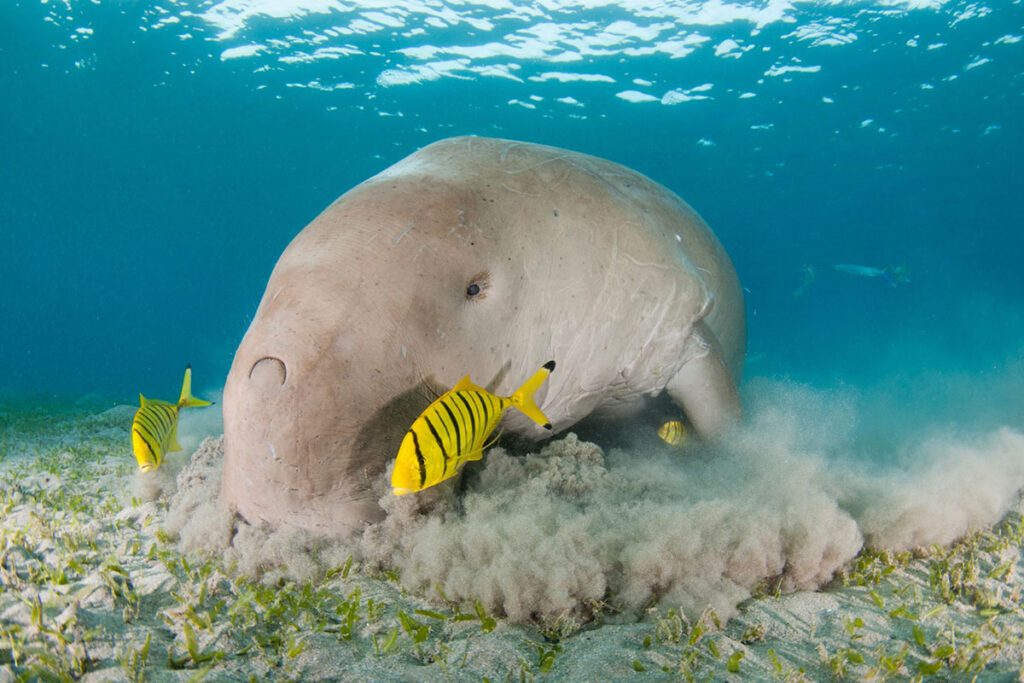
The park’s seagrass meadows support one of the largest surviving dugong populations in the Red Sea. Dugongs are globally threatened due to habitat loss, boat strikes, and entanglement, but here they benefit from:
- Protected feeding areas free from heavy boat traffic.
- Extensive seagrass beds dominated by Halodule and Thalassia species.
- Minimal coastal development and pollution.
This combination makes Dungonab Bay one of the best places in the Red Sea to observe these gentle “sea cows” in the wild.
Marine Mammals, Sharks, Rays, and Diverse Fish Life
Beyond whale sharks and dugongs, the park boasts an incredibly rich array of marine species:
- Dolphins: bottlenose, spinner, and common dolphins.
- Sharks: black-tip, white-tip, grey reef sharks, and occasional hammerheads.
- Rays: manta rays, eagle rays, blue-spotted rays.
- Turtles: green, hawksbill, and loggerhead sea turtles.
- Reef fish: angelfish, butterflyfish, snappers, parrotfish, anthias, napoleon wrasse, trevallies, and emperor fish.
For divers, this biodiversity offers both macro and pelagic wildlife encounters across a variety of diving environments—walls, reefs, lagoons, and sandy channels.
Invertebrates, Mangroves, and Seagrass Meadows
The park’s invertebrate fauna includes:
- Giant clams (Tridacna)
- Colorful nudibranchs
- Starfish and feather stars
- Sponges and corallimorphs
- Crabs, shrimps, and lobsters
Seagrass and mangrove systems play essential ecological roles:
- Nurseries for fish and crustaceans
- Carbon sinks crucial for climate regulation
- Habitat for dugongs and sea turtles
- Coastal stabilizers protecting against erosion
Their health is a key indicator of the park’s overall ecological stability.
Birdlife and Migratory Importance
Dungonab Bay lies directly along the East African–West Asian Flyway, one of the world’s most important migratory routes. Resident and migratory species include:
- White-eyed gull (endemic to the Red Sea)
- Sooty gull
- Bridled tern
- Western reef heron
- Osprey
For birdwatchers, the park offers exceptional opportunities to observe large flocks during spring and autumn migrations.
Local Communities, Culture, and Sustainable Livelihoods
The Beja and Rashaida communities surrounding the park maintain deep cultural traditions linked to the Red Sea. Their livelihoods include:
- Sustainable net and handline fishing
- Traditional dhow construction
- Oral navigation knowledge passed through generations
- Cultural ceremonies tied to the sea
Community engagement is central to the park’s conservation efforts, ensuring that local people benefit economically from eco-tourism and scientific research initiatives.
Diving, Snorkeling, and Key Marine Sites
Dungonab Bay–Mukkawar Island offers world-class diving with minimal tourism pressure, allowing divers to explore reefs in pristine condition. Key sites include:
- Mukkawar East Wall: Steep drops, sharks, and pelagic life.
- Dungonab Lagoon Gardens: Shallow coral fields ideal for beginners.
- Whale Shark Alley: Peak-season feeding corridor.
- Ridge of Stars: Soft corals, sponges, and anthias clouds.
Underwater visibility often exceeds 30 meters, making the area a paradise for underwater photographers.
Tourism Infrastructure, Access, and Responsible Travel
The park is accessed via Port Sudan by boat or liveaboard. Due to its remote nature, tourism infrastructure is minimal, which helps preserve its wild character. Visitors should travel with registered operators to ensure compliance with conservation rules.
Essential guidelines include:
- No approaching or touching whale sharks.
- No anchoring on coral reefs.
- No landing on bird nesting islands during breeding season.
- No collection of shells, corals, or marine life.
- No use of drones near wildlife.
These rules help protect fragile habitats while promoting sustainable eco-tourism.
Conservation Challenges and Climate Threats
Although the park is better protected than many Red Sea regions, it still faces threats, including:
- Climate-induced coral bleaching during extreme heatwaves
- Illegal fishing in buffer zones
- Ghost nets harming turtles and marine mammals
- Shipping traffic presenting collision risks for whale sharks
- Seagrass die-off during hot summers
Ongoing monitoring, expansion of protected areas, and increased community involvement are essential for maintaining the park’s ecological resilience.
Scientific Research and Global Marine Importance
Dungonab Bay–Mukkawar Island is a global reference site for marine science. Research programs conducted by UNESCO, IUCN, UNEP, and regional institutions focus on:
- Coral bleaching resistance and genetics
- Whale shark tagging and migratory tracking
- Dugong population viability
- Seagrass carbon sequestration studies
- Long-term ecosystem health monitoring
These efforts highlight the park’s role in global climate adaptation research and reef conservation strategy.
Best Time to Visit
- October–February: Whale shark peak season
- March–May: Excellent diving visibility
- June–September: Calm seas and warm water ideal for snorkeling
Why Visit Dungonab Bay–Mukkawar Island?
Visitors come for the rare opportunity to explore a marine ecosystem that remains largely untouched by development—a place where whale sharks glide peacefully, dugongs graze undisturbed, coral reefs burst with life, and sandy islands host nesting birds and sea turtles. With UNESCO protection, exceptional beauty, and biodiversity richness, the park is one of the top Red Sea destinations for diving, snorkelling, marine photography, nature study, and low-impact eco-tourism.
Conclusion
Dungonab Bay–Mukkawar Island Marine National Park stands as one of the most important marine protected areas in the world—a haven for whale sharks, dugongs, coral reefs, seabirds, and thousands of marine species. Its unspoiled landscapes, ecological resilience, and cultural heritage make it a global treasure and a must-visit destination for those seeking the purest Red Sea experience. As Sudan continues to develop its eco-tourism potential, this UNESCO World Heritage Site remains a shining example of what marine conservation can achieve when nature is protected with dedication and vision.