
Dzanga-Ndoki National Park
Dzanga-Ndoki National Park – Central African Republic’s Pristine Congo Basin Wilderness of Forest Elephants, Western Lowland Gorillas, Baï Clearings, Indigenous BaAka Culture, and UNESCO-Protected Biodiversity
Dzanga-Ndoki National Park is one of the most spectacular and scientifically important rainforest ecosystems in Africa. Located in the deep southwestern corner of the Central African Republic (CAR), this untouched paradise spans more than 1,220 km² of primary rainforest and forms a core section of the Sangha Trinational Landscape—a UNESCO World Heritage Site shared with Cameroon and the Republic of Congo. The park is world-famous for the unrivaled wildlife spectacles at Dzanga Baï, its thriving population of western lowland gorillas, and the extraordinary density of forest elephants that visit its mineral-rich clearings daily.
This region is considered one of the last remaining strongholds of the Congo Basin rainforest, a globally critical ecosystem that stores vast amounts of carbon and supports some of the highest levels of biodiversity on Earth. Dzanga-Ndoki’s remoteness, intact forests, cultural depth, and wildlife density make it a dream destination for primatologists, ecologists, birders, wildlife photographers, conservationists, and adventurous travelers seeking a genuine, immersive wilderness experience.
Location, Geography, and UNESCO Sangha Trinational Landscape
The park sits in one of the most ecologically important zones of Central Africa, bordering Cameroon’s Lobéké National Park and Congo’s Nouabalé-Ndoki National Park. Together, these three parks form the Sangha Trinational (TNS)—a massive transboundary conservation area recognized by UNESCO for its unmatched ecological integrity. Wildlife moves freely across these borders, creating a mega-ecosystem that protects elephants, gorillas, leopards, bongos, and numerous rare forest species.
Dzanga-Ndoki is composed of two primary zones, each offering unique ecological value:
- Dzanga Sector – the most visited area, home to Dzanga Baï, habituated gorilla groups, research stations, eco-lodges, and BaAka cultural activities.
- Ndoki Sector – extremely remote, untouched, and completely uninhabited; one of the few rainforests in Africa with absolutely no human settlement.
The rainforest here is characterized by towering hardwood trees, monsoon-fed rivers, dense undergrowth, swamp forests, seasonal wetlands, and the iconic baïs—open clearings where wildlife congregates in astonishing numbers. The forest is so intact that large mammals such as elephants and gorillas still follow ancient movement patterns unchanged for generations.
Hydrology and River Ecosystems
Dzanga-Ndoki’s hydrology is dominated by the Sangha River, a major tributary of the Congo River and one of Central Africa’s most ecologically important waterways. The Sangha’s tributaries and swamp channels flow throughout the park, nourishing vast forests, creating rich floodplains, and supporting a remarkable array of aquatic life.
Seasonal flooding regenerates forest soils, enriches baïs with minerals, and creates temporary wetlands that attract amphibians, wading birds, and forest antelopes. These waterways also serve as migration corridors for fish, crocodiles, otters, and waterbirds, while providing natural navigation routes for research teams and local communities.
Exceptional Biodiversity and Ecological Importance
Dzanga-Ndoki National Park is one of the most biodiverse rainforest ecosystems in Africa. It lies within the Congo Basin, the world’s second-largest tropical rainforest after the Amazon, and serves as a refuge for species that have disappeared from many other parts of Central Africa.
The park protects:
- More than 100 mammal species
- Over 400 bird species
- Extremely high amphibian and reptile diversity
- Thousands of insect species, including butterflies, termites, and tropical beetles
- Diverse tree and plant species with dozens of medicinal plants used by the BaAka
Its position within the TNS landscape allows for genetic exchange among wildlife populations, helping protect critically endangered species such as forest elephants and western lowland gorillas. The area’s undisturbed forests also play a major global role in carbon sequestration and climate regulation.
Botanical Diversity and Forest Vegetation
The vegetation in Dzanga-Ndoki features enormous hardwood trees, thick undergrowth, and multiple canopy layers. The forest is dominated by species such as Sapelli, Sipo, Azobé, and Okoumé, many of which are highly valued in logging industries—but protected here under conservation law.
The forest floor is rich with medicinal herbs, edible mushrooms, tubers, vines, and wild fruits traditionally used by the BaAka people. Giant buttress-rooted trees, lianas, and epiphytes shape the park’s three-dimensional habitat structure, offering shelter and food sources for countless mammals, insects, and birds.
Dzanga Baï – The Most Spectacular Forest Elephant Gathering in Africa
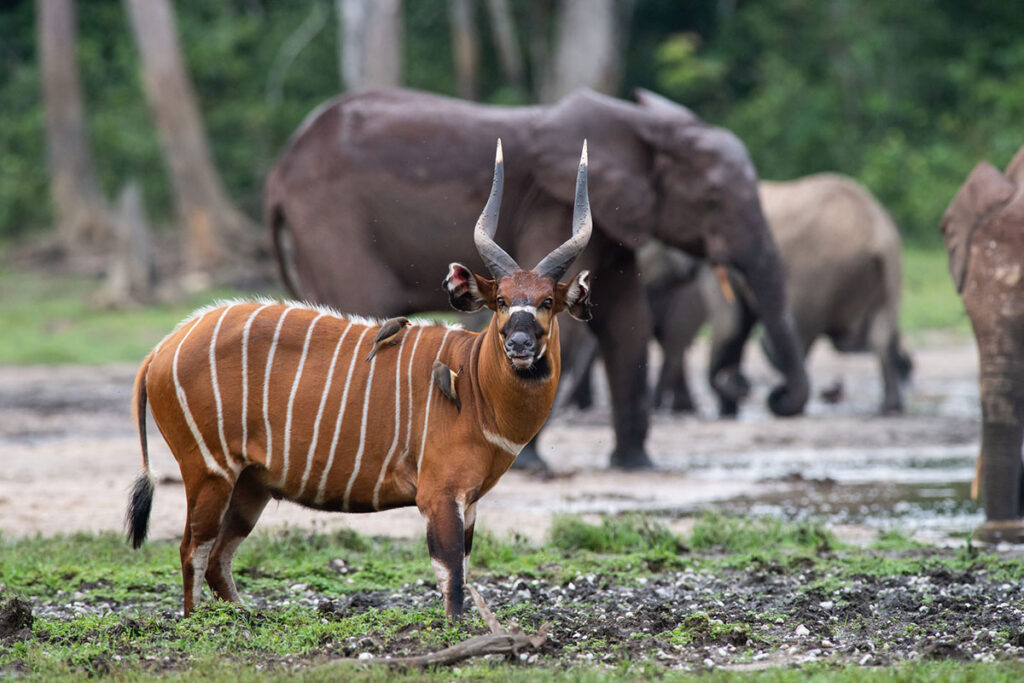
Nothing in the Congo Basin compares to Dzanga Baï, a natural mineral-rich swampy clearing where hundreds of forest elephants visit daily. Known as “The Village of Elephants,” it offers one of the most extraordinary wildlife spectacles on the continent.
Visitors can observe:
- 20–100 forest elephants at once
- Bongos – one of the rarest antelopes in Africa
- Sitatungas
- Forest buffalo
- Giant forest hogs
- Colobus monkeys around the forest edge
Dzanga Baï has been monitored daily for decades, producing one of the richest long-term wildlife datasets in Africa. The wooden viewing platform offers safe, close-up observation, making this one of the best wildlife-viewing locations in the entire Congo Basin.
Western Lowland Gorillas – One of the Top Gorilla Habituation Sites in Africa
Dzanga-Ndoki is among the best places in Africa to observe habituated western lowland gorillas. Unlike mountain gorillas, lowland gorillas inhabit dense jungles and are generally harder to see. However, the Primate Habituation Program (PHP) has succeeded in habituating several families to human presence.
The Mokoko and Makumba gorilla groups allow visitors to witness:
- feeding and foraging behavior,
- silverback leadership displays,
- playful interactions among juveniles,
- tree-climbing and nest-building,
- vocal communication and social dynamics.
Tracking is conducted with BaAka guides whose unmatched forest knowledge guarantees an authentic and deeply informative experience.
Other Primates of the Dzanga Forest
Beyond gorillas, Dzanga-Ndoki hosts a spectacular diversity of primates—making it one of Central Africa’s top primate-viewing destinations.
Notable species include:
- Chimpanzees
- Agile mangabeys
- Allen’s swamp monkeys
- Putty-nosed monkeys
- Crowned monkeys
- De Brazza’s monkeys
- Black colobus (rare)
This wealth of primate diversity underscores the ecological complexity and health of the Congo Basin ecosystem.
Reptiles, Amphibians, and Invertebrates
Dzanga-Ndoki’s rainforest supports an impressive array of smaller but ecologically essential wildlife. The swamp forests and riverbanks are home to:
- Goliath frogs—the world’s largest frog species
- African rock pythons
- Forest cobras
- Chameleons and geckos
- Rare forest vipers
Insects are equally abundant and play critical roles in pollination, decomposition, and nutrient cycling. The forest is alive with:
- Butterflies
- Beetles
- Dragonflies
- Termites
- Specialized ants
Many species here are endemic and have adapted to unique microhabitats within the dense rainforest.
BaAka Culture and Traditional Knowledge
The BaAka people are one of Central Africa’s most culturally rich Indigenous communities. Their deep relationship with the forest spans centuries, and their knowledge of wildlife behavior, medicinal plants, and forest navigation is unparalleled.
Visitors can experience:
- Traditional net hunting demonstrations
- Honey gathering rituals high in the canopy
- Foraging walks showing edible plants and medicinal herbs
- BaAka polyphonic singing – a UNESCO-recognized intangible heritage
These cultural activities strengthen community livelihoods and help preserve traditional knowledge vital to conservation.
Nocturnal Wildlife Encounters
Dzanga-Ndoki transforms at night into a vibrant world of nocturnal animals. Guided night walks reveal:
- Galagos (bushbabies)
- Pottos
- Civets
- Genets
- Tree hyrax
These nighttime safaris offer a rare chance to experience the Congo Basin’s hidden wildlife and the symphony of sounds that echo through the rainforest.
Birdlife
With more than 400 bird species, Dzanga-Ndoki is a premier birding destination. The intact rainforest and forest-edge habitats support a rich variety of species, including:
- Great blue turacos
- Palm-nut vultures
- African grey parrots
- White-crested hornbills
- Shoebill (occasionally seen in swampy areas)
Riverine and swamp zones host kingfishers, herons, and rare wading birds, making the region ideal for bird photographers and ornithologists.
Conservation Partnerships and Protection
Dzanga-Ndoki is a global conservation priority, supported by numerous international organizations including:
- WWF
- Wildlife Conservation Society (WCS)
- UNESCO
- Sangha Trinational Foundation
- Primate Habituation Program (PHP)
These partnerships focus on anti-poaching patrols, forest monitoring, elephant protection, community engagement, scientific research, and sustainable tourism development.
Threats and Conservation Challenges
Despite strong international protection, Dzanga-Ndoki faces several challenges:
- Poaching of forest elephants due to the illegal ivory trade
- Logging pressure outside buffer zones
- Regional instability affecting conservation capacity
- Wildlife trafficking networks
- Potential habitat fragmentation in surrounding areas
Nevertheless, the park remains one of the most intact rainforest ecosystems thanks to dedicated conservation efforts and the area’s remote location.
Visitor Accommodation and Tourism Infrastructure
Most visitors stay at Sangha Lodge, an acclaimed eco-lodge offering comfortable accommodation, expert guides, boat excursions, and direct access to Dzanga Baï and gorilla tracking sites. The lodge also supports local conservation initiatives and works closely with the BaAka community.
Basic research camps and ranger posts exist within the forest for scientists, and all tourism activities follow strict ecological guidelines to ensure minimal impact on wildlife.
Access, Logistics, and Permits
Reaching Dzanga-Ndoki typically involves travel to Bangui, followed by a road transfer or charter flight to Bayanga. Due to the park’s remoteness, visitors must obtain permits for:
- gorilla tracking,
- Dzanga Baï visits,
- forest hikes,
- BaAka cultural experiences.
Travel is safest and most efficient when arranged through authorized tour operators familiar with the region’s logistics and conservation protocols.
Documentary Filming and Scientific Research Importance
Dzanga-Ndoki has been featured in numerous international documentaries by:
- National Geographic
- BBC
- Smithsonian Channel
These films highlight the extraordinary wildlife densities at Dzanga Baï, the behavior of western lowland gorillas, and the daily rhythms of the Congo rainforest. The park is also a research hotspot, hosting some of the longest-running wildlife studies in Central Africa.
Best Time to Visit
- December–May – Best overall wildlife viewing, gorilla tracking, and elephant activity.
- June–November – Lush landscapes and excellent birding during the rainy season.
Why Visit Dzanga-Ndoki National Park?
Dzanga-Ndoki offers one of the most immersive and dramatic rainforest experiences in Africa. It is one of the few places on Earth where visitors can watch dozens of forest elephants at once, encounter habituated lowland gorillas up close, witness rare forest antelopes, and engage with one of Africa’s most vibrant Indigenous cultures—all within a single protected area.
Its untouched forests, global conservation importance, and sheer wildlife spectacle make it a destination unlike any other in the Congo Basin or the rest of Africa.
Conclusion
Dzanga-Ndoki National Park is a living masterpiece of the Congo Basin—wild, ancient, culturally rich, and biologically extraordinary. Its baïs, gorillas, elephants, BaAka traditions, and pristine rainforests create a timeless landscape where nature still rules. For eco-travelers, researchers, and conservation-minded explorers, Dzanga-Ndoki remains one of the most powerful and unforgettable wilderness destinations on the African continent.