
Etosha National Park
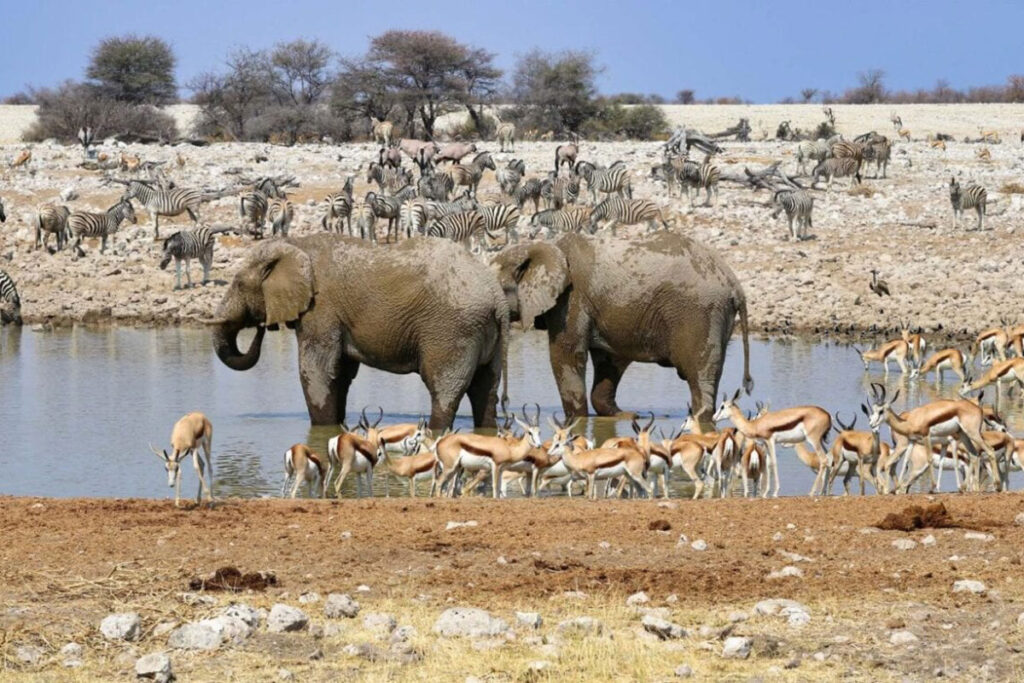
Etosha National Park – Complete Safari Guide to Namibia’s Great White Place
Etosha National Park, located in northern Namibia, is one of Africa’s most extraordinary wildlife destinations and a globally recognised conservation landscape. The park revolves around the vast Etosha Pan – a shimmering white salt desert visible from space – and encompasses over 22,000 km² of savanna, mopane woodlands, arid plains, and seasonal wetlands. Established in 1907, Etosha has become Namibia’s flagship park, celebrated for its easy game viewing, strong conservation success stories, and world-class safari infrastructure. From large elephant herds and endangered black rhinos to sweeping desert scenery, Etosha offers one of the most rewarding and accessible safari experiences in Africa.
Overview of Etosha National Park
Etosha National Park is categorised as an IUCN Category II protected area and remains one of the most significant wildlife reserves in Southern Africa. While many safari destinations depend on a network of rivers or forests, Etosha’s unique ecological system is centred around a vast salt pan that dominates the landscape and acts as a magnet for wildlife. This unusual environment creates exceptional visibility for spotting animals, particularly during the dry season when thousands of animals gather around permanent waterholes.
The park contributes heavily to Namibia’s tourism economy and conservation legacy. It is a sanctuary for rare and endangered species such as the south-western black rhino and the endemic black-faced impala. With its wide range of wildlife, easy self-drive routes, and iconic floodlit waterholes, Etosha is regarded as one of Africa’s most visitor-friendly big-game parks, ideal for both first-time safari travellers and seasoned wildlife enthusiasts.
Location and Size
Etosha National Park stretches across the northern regions of Kunene, Oshana, Oshikoto, and Otjozondjupa, forming part of the larger Cuvelai–Etosha Basin. Its northernmost sections lie close to the Angola border, making it strategically positioned within regional transboundary ecosystems. The park covers approximately 22,000–23,000 km², making it one of the largest protected areas in Africa.
The Etosha Pan alone spans roughly 4,700–5,000 km². This immense salt flat has a powerful influence on the park’s climate, vegetation patterns, and wildlife movements, giving the region its distinctive ecological character.
Geography and Geology
Geologically, Etosha sits on a tectonically stable plateau at about 1,000–1,100 metres above sea level. Its most defining feature—the Etosha Pan—is an enormous, shallow depression that likely formed from a prehistoric lake fed by ancient rivers flowing south from Angola. Over thousands of years, tectonic shifts and climate changes caused the lake to dry up, leaving behind mineral-rich sediments that form today’s expansive white salt crust.
The southern and western areas of the park consist of gently rolling plains, calcareous soils, fossil riverbeds, and dolomite outcrops. These dolomite hills, particularly prominent in western Etosha, support unique plant species and provide habitat for specialised wildlife such as klipspringers and rock hyrax. The north-eastern parts of the park are more open and flat, merging into the Cuvelai drainage patterns that seasonally bring water into shallow depressions.
Climate
Etosha’s climate is classified as hot and semi-arid, receiving most of its rainfall during a short summer wet season between November and April. Rainfall varies considerably by year but typically ranges from 300–500 mm annually. During the rainy months, dramatic thunderstorms sweep across the plains, transforming the park from dusty beige to vibrant green and filling ephemeral pans with water.
From May to October, Etosha enters its long dry season—arguably the best time for game viewing. Water sources shrink, vegetation thins, and wildlife congregates around permanent waterholes. Daytime temperatures remain warm, but early mornings and nights in June–August can be surprisingly cold due to low humidity and clear skies. This extreme seasonal contrast drives many of the park’s ecological dynamics and wildlife behaviours.
Hydrology and the Etosha Pan
Etosha forms the southern terminus of the Cuvelai–Etosha Basin, a hydrological system of shallow channels that carry seasonal water from southern Angola into Namibia. During exceptionally wet years, rivers such as the Ekuma and Oshigambo temporarily flood parts of the Etosha Pan, creating one of the largest ephemeral lakes in Southern Africa. This rare event attracts spectacular flocks of flamingos, pelicans, and migratory waterbirds.
Outside the rainy season, the pan remains bone-dry—an endless, white, shimmering expanse of salt and mineral sediments. Windstorms often sweep across its surface, creating dust clouds that rise dramatically into the sky. Around its edges, permanent and semi-permanent waterholes sustain wildlife throughout the year. These waterholes—some natural, others maintained by park management—are the heart of Etosha’s safari experience, drawing thousands of animals daily during the dry season.
Ecosystems and Habitats
The diverse habitats within Etosha support an impressive variety of species. These ecosystems shift gradually from the saline desert environment around the pan to savanna, woodland, and rocky upland habitats in the surrounding regions.
- Grass Plains: Open, treeless plains dominate the southern and eastern margins, offering prime grazing areas for springbok, wildebeest, and zebra.
- Mopane Woodlands: The most extensive habitat, providing essential browse for elephants, giraffes, and kudu.
- Pan Margins: Characterised by salt-tolerant grasses and halophytic plants that attract herbivores during fresh seasonal growth.
- Rocky Dolomite Hills: Rugged outcrops supporting unique flora and fauna, including birds of prey and mountain-adapted mammals.
- Seasonal Wetlands: Flooded depressions and drainage lines that support amphibians, insects, and waterbirds in wet years.
Vegetation
Etosha’s vegetation reflects dramatic gradients in salinity, soil depth, and moisture availability. The interior of the pan is mostly barren, interrupted only by specialised salt-loving grasses and tiny hardy herbs. Moving outward, open plains transition into mixed savanna dominated by perennial grasses such as Eragrostis and Enneapogon, which form lush grazing grounds after summer rains.
Mopane trees (Colophospermum mopane) dominate the woodlands across western and northern Etosha. These trees, highly drought-tolerant and nutrient-rich, are vital for elephants, which strip their bark and leaves extensively. Acacia species, Boscia trees, Terminalia shrubs, and the iconic makalani palms appear in pockets of deeper soils. Rocky regions support moringa trees and succulents, creating a unique microhabitat and contributing to Etosha’s botanical diversity.
Wildlife of Etosha National Park
Mammals
Etosha is home to more than 100 mammal species, including some of Africa’s most recognisable animals. The park is a stronghold for the critically endangered black rhino and one of the few places where visitors can reliably see these elusive giants in the wild. Elephants in Etosha are known for their striking pale coloration, caused by regular dust baths in the park’s mineral-rich soil.
Predators include lions, leopards, cheetahs, and hyenas, all supported by abundant prey such as zebra, wildebeest, springbok, gemsbok, giraffe, eland, and kudu. The far western sector is notable for Hartmann’s mountain zebra, a species adapted to rugged terrain. Smaller mammals such as bat-eared foxes, jackals, honey badgers, caracals, and various mongoose species add to the ecosystem’s depth.
Birds
With 340–400 species recorded, Etosha is one of Southern Africa’s premier birding destinations. Large terrestrial birds like ostriches and kori bustards roam the plains, while raptors—including martial eagles, bateleurs, secretarybirds, and vultures—dominate the skies. Numerous colourful species such as lilac-breasted rollers, bee-eaters, and hornbills are easily spotted along woodland edges and around waterholes.
In wet years, the pan becomes one of the most important breeding sites for flamingos in the region. Pelicans, avocets, stilts, and dozens of migratory waders arrive to exploit the temporary wetlands, creating breathtaking scenes across the shimmering waters.
Reptiles, Amphibians, and Insects
Etosha supports a thriving population of reptiles such as agamas, skinks, geckos, monitor lizards, tortoises, and various snakes including cobras, mole snakes, and puff adders. Amphibians emerge with the first rains, breeding rapidly in temporary pools across the plains.
Insects are particularly abundant after rainfall. Termite emergences, butterfly migrations, beetle blooms, and grasshopper populations contribute significantly to pollination, nutrient cycling, and the seasonal food chain that supports birds and small mammals.
Unique Features of Etosha National Park
Etosha’s most iconic feature is the massive Etosha Pan—one of Earth’s largest salt flats. Its reflective surface creates striking mirages, dramatic sunrises, and unforgettable photographic compositions. Unlike many African parks, Etosha’s open landscapes provide unparalleled wildlife visibility, making it easy to witness predator–prey interactions and large mammal gatherings.
Another standout feature is the park’s network of reliable waterholes. Many rest camps, including Okaukuejo and Halali, offer floodlit waterholes where guests can safely observe nocturnal wildlife, including rhinos, elephants, and lions, making Etosha one of the few parks in Africa with exceptional wildlife viewing both day and night.
Cultural and Indigenous Communities
The Etosha region is the ancestral homeland of the Hai//om San people, who lived as hunter-gatherers around the pan for generations. Their intimate traditional knowledge of plants, wildlife tracks, water sources, and seasonal changes contributed to the region’s cultural landscape long before the establishment of the park.
Today, the Hai//om, alongside neighbouring Ovambo, Herero, and Damara communities, participate in community-based conservation initiatives, conservancies, and cultural tourism projects. These partnerships help support livelihoods, preserve traditional knowledge, and strengthen the cultural heritage linked to Etosha.
Conservation Importance
Etosha is one of the most crucial conservation landscapes in Southern Africa. It protects key populations of elephants, lions, cheetahs, leopards, hyenas, giraffes, and numerous antelopes. The park is internationally recognised for its success in safeguarding black rhinos through strong anti-poaching enforcement, scientific wildlife management, and collaboration with local communities.
Etosha also forms part of broader regional conservation strategies, including efforts to protect carnivores across larger landscapes and initiatives to maintain ecological connectivity between communal conservancies and protected areas. Its relatively intact ecosystems make it a vital refuge for wildlife and an important research site for studying savanna ecology.
Threats and Challenges
Despite its strong protection status, Etosha faces ongoing conservation threats. Rhino poaching remains a significant concern, driven by illegal wildlife trade dynamics across Southern Africa. Human–wildlife conflict in adjacent communal lands poses additional challenges, particularly involving elephants and lions that occasionally move beyond park borders.
Increasing climate variability has led to prolonged droughts, affecting water availability and wildlife survival. Occasional large wildfires also threaten vegetation and habitat integrity. Managing tourism impact, maintaining fencing, and preventing the spread of invasive species are continuous priorities for park authorities.
Research and Monitoring
Etosha is one of Africa’s best-studied savanna ecosystems thanks to the long-standing work of the Etosha Ecological Institute. Research programmes include predator–prey dynamics, population monitoring, vegetation studies, hydrology, dust ecology, climate impacts, and disease surveillance.
These scientific findings guide the park’s adaptive management strategies, ensuring that waterholes, fire policies, wildlife corridors, and anti-poaching initiatives are continuously improved based on real data and ecological insights.
Tourism Activities
Etosha offers a rich variety of activities tailored to both independent travellers and guided safari guests. Game viewing is the highlight, with animals easily spotted on self-drive routes or professionally guided game drives. The park’s waterholes create predictable wildlife encounters, allowing visitors to witness everything from elephant herds to predator activity with minimal effort.
- Self-drive game drives: Etosha is one of Africa’s best parks for self-drive safaris.
- Guided day and night drives: Offered by lodges and rest camps for deeper wildlife insights.
- Birdwatching: Especially rewarding during the wet season when migratory species arrive.
- Photography: Elevated hides, open plains, and dramatic lighting make Etosha a favourite among wildlife photographers.
Access and Getting There
Etosha is easily accessible by road, with well-maintained highways from Windhoek and major towns. Four main gates provide convenient entry points depending on your itinerary:
- Andersson Gate: Southern entrance, closest to Okaukuejo.
- Von Lindequist Gate: Eastern entrance near Namutoni.
- King Nehale Gate: Northern entrance connecting to Ovambo regions.
- Galton Gate: Western entrance, ideal for accessing the remote and less-visited areas.
Windhoek to Etosha is a 4.5–6-hour drive. For luxury travellers, fly-in safaris and charter flights operate to nearby airstrips.
Permits, Fees, and Park Rules
Visitors must pay daily conservation fees and a vehicle fee at the gate. Fees differ for international travellers, SADC residents, and Namibian citizens. All visitors must adhere to park rules designed to protect wildlife and ensure safety:
- Stay on designated roads.
- Remain in your vehicle except in fenced areas.
- Do not feed or disturb wildlife.
- Respect speed limits and gate opening times.
Accommodation
Etosha offers a wide range of accommodation options both inside and outside the park. Namibia Wildlife Resorts (NWR) operates six main facilities inside the park:
- Okaukuejo: Famous for its floodlit waterhole attracting rhinos and elephants.
- Halali: Centrally located with easy access to diverse habitats.
- Namutoni: Eastern camp centred around a historic German fort.
- Dolomite Camp: West Etosha’s exclusive lodge with breathtaking views.
- Olifantsrus: Rustic, camping-only camp with an impressive hide.
- Onkoshi: Eco-luxury retreat overlooking the pan’s remote eastern edge.
Outside the park, numerous lodges and guest farms near the gates offer budget, mid-range, and luxury accommodation, often with private reserves and guided safari activities. Booking in advance is essential during peak months.
Best Time to Visit
The dry season (May–October) is the best time to visit Etosha. Wildlife congregates at waterholes, vegetation thins, and temperatures are comfortable for game drives. This season offers unbeatable opportunities for photography and predator sightings.
The wet season (November–April) transforms the park into a lush, green landscape. While wildlife is more dispersed, birdwatching is exceptional, and the scenery is stunning. Travellers who enjoy dramatic skies, thunderstorms, and vibrant colours often prefer this time of year.
Why Etosha National Park Is Unique
Etosha stands apart from other African safari destinations because of its extraordinary salt pan, exceptional wildlife visibility, and world-class waterhole viewing. Its landscapes are surreal, its wildlife encounters reliable, and its accessibility unmatched. Few parks offer such a natural combination of dramatic scenery, rich biodiversity, and visitor-friendly infrastructure.
As a conservation stronghold, cultural landscape, and ecological wonder, Etosha National Park remains one of Africa’s most iconic and unforgettable safari destinations—an essential highlight for anyone exploring Namibia or Southern Africa.