
Maiko National Park
Maiko National Park, DR Congo – Okapis, Eastern Lowland Gorillas, Forest Elephants, Rainforest Wilderness and Complete Travel Guide
Maiko National Park stands as one of the last true wilderness frontiers in the Democratic Republic of Congo. Stretching across approximately 10,885 km² of pristine equatorial rainforest, Maiko forms an immense green heart within the Congo Basin—the world’s second-largest rainforest. Established in 1970 to conserve rare species and fragile ecosystems, the park remains a sanctuary for some of the planet’s most endangered wildlife, including okapis, eastern lowland gorillas, forest elephants and countless forest-dwelling species. Very few places on Earth still feel as untouched and naturally preserved as Maiko, where ancient ecosystems continue to thrive largely undisturbed by modern development.
The park’s landscapes are as dramatic as they are diverse. Dense rainforest blankets steep escarpments, rugged slopes and remote valleys. Countless rivers weave through the forest floor, forming waterfalls, deep pools and swampy habitats where amphibians and aquatic insects flourish. Forest canopies tower overhead, filtering golden light onto the shadowed forest floor. With its vast size, challenging terrain and isolation from major towns, Maiko offers a rare glimpse into Africa as it existed centuries ago—raw, wild and teeming with life.
Location and Geography
Maiko National Park is situated in eastern DR Congo and spans three provinces: North Kivu, Tshopo and Maniema. The park lies in an extremely remote region with very limited infrastructure, bordered by small villages separated by long stretches of unbroken forest. Its geography is shaped by the rugged terrain of the western Albertine Rift and the immense hydrological systems feeding the Congo River. Because access is challenging, much of the forest remains unexplored, and many valleys, ridges and river basins have never been surveyed by scientists or tourists.
The park’s isolation has played a vital role in preserving its ecological integrity. Unlike other protected areas impacted by settlement, agriculture or road construction, Maiko’s forests remain intact because the terrain naturally restricts human movement. This allows species that require large territories—such as gorillas, elephants, leopards and okapis—to persist in meaningful numbers.
Size, Coordinates and Elevation
- Area: Approximately 10,885 km²
- Coordinates: Roughly 0°–2° N and 26°–28° E
- Elevation: Between 500 m and 1,400 m above sea level
This elevation gradient creates distinct ecological zones. Lower altitudes are dominated by swamp forests and dense lowland rainforest, while higher elevations support cooler upland forests rich in mosses, ferns and epiphytes.
Geology and Rainforest Formation
Maiko’s geological foundation is tied to the western edge of the Albertine Rift, a region shaped by tectonic uplift, volcanic activity and erosion over millions of years. The park’s valleys and ridges are formed from a mix of volcanic basalts and sedimentary rocks that feed rich volcanic soils. These fertile surfaces support towering forest canopies that reach up to 50 meters, creating multi-layered habitats ideal for birds, primates and insects.
The geological history of the Congo Basin—one of the oldest continuously wet forests on Earth—has allowed species to evolve in isolation for long periods. This long-term stability is responsible for the extraordinary biodiversity and exceptional number of endemic species found in Maiko today.
Climate
The climate in Maiko National Park is warm, humid and equatorial. Rainfall is abundant throughout the year, ensuring continuous vegetation growth and lush green landscapes. Seasonal shifts are subtle but still influence wildlife activity, water levels and forest fruiting cycles.
- Main Wet Season (September–May): Characterized by heavy, frequent rains, high river levels, and explosive plant growth.
- Drier Season (June–August): Slightly reduced rainfall, improved forest visibility, and easier movement through the undergrowth.
Temperatures typically range between 20°C and 28°C across the year. Shade from forest canopies creates cooler and more comfortable microclimates—especially along river valleys and high forest slopes. Humidity remains high, contributing to abundant ferns, mosses and fungi.
Hydrology – Rivers, Swamps and Watersheds
Water systems are the lifeblood of Maiko National Park. Several major rivers—such as the Maiko, Ulindi, Lindi and Oso—flow directly through the park and provide essential nourishment for wildlife and vegetation. These rivers connect to the Congo River, forming part of one of the most important freshwater networks on the continent.
Permanent swamps, seasonally flooded forests, marshlands and riverine corridors add ecological richness to the landscape. These habitats support otters, amphibians, freshwater fish, aquatic birds and countless insect species. Riverbanks also serve as vital movement corridors for elephants, gorillas and forest antelopes, especially during the dry season when water becomes limited in upland zones.
Ecosystems and Vegetation
Maiko National Park contains some of the most intact and biologically significant rainforest ecosystems in Africa. The combination of low human disturbance, complex terrain and abundant rainfall supports a tapestry of vegetation types, each offering unique habitats for wildlife.
Major Vegetation Zones
- Primary Lowland Rainforest: Dominant across the park, with colossal buttressed trees, thick lianas, strangler figs and rich leaf litter.
- Swamp Forest: Water-filled zones with raffia palms, sedges and unique amphibian communities.
- Riparian Forest: Dense vegetation along rivers, rich in figs, palms and berry-producing trees that attract primates and birds.
- Upland Rainforest: Cooler, mist-covered forests found at higher altitudes with moss-covered trunks and diverse epiphytes.
Key tree species include Entandrophragma cylindricum (sapelli), Terminalia superba, Gilbertiodendron dewevrei, Irvingia gabonensis, African mahogany, strangler figs and numerous medicinal plants used by local communities. Many tree species bear fruit seasonally, providing food for gorillas, chimpanzees and forest-dwelling antelopes.
Wildlife of Maiko National Park
Maiko National Park is globally renowned as a refuge for rare megafauna. Its remote, dense forests protect species that have vanished from other parts of the Congo Basin due to hunting and habitat loss. Maiko’s wildlife diversity is remarkable, and scientific surveys indicate that large areas still hold healthy populations of species that are globally threatened.
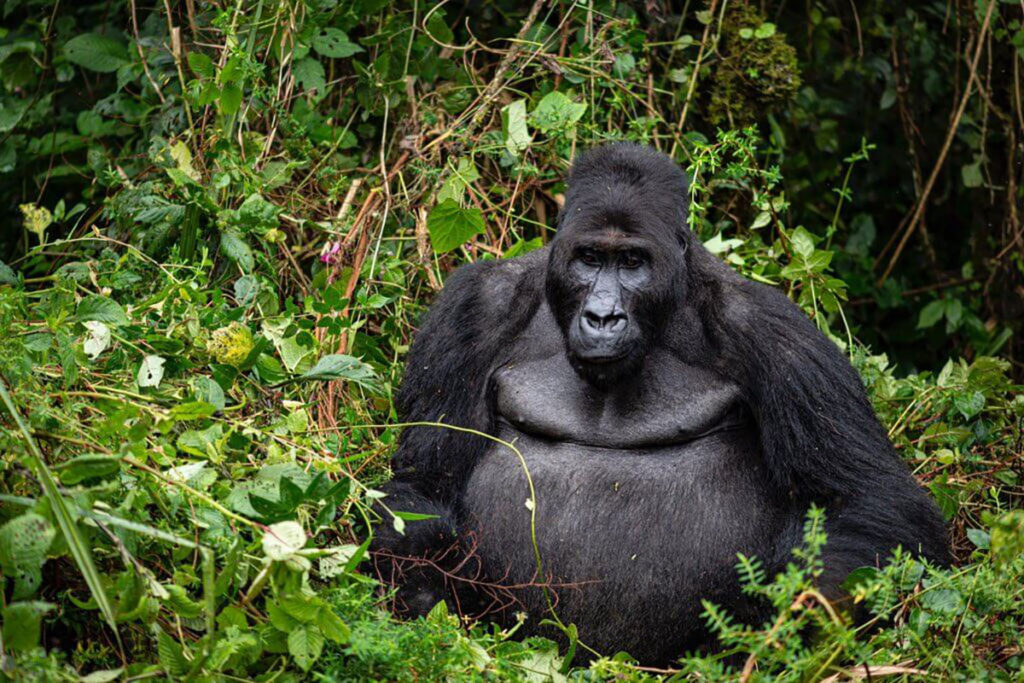
Eastern Lowland Gorillas (Grauer’s Gorillas)
Maiko is one of the most important sanctuaries for eastern lowland gorillas. These gorillas inhabit deep forest zones with abundant vines and fruiting trees. Though rarely seen due to the forest’s density, their presence reflects the park’s ecological integrity. Small subpopulations persist across different sectors, offering conservation optimism.
Okapis
The okapi—endemic to DR Congo and known for its zebra-like stripes—thrives in Maiko’s quiet understory. The park’s low level of human activity allows okapis to move freely through the forest, feeding on leaves, fungi and fruits. Maiko is considered one of the species’ most important strongholds.
African Forest Elephants
Forest elephants roam Maiko’s river valleys, salt licks and pilgrimage sites where mineral-rich soils attract them. Their foraging and movement patterns help shape forest structure by dispersing seeds and creating open spaces in dense vegetation. Although pressures exist regionally, Maiko continues to shelter significant elephant populations thanks to its remoteness.
Chimpanzees and Other Primates
- Chimpanzees (Pan troglodytes schweinfurthii)
- Red colobus monkeys
- Black-and-white colobus
- Blue monkeys
- L’Hoest’s monkeys
- Mangabeys
- Thomas’s galagos
- Pottos
Primates thrive in Maiko due to its abundant fruiting trees, tall canopy layers and secure forest cover. Some valleys hold unusually high primate densities, a testament to the park’s ecological richness.
Other Mammals
- Forest buffalo
- Yellow-backed duiker
- Bay duiker
- Sitatunga
- Giant forest hog
- African golden cat
- Servaline genet
- Congo clawless otter
Camera trap studies reveal an impressive diversity of mammals that are rarely observed elsewhere in Central Africa. Many species are still being catalogued, and scientists believe new discoveries remain likely in Maiko’s interior.
Birds
Maiko supports more than 300 bird species, including Congo Basin specialists and Albertine Rift endemics. Its dense forest canopy, riverine zones and swamp areas provide rich feeding and nesting sites.
- Congo peafowl (near-endemic)
- Great blue turaco
- African grey parrot
- Hornbills and barbets
- Green pigeons and forest doves
- African green broadbill
Birdwatching potential is enormous—even though the park is not yet open for organized birding tourism.
Reptiles, Amphibians and Insects
The park supports chameleons, pythons, vipers, tree frogs, forest geckos and countless insect species. Many amphibians and insects are believed to be undescribed by science, highlighting Maiko’s role as a living biological archive.
Cultural Heritage and Indigenous Knowledge
Maiko overlaps with ancestral territories of the Kumu, Bali, Ndaka and Lokele communities. These groups have thrived alongside the forest for generations, practicing sustainable hunting, fishing and honey gathering while maintaining strong cultural ties to the land. Their traditional ecological knowledge—ranging from medicinal plants to wildlife behaviour—is invaluable for conservation and scientific research.
Cultural practices include forest rituals, sacred groves, spiritual beliefs related to wildlife, and oral histories tied to specific rivers, hills and ancient trails. Many communities continue to protect traditional forests, strengthening the ecological resilience of surrounding landscapes.
Conservation Importance
Maiko National Park is one of the world’s most irreplaceable conservation areas. It shelters rare and endangered species, supports genetic diversity and safeguards ecosystems essential for climate regulation and hydrological stability. Its forests sequester large amounts of carbon, contributing to global climate mitigation.
The park is managed by the Congolese Institute for Nature Conservation (ICCN) with support from international partners. Conservation efforts include ranger patrols, wildlife monitoring, community engagement and habitat protection programs designed to reduce pressure on forest resources.
Threats and Environmental Pressures
- Illegal artisanal mining (gold, coltan, cassiterite)
- Bushmeat hunting and trafficking routes
- Forest clearing near boundaries for agriculture
- Presence of armed groups in remote zones
- Limited ranger capacity due to the park’s immense size
Although these challenges exist, Maiko continues to remain largely intact compared to other Congo Basin protected areas. Its remoteness, vast area and community partnerships provide strong protection for the forest.
ICCN Rangers and Conservation Efforts
Rangers working in Maiko face some of the most demanding conditions in Africa. Dense vegetation, steep terrain and enormous distances require exceptional resilience and dedication. Patrols focus on dismantling illegal hunting networks, monitoring wildlife populations, protecting elephant migration routes and identifying illegal mining sites. Support from conservation organizations has strengthened training, equipment and monitoring systems in the park.
Ecological Connectivity and Conservation Landscape
Maiko forms a vital ecological link with nearby protected areas, enabling wildlife to migrate and maintain genetic exchange. Key connections include:
- Tayna Nature Reserve
- Kahuzi-Biega National Park
- Community-managed forests in Maniema and North Kivu
These corridors are crucial for gorillas, elephants, okapis and other large mammals. Maintaining intact forest connections ensures long-term species survival and landscape resilience.
Research and Scientific Exploration
Because access to Maiko is challenging, many regions remain scientifically unexplored. This makes the park a frontier for future research. Areas of active study include:
- Eastern lowland gorilla monitoring
- Okapi habitat and population mapping
- Elephant movement and corridors
- Insect and amphibian diversity
- Tree and plant surveys in remote valleys
Researchers believe that Maiko holds numerous undiscovered species, making it one of the most promising areas for biodiversity discovery in Africa.
Tourism Activities
Tourism in Maiko is extremely limited, but the park’s future tourism potential is enormous. Activities that may be possible with improved infrastructure include:
- Gorilla and primate tracking in controlled zones
- Rainforest trekking and botanical exploration
- Birdwatching in remote forest areas
- River and waterfall expeditions
- Photography and documentary filmmaking
Tourism development must be carefully managed to protect the park’s ecological integrity while supporting local communities.
Access – How to Get There
- By Air: Flights to nearby towns followed by multi-day overland journeys.
- By Road: Seasonal, challenging routes requiring experienced drivers.
- By River: Expeditions using canoes or motorboats depending on water levels.
Reaching Maiko requires careful planning, local coordination and expedition-level logistics. Only experienced teams or organized research groups typically attempt the journey.
Permits and Regulations
- Access requires authorization from ICCN.
- Research permits are mandatory for scientific teams.
- Entry may be limited in certain park sectors.
- Wildlife protection rules are strictly enforced.
All visits must be arranged in advance with conservation authorities to ensure safety and compliance with park regulations.
Accommodation Options
Accommodation inside Maiko is minimal due to its remoteness. Options include:
- Basic ranger posts
- Community shelters near boundaries
- Expedition-style tented camping
Visitors must be entirely self-sufficient, carrying supplies, medical kits, camping equipment and communication devices.
Best Time to Visit
- June–August: Easiest travel and reduced rainfall.
- December–February: Additional window with workable conditions.
- March–May & September–November: Very heavy rains and difficult access.
Expeditions should plan around weather conditions, logistics and river levels.
Why Maiko National Park Is Unique
Maiko National Park is one of Africa’s last true rainforest strongholds—an immense expanse of wild, untouched wilderness where megafauna, rare species and ancient ecosystems continue to thrive. Its deep cultural history, biodiversity importance, ecological significance and dramatic landscapes make it a place of extraordinary value. Few parks on Earth offer such pure, unaltered nature, or hold such potential for future scientific discovery and conservation impact.
For adventurers, researchers and conservation enthusiasts seeking a glimpse of Africa’s most hidden rainforest sanctuary, Maiko offers a rare journey into a world that time has preserved.