
Mount Nimba Strict Nature Reserve
Mount Nimba Strict Nature Reserve – UNESCO World Heritage Rainforest, Endemic Wildlife, High-Altitude Grasslands and West Africa’s Most Important Biodiversity Stronghold
Mount Nimba Strict Nature Reserve, stretching across southeastern Guinea and Côte d’Ivoire with adjoining protected areas in Liberia, is one of the most ecologically valuable and scientifically important regions in all of West Africa. Recognized globally as a UNESCO World Heritage Site, this vast mountainous sanctuary protects an astonishing diversity of habitats—from tropical lowland rainforest to cool, wind-swept montane grasslands rising to the 1,752-meter summit of Mount Richard-Molard, the highest peak in both Guinea and Côte d’Ivoire. Its rugged ridges, mist-filled valleys, iron-rich geological formations, and ancient forests create a landscape unlike any other in the region, offering unparalleled opportunities for scientific study and nature-based tourism.
The reserve covers approximately 17,540 hectares in Guinea and Côte d’Ivoire, and when combined with the Liberian East Nimba Nature Reserve, it forms one of the largest contiguous highland ecosystems in West Africa. Officially established in 1944 and designated a UNESCO World Heritage Site in 1981, Mount Nimba holds extraordinary biological and evolutionary significance. It is home to some of the world’s rarest and most specialized species, including the Nimba viviparous toad—a unique amphibian that gives birth to live young—and highly adapted populations of West African chimpanzees known for distinctive tool-use behaviors. With its high levels of endemism and unique ecological gradients, Mount Nimba is widely regarded as the crown jewel of West African biodiversity.
Overview of Mount Nimba Strict Nature Reserve
Mount Nimba Strict Nature Reserve stands out as one of the most critically important protected areas on Earth due to its exceptional natural beauty, extreme endemism, and scientific value. The reserve’s protection status is among the strongest on the continent: hunting, settlement, agriculture, mining, and resource extraction are strictly prohibited inside the core zone. These strict protections have allowed the ecosystems to remain largely intact, preserving ancient forests that have survived dramatic climate shifts, including glacial and interglacial periods.
Its steep environmental gradients—from 450 meters to 1,752 meters above sea level—produce rapid ecological transitions that provide habitats for species typically separated by hundreds of kilometers in other regions. This makes Mount Nimba not only a biodiversity refuge but also a living evolutionary laboratory where scientists can observe natural selection, adaptation, and speciation in real time. The site’s global significance has made it a priority area for international conservation organizations, research institutions, and UNESCO-led preservation efforts.
- A UNESCO World Heritage Site recognized for extraordinary natural value.
- One of the highest concentrations of endemic species in West Africa.
- An invaluable refuge for West African chimpanzees and endangered small mammals.
- A natural laboratory for studying evolution, climate resilience, and speciation.
Location and Regional Context
Mount Nimba is located at the tri-border region where Guinea, Côte d’Ivoire, and Liberia meet, occupying a central position within the Upper Guinean Forest Biodiversity Hotspot—one of the most threatened tropical forest systems in the world. The mountain range forms a dramatic natural barrier and climatic divide, capturing rainfall-laden winds from the Atlantic and generating microclimates essential for sustaining its cloud forests and high-altitude wetlands.
The reserve’s central geographic location also makes it a critical ecological bridge between the fragmented forest patches of the Upper Guinean Zone. Wildlife move between these habitats using Mount Nimba’s forests and slopes as corridors, maintaining genetic flow across regions where human activity has fragmented natural landscapes. This role in regional landscape connectivity enhances the reserve’s ecological significance far beyond its official boundaries.
Geography and Landscapes
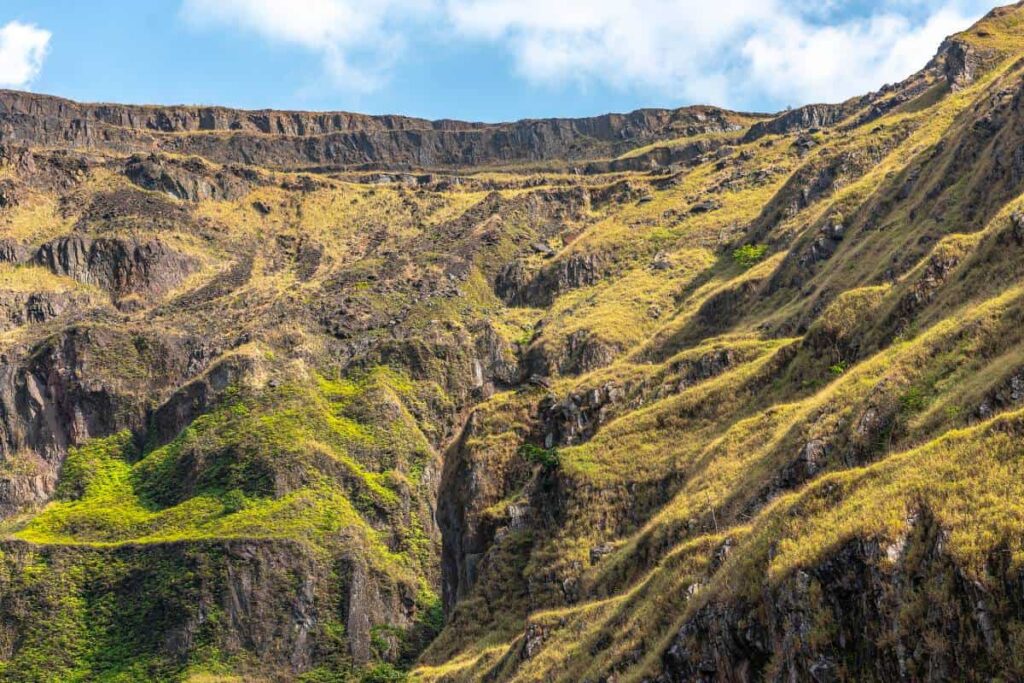
The Mount Nimba massif is one of the most visually striking geological features in West Africa. Its sharp ridges, rugged escarpments, steep valleys, and iron-rich outcrops create dramatic natural scenery that rivals any mountain range on the continent. Formed from ancient metamorphic rock, the massif contains banded ironstone, quartzite, and schists that date back hundreds of millions of years—making it a geological treasure as well as a biological one.
Its landscape can be categorized into three major elevation-based zones:
- Lowland and mid-elevation rainforests: Dense evergreen forests dominated by tall canopy trees, lianas, and rich undergrowth.
- Cloud forests: Unique moss-laden forests sustained by near-permanent mist, essential for specialized flora and fauna.
- Montane grasslands: Open high-altitude meadows above the cloud forest zone, home to rare and highly adapted species like the Nimba viviparous toad.
Above the grasslands lie rocky summits and windswept plateaus where temperatures drop sharply, winds intensify, and specialized alpine-like vegetation persists. These high elevation ecosystems are extremely fragile and support species found nowhere else in the world.
Climate of Mount Nimba
The climate of Mount Nimba varies strongly with altitude, creating a complex vertical climatic gradient that drives ecological diversity. The lower elevations experience a humid tropical climate with high rainfall ranging from 1,800 to 2,500 mm annually. Temperatures in the lowlands can reach 30°C or higher, creating ideal conditions for evergreen rainforest.
Mid-elevation cloud forests experience cooler temperatures, persistent fog, and high humidity. Here the climate becomes subtropical, and the forests remain wet year-round due to constant condensation. These mist zones provide essential moisture for mosses, orchids, ferns, lichens and epiphytic plants that depend on humid air rather than soil moisture.
At elevations above 1,400 meters, the climate becomes cool and temperate. Night temperatures can drop significantly, especially in windy conditions, creating stressful environments where only the most specialized species can thrive. These extreme microclimates contribute to the mountain’s high levels of endemism.
Hydrology and Water Systems
Mount Nimba is a major hydrological tower for the region, feeding multiple watersheds that supply water to downstream communities and ecosystems in Guinea, Liberia, and Côte d’Ivoire. Its high rainfall and cloud capture create numerous springs, streams, waterfalls, and underground seep zones that remain active even during dry seasons. These perennial water sources support aquatic life and ensure that the surrounding lowlands remain fertile.
The mountain’s geology, dominated by iron-rich formations, influences water acidity and mineral composition. Underground caves and fissures shelter unique cave-dwelling invertebrates, while montane wetlands support amphibians and aquatic insects. These exceptional hydrological systems help regulate microclimates and sustain biodiversity across the mountain’s slopes.
Ecosystems and Vegetation
Mount Nimba hosts an extraordinary diversity of ecosystems. Its lowland rainforests feature massive emergent trees, buttressed trunks, thick undergrowth, and a dense canopy home to primates, hornbills, and forest antelope. As elevation increases, the vegetation transitions into cloud forests—unique ecosystems filled with moisture-loving plants such as epiphytes, mosses, orchids, and lichens that blanket tree trunks and rocks.
Above 1,400 meters, the landscape shifts to montane grasslands where tough grasses, heathers, alpine-like herbs, and endemic wildflowers thrive. These grasslands constitute one of the most botanically unique ecosystems in West Africa. Several plants such as Haumaniastrum nimbae and Stachydeoma nimbaense exist nowhere else. Their adaptations to cold nights, high winds, and nutrient-poor soils underscore the evolutionary uniqueness of the Nimba massif.
Wildlife of Mount Nimba Strict Nature Reserve
Mammals
The reserve’s mammalian diversity is exceptional. West African chimpanzees live in the forested valleys and slopes, forming one of the region’s most important chimpanzee populations. These chimpanzees are known for their specialized behaviors, including sophisticated tool use and unique food-processing techniques. Their survival depends heavily on the protection of montane and mid-elevation forests.
Other notable mammals include the rare Nimba otter-shrew—an aquatic, shrew-like mammal found only in this mountain system—as well as several duiker species (including Maxwell’s duiker and the endangered Jentink’s duiker in adjacent lowlands), forest buffalo, red river hogs, pangolins, mongooses, civets, porcupines, and multiple species of bats.
Birds
Birdlife in Mount Nimba is rich and diverse, with species representing forest specialists, montane birds, raptors, and migratory visitors. Cloud forests host the Nimba flycatcher, fire-crested alethe, and various sunbirds, while rocky cliffs attract crowned eagles and other birds of prey. Forest edges provide habitat for turacos, green pigeons, hornbills, and weavers. Seasonal migrations bring additional species, making the reserve one of the most attractive birding locations in West Africa.
Reptiles, Amphibians and Insects
Mount Nimba is world-famous for its amphibian diversity. The Nimba viviparous toad is the reserve’s most iconic species—an evolutionary oddity that gives birth to live young rather than laying eggs. This toad lives exclusively in high-altitude grasslands and is extremely sensitive to habitat changes. The reserve also harbors numerous frog species, chameleons, skinks, geckos, and snakes such as forest cobras.
Insects are extraordinarily diverse, including endemic butterflies, beetles, ants, termites, and cave invertebrates. Many species are highly specialized, surviving only in narrow altitude bands or specific microhabitats. This exceptional invertebrate diversity highlights Mount Nimba as one of the most important locations for evolutionary and entomological research in Africa.
Unique Features of Mount Nimba
- A globally significant evolutionary refuge with species found nowhere else.
- The only habitat for the critically endangered Nimba viviparous toad.
- Dramatic iron-rich geology and rugged mountain peaks offering stunning views.
- Rare montane cloud forests unique to the Upper Guinean region.
- An unparalleled natural laboratory for scientists studying climate adaptation.
Indigenous and Local Communities
Communities such as the Dan, Mano, Kpelle, and Guerzé live around the reserve and maintain deep cultural, spiritual, and historical ties to the mountain. Mount Nimba is considered sacred in many local traditions, and these longstanding beliefs have traditionally helped protect parts of the forest from overexploitation. Today, local communities participate actively in conservation efforts through eco-tourism, environmental monitoring, trail management, and sustainable livelihood initiatives.
Community participation is crucial for preserving buffer zones around the core reserve, helping reduce pressures from agriculture, firewood collection, and small-scale hunting. Partnerships between conservation authorities and local leaders ensure that the reserve’s protection benefits surrounding populations through eco-tourism revenues and conservation employment.
Conservation Importance
Mount Nimba’s conservation importance cannot be overstated. Its ecosystems support countless species that would face immediate extinction if their habitats were lost. Because many animals and plants have extremely small home ranges limited to specific elevation bands, even minor habitat degradation could have catastrophic consequences. The reserve also acts as a genetic refuge for the Upper Guinean Forests, which have suffered extensive loss across West Africa.
Additionally, Mount Nimba is a climate refuge: as temperatures rise, many species migrate upward, making its high-altitude zones crucial for long-term survival. Protecting Mount Nimba is therefore essential not only for regional biodiversity but also for global conservation priorities.
Main Threats and Challenges
- Mining pressure: The mountain’s iron-ore reserves have attracted decades of mining interest, posing serious risks to habitats.
- Deforestation: Agricultural expansion in surrounding lowlands threatens buffer zones.
- Poaching: Chimpanzees, duikers, and other wildlife are vulnerable to hunting outside the core reserve.
- Climate change: Warming temperatures and altered rainfall patterns threaten high-altitude species.
- Encroachment: Growing human populations increase pressure on forest edges and watersheds.
Research, Monitoring and Scientific Programs
For more than a century, Mount Nimba has served as a focal point for scientific exploration. Researchers study primate behavior, amphibian reproduction, evolutionary adaptation, plant ecology, geology, hydrology, climate variability, soil fauna, and endemic insect species. The reserve hosts long-term monitoring stations that gather data on forest health, species distribution, and climate trends.
International organizations including UNESCO and IUCN work alongside local institutions to ensure that conservation strategies are grounded in scientific evidence. Many research findings from Mount Nimba have influenced global understanding of speciation and mountain ecology, making it one of the world’s most important natural biological laboratories.
Tourism Activities in Mount Nimba Strict Nature Reserve
- Guided hiking and trekking: Explore montane forests, sweeping ridges, waterfalls, and high-altitude grasslands.
- Birdwatching: Exceptional opportunities to observe rare montane and forest bird species.
- Photography: Stunning mountain vistas, mist-filled forests, unique wildlife, and vibrant plant life.
- Cultural visits: Experience the traditions, crafts, and lifestyle of nearby communities.
- Scientific tourism: A destination for researchers, students, and conservation volunteers.
Access and How to Get There
Access points vary by country. The Guinean side near Nzérékoré provides the most common gateway, while Côte d’Ivoire access is through Danané. Liberia’s Yekepa area provides access to the East Nimba Nature Reserve. Roads leading to the reserve can be challenging and often require 4×4 vehicles, especially during the rainy season when tracks become muddy and slippery. Permits and authorized guides are required for all visits.
Permits, Entry Regulations and Restrictions
As a strict nature reserve, Mount Nimba enforces stringent regulations to protect its fragile ecosystems. Entry must be arranged through national protected area authorities, and visitors must be accompanied by certified guides. Off-trail hiking, artifact collection, camping, fires, and disturbing wildlife are strictly prohibited. Sensitive zones such as high-altitude grasslands and amphibian breeding areas are accessible only to researchers with special permission.
Accommodation Options Near Mount Nimba
- Eco-lodges in Danané, Yekepa, Nzérékoré, and neighboring towns.
- Community-run guesthouses offering simple but authentic accommodations.
- Local hotels in nearby urban centers for longer stays.
- Research camps for scientists conducting field studies.
Best Time to Visit Mount Nimba Strict Nature Reserve
- Dry season (November–April): Best for hiking, photography, and wildlife viewing; clearer skies and safer access.
- Rainy season (May–October): Lush landscapes, full waterfalls, peak ecological activity, but challenging access.
Why Mount Nimba Strict Nature Reserve Is Unique
Mount Nimba Strict Nature Reserve is a sanctuary of global importance—a place where evolutionary processes, dramatic geology, ancient forests, and unique species converge in spectacular fashion. Its ecosystems are irreplaceable; many species exist nowhere else on Earth. The reserve’s scientific value is immense, offering insights into climate resilience, species adaptation, and the origins of biodiversity. For travelers, conservationists, and researchers, Mount Nimba provides one of the last opportunities to explore a truly wild, high-altitude rainforest ecosystem in West Africa.
Few places on the continent offer such a powerful combination of natural beauty, scientific intrigue, and conservation urgency. Mount Nimba stands as one of Africa’s great natural wonders—a living museum of evolution, a refuge for endangered species, and a symbol of the extraordinary ecological heritage of West Africa.