
Nouabalé-Ndoki National Park
Nouabalé-Ndoki National Park – Western Lowland Gorillas, Pristine Congo Basin Rainforest, Forest Elephants, Mbeli Bai and Africa’s Last Great Intact Wilderness
Nouabalé-Ndoki National Park is one of the most untouched rainforest wildernesses left on Earth—a vast, primeval sanctuary where western lowland gorillas forage beneath towering cathedral-like forests, forest elephants wander silently through mineral-rich clearings and clear-water rivers weave their way through landscapes unchanged for millennia. Covering 4,238 km² of uninhabited primary rainforest in the northern Republic of Congo, Nouabalé-Ndoki is the beating heart of the Sangha Trinational conservation landscape, a UNESCO World Heritage Site shared by Congo, Cameroon and the Central African Republic. It is widely regarded by scientists and conservationists as one of the most intact tropical forest ecosystems remaining in Africa, with no villages, no roads, no logging and no permanent human settlements within its borders.
This extraordinary national park shelters some of the largest remaining populations of western lowland gorillas and forest elephants, alongside forest buffalo, chimpanzees, bongos, sitatunga, red river hogs and many species of monkeys. Wildlife densities here are exceptional for a rainforest system because the forest is mature, the hydrology is stable and the ecosystem has been protected long enough to allow ecological processes to run uninterrupted. Nouabalé-Ndoki is a stronghold for species that are declining across the Congo Basin, making it one of the most critical conservation areas on the continent.
Location, Size and Geographic Context
The park sits in the remote far north of the Republic of Congo, bordering Cameroon’s Lobéké National Park to the northwest and the Central African Republic’s Dzanga-Sangha Reserve to the northeast. Together, these three parks form the 28,000 km² Sangha Trinational Landscape, one of the most important transboundary conservation zones in Africa. Nouabalé-Ndoki itself spans 4,238 km² of uninterrupted rainforest, making it one of the few places on Earth where an entire ecosystem remains intact, unroaded and uninhabited.
- Country: Republic of Congo
- Region: Sangha Department
- Total Area:</strong 4,238 km²
- Coordinates: At the tri-border of Congo, Cameroon and Central African Republic
- Ecosystem: Core block of the Congo Basin Rainforest
The park’s remoteness is central to its ecological purity. Access is typically through the small conservation town of Bomassa near the Sangha River. From here, visitors and researchers travel by boat or forest tracks into the park. Its isolation has allowed wildlife populations to flourish largely undisturbed, making it one of the most scientifically valuable conservation areas in all of Central Africa.
Geology and Landscape Formation
The Nouabalé-Ndoki landscape lies on an ancient Precambrian foundation covered by deep, nutrient-poor tropical soils—typical of old-growth rainforest ecosystems that have undergone millions of years of weathering. These stable geological conditions created the platform for one of the most structurally complex rainforests on the planet. The park’s gently undulating terrain includes hills, plateaus, river valleys and floodplain depressions where mineral-rich bais form.
- Precambrian basement rocks: Geologically ancient formations underlying the forest.
- Latosol soils: Deep, heavily weathered soils supporting evergreen forest.
- Alluvial soils: Richer deposits along riverbanks and bais.
- Bais: Hydrological and geological depressions enriched by minerals.
The terra firme rainforest, untouched by seasonal flooding, dominates much of the park. Meanwhile, riverine zones, swamps and bais add ecological diversity. The landscape remains dynamic through treefall gaps, river meandering, soil sedimentation and wildlife-driven vegetation changes—particularly from elephants, which play a major role in shaping vegetation structure.
Climate and Seasonal Patterns
Nouabalé-Ndoki lies in a humid equatorial climate zone with high rainfall and fairly stable temperatures year-round. The park’s climate supports evergreen forest and steady ecological productivity. Although rainfall is abundant, the seasons still influence wildlife behavior, fruiting events, gorilla movements and elephant visitation to bais.
- Rainy seasons: March–May and September–November
- Drier seasons: December–February and June–August
- Annual precipitation: Approximately 1,500–1,800 mm
- Temperatures: Generally 21°C–29°C
During wetter periods, amphibians emerge in full diversity, rivers swell, and forest fruiting events intensify—providing crucial food for gorillas and monkeys. In the relatively drier months, bais become hotspots for elephant activity as they seek minerals and water. This cyclical rhythm supports a dynamic balance within the rainforest.
Hydrology – Rivers, Streams and the Lifeblood of the Ndoki Forest
Nouabalé-Ndoki is crisscrossed by clear-water rivers and streams that feed into the Sangha and Likouala river systems. These waterways carve through the landscape and create essential habitats for fish, amphibians, reptiles and mammals. The hydrology is notable for its clarity because the rivers drain sandy soils with minimal sedimentation, giving them a distinctive turquoise or tea-like color.
- Ndoki River: Forms the western boundary and provides a key wildlife corridor.
- Motaba River: Supports swamp forests with sitatunga and rare birds.
- Likouala-aux-Herbes River: Influences seasonal floodplain ecosystems.
- Forest streams: Countless small tributaries sustaining amphibians and fish.
Seasonal rainfall expands swamp forests and temporarily floods low-lying areas, depositing nutrients that enrich the surrounding vegetation. Bais—low-lying clearings created by a mix of hydrology, soil chemistry and wildlife disturbance—form some of the park’s most important ecological hotspots. Elephants dig into mineral-rich soils in these clearings, creating pits that hold water and attract buffalo, gorillas, antelope and birds.
Ecosystems and Habitat Diversity
Nouabalé-Ndoki contains a diverse mosaic of rainforest ecosystems, each shaped by subtle variations in soil, elevation and hydrology. This diversity supports exceptionally high numbers of species and provides ecological niches for wildlife ranging from large mammals to tiny amphibians and insects.
- Primary terra firme rainforest: Dominates the park; tall, ancient trees and dense canopy.
- Riverine forest: Moist, lush vegetation along streams and rivers.
- Swamp forest: Waterlogged peat-rich zones supporting sitatunga and swamp monkeys.
- Seasonally flooded forest: Nutrient-rich habitat attracting forest buffalo and duikers.
- Bais: Open mineral clearings serving as wildlife aggregation points.
This ecological complexity allows the park to support some species that require highly specialized habitats—such as bongos in forest thickets, red colobus monkeys in high canopy zones and dwarf crocodiles in swampy depressions. Habitat continuity also allows large mammals to move across vast areas without encountering human barriers.
Flora – Botanical Richness of the Ndoki Rainforest
The flora of Nouabalé-Ndoki is among the most diverse in the Congo Basin, with thousands of plant species forming layered vegetation structures. Enormous canopy trees reach heights of 40–60 meters, creating deep shade where specialized understory plants thrive. Lianas and vines climb toward the canopy, while Marantaceae plants form dense groundcover essential for gorilla nesting and foraging.
- Canopy trees: Gilbertiodendron dewevrei, Entandrophragma spp., Terminalia spp.
- Mid-story trees: Rich mixtures of hardwoods supporting epiphytes.
- Understory: Marantaceae and Zingiberaceae plants used by gorillas.
- Wetland flora: Palms, ferns, sedges and raffia forests.
- Epiphytes and orchids: Thriving in humid canopy layers.
This botanical diversity supports a wide array of wildlife, from fruit-eating monkeys to leaf-specialist insects. The forest also plays a major role in global climate regulation by storing vast amounts of carbon in its biomass.
Wildlife of Nouabalé-Ndoki National Park
Nouabalé-Ndoki is one of the last strongholds for many species that are increasingly threatened across Central Africa. The complete absence of settlement within the park means wildlife can behave naturally, resulting in high densities and healthy breeding populations.
Western Lowland Gorillas
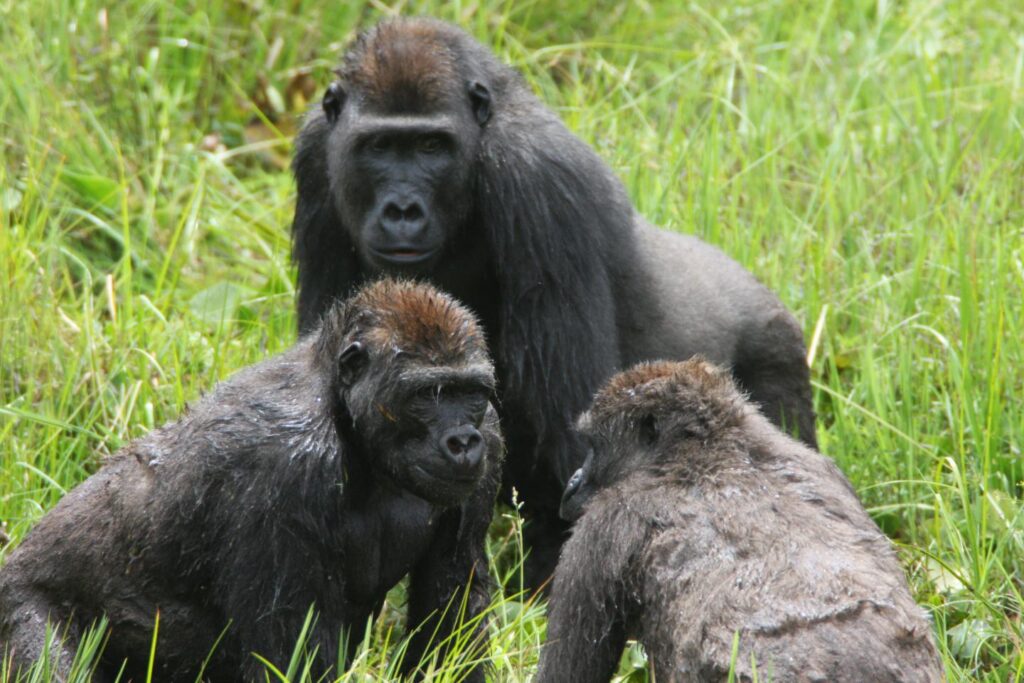
Nouabalé-Ndoki hosts one of the world’s most studied and stable populations of western lowland gorillas. Gorilla tracking at Mondika offers rare opportunities to observe a fully habituated gorilla group in dense rainforest. Researchers have followed these gorillas for decades, documenting social structures, dominance hierarchies, feeding ecology and mother-infant behavior.
Gorillas feed primarily on fruits during peak fruiting seasons, while leaves, stems and bark become more important in leaner months. They build new nests each evening, usually on the ground but sometimes in trees, depending on season and safety. Their ecological role is vital—gorillas disperse seeds across long distances, helping regenerate forest growth.
Forest Elephants
Forest elephants are smaller, quieter and more secretive than savanna elephants, but Nouabalé-Ndoki remains one of their safest refuges. These elephants are ecosystem engineers—opening gaps in the forest, dispersing seeds and maintaining pathways used by other wildlife. Their presence is crucial for forest dynamics.
Bais are especially important for forest elephants. They visit these clearings to extract minerals from soil, socialize, bathe and drink. At Mbeli Bai, it is common to see groups of elephants interacting peacefully, mothers guiding calves to water, or bulls engaging in subtle dominance behaviors.
Forest Buffalo, Sitatunga and Bongos
Forest buffalo thrive in the open conditions of bais, where they graze on fresh vegetation and drink mineral-rich water. Their reddish coats contrast beautifully with the bright greens of wetland grasses.
Sitatunga, highly adapted to swampy environments, have elongated hooves that enable them to move silently through muddy waters. Bongos—Africa’s largest forest antelope—roam deep thickets and occasionally appear at bais, offering some of the most striking sightings in the rainforest.
Primates
Nouabalé-Ndoki is rich in primate diversity, with at least 11 species recorded throughout the park. Chimpanzees frequent fruiting trees, red colobus monkeys form large canopy groups and De Brazza’s monkeys patrol river edges.
- Chimpanzees
- De Brazza’s monkeys
- Putty-nosed monkeys
- Allen’s swamp monkeys
- Grey-cheeked mangabeys
- Black-and-white colobus
- Red colobus
The primate community is very active and vocal—pant-hoots, alarm calls and rustling in the canopy are heard throughout the day.
Birdlife
The park supports more than 350 bird species, with exceptional observation opportunities around rivers, swamps and bais. Species such as African grey parrots, hornbills and turacos are common, while rarer birds such as the white-crested tiger heron and forest eagles enhance the park’s appeal for bird enthusiasts.
- African grey parrots
- Great blue turacos
- Black-casqued hornbills
- White-crested tiger herons
- Green pigeons
- Shining-blue kingfishers
Bais often attract storks, cattle egrets, bee-eaters and herons, offering open views that contrast with the dense forest canopy.
Reptiles, Amphibians and Insects
Reptiles include dwarf crocodiles in swampy areas, Nile crocodiles along larger rivers and a variety of tree snakes, monitor lizards and chameleons. Amphibian diversity is remarkable, especially during rainy seasons when frogs and toads call from flooded forest patches.
Insects—particularly butterflies, ants, beetles and moths—form an essential part of the rainforest food web. Hundreds of species depend on specific host plants, and their abundance supports birds, bats, primates and small predators.
Unique Features – Mbeli Bai, Mondika, Clear-Water Rivers and the Pure Ndoki Wilderness
Nouabalé-Ndoki is famous for its bais—natural forest clearings where wildlife gathers for minerals and water. The most renowned is Mbeli Bai, where researchers study gorillas, elephants, buffalo and sitatunga from a raised observation platform. Wildlife activity here is constant, offering remarkable visibility in an ecosystem normally dominated by thick foliage.
Mondika, the gorilla research site, provides one of the best opportunities anywhere in Africa to track habituated western lowland gorillas. The experience takes visitors through mature rainforest rich in birds, primates, insects and ancient trees.
- Mbeli Bai: World-class wildlife viewing site with high animal activity.
- Mondika Gorilla Tracking: Habituated gorilla group accessible on foot.
- Clear-water rivers: Stunning waterways ideal for canoeing and birdwatching.
- Intact rainforest: One of the purest forest blocks left in Africa.
Together, these features make Nouabalé-Ndoki one of the most extraordinary rainforest destinations on Earth.
Cultural and Indigenous Communities
Although the park itself has no permanent settlements, the surrounding region is inhabited by Indigenous forest communities such as the BaAka, BaMboko and Sangha peoples. These communities have lived in harmony with the forest for generations, developing sophisticated ecological knowledge that guides their hunting, gathering and medicinal plant use.
The BaAka in particular are renowned for their deep understanding of rainforest ecology—able to interpret animal tracks, predict fruiting patterns, identify edible plants and navigate dense forest with remarkable ease. Their knowledge is invaluable in scientific research and conservation work, especially in projects involving great ape monitoring.
Conservation Significance
Nouabalé-Ndoki is one of the most important protected areas in the Congo Basin, safeguarding species and ecological processes that are declining elsewhere due to habitat loss, logging and hunting. The park contributes significantly to global biodiversity preservation and climate stabilization.
- Protects one of the largest populations of western lowland gorillas.
- Vital refuge for forest elephants.
- Core component of the Sangha Trinational UNESCO Site.
- Massive carbon storage capacity.
- Intact forest landscape supporting healthy wildlife communities.
Because the forest is unbroken and undisturbed, it functions as a living laboratory for studying natural rainforest dynamics.
Threats and Environmental Challenges
- Poaching: Once severe but now significantly reduced through strong patrolling.
- Illegal wildlife trade: Still a risk to elephants and bushmeat species.
- Epidemics: Ebola poses serious threats to great apes.
- Climate change: Potential alterations in rainfall and fruiting cycles.
Despite these challenges, Nouabalé-Ndoki remains one of Africa’s best-protected rainforests thanks to effective law enforcement, transboundary cooperation and community engagement.
Scientific Research and Monitoring Programs
The park is one of the most active scientific research zones in Africa. Long-term studies at Mbeli Bai and Mondika have produced invaluable data on wildlife populations, behavior and ecology.
- Mondika Gorilla Project: Decades of continuous gorilla monitoring.
- Mbeli Bai Study: One of Africa’s longest-running wildlife observation projects.
- Elephant GPS tracking: Understanding movement patterns and habitat use.
- Camera trap surveys: Documenting elusive species like pangolins and leopards.
- Biodiversity inventories: Amphibians, birds, insects, plants and mammals.
Research findings guide conservation decisions across the entire Congo Basin and strengthen regional policies for protected areas.
Tourism Activities in Nouabalé-Ndoki National Park
- Gorilla tracking: Experience the Mondika habituated gorilla group.
- Bai observation: Watch elephants, gorillas and buffalo at Mbeli Bai.
- Forest walks: Guided hikes through pristine rainforest.
- Birdwatching: Excellent sightings along rivers and clearings.
- Canoeing: Explore calm, crystal-clear rainforest rivers.
Tourism here is low-impact and tightly controlled to protect the ecosystem while providing intimate, unforgettable encounters with rainforest wildlife.
Access – How to Reach the Park
- By air: Charter flights to Bomassa.
- By river: Boat transfers along the Sangha River.
- By forest track: Seasonal routes from nearby conservation bases.
Due to its remoteness, visiting Nouabalé-Ndoki requires planning, but the reward is experiencing a rainforest nearly untouched by modern influence.
Permits and Regulations
- Gorilla tracking permits mandatory for Mondika visits.
- No off-trail walking without authorized guides.
- Strict hygiene and distance rules for primate viewing.
- No removal of plants, animals or wood.
- Camping only in designated sites.
Accommodation Options
- Ngaga Camp: Near Mondika, ideal for gorilla tracking.
- Mbeli Camp: Simple research lodge near Mbeli Bai.
- Bomassa Camp: Main access base for visitors.
These eco-friendly camps are designed to minimize environmental impact while offering comfortable lodging in remote rainforest settings.
Best Time to Visit Nouabalé-Ndoki National Park
- December–February: Excellent gorilla tracking and bai viewing.
- June–September: Favourable conditions for wildlife observation.
- March–May & September–November: High rainfall but lush forest scenery.
Wildlife viewing is rewarding year-round, but trails and river levels differ across seasons.
Why Nouabalé-Ndoki National Park Is Unique
Nouabalé-Ndoki is one of the last truly wild places on Earth—a vast cathedral of rainforest where gorillas, elephants, buffalo and countless other species live undisturbed. Its unbroken forests, famous bais, clear-water rivers and scientific research legacy make it one of Africa’s greatest conservation achievements. Visiting this park offers a rare opportunity to witness the Congo Basin in its purest form—an ecosystem unchanged by time, governed only by natural cycles and ancient wilderness.