
Rubondo Island National Park
Rubondo Island National Park, Tanzania – Chimpanzee Sanctuary, Forest Elephants, Lake Victoria Wilderness and Africa’s Largest Protected Island Paradise
Rubondo Island National Park is one of Africa’s most remarkable protected areas — a remote, forest-covered volcanic island rising from the shimmering waters of Lake Victoria. Established in 1977 and covering approximately 456 km² of land and surrounding waters, Rubondo is Africa’s largest island national park and a crown jewel of Tanzanian conservation. Its extensive lowland forests, biodiverse papyrus swamps, secluded beaches, deep freshwater bays and untouched volcanic hills create an extraordinary sanctuary where wildlife thrives in complete isolation from human settlement.
What makes Rubondo truly unique is its radical conservation history. In the 1960s, pioneering German conservationist Professor Bernhard Grzimek and the Tanganyika government began one of Africa’s boldest wildlife rehabilitation projects. They introduced rescued chimpanzees, forest elephants, sitatunga, giraffes and other threatened species onto the island to give them a safe refuge far removed from poaching and human pressure. Over decades, these animals adapted, reproduced and formed self-sustaining populations. This extraordinary “rewilding experiment” transformed Rubondo into a living conservation laboratory and one of the continent’s most successful wildlife rehabilitation stories.
Today, Rubondo Island National Park is a pristine rainforest ecosystem, a sanctuary for rare species, a paradise for bird lovers, an angler’s dream, and one of Tanzania’s most immersive wilderness destinations. The island remains almost entirely undeveloped, with minimal infrastructure, no villages, no permanent residents and only a handful of visitors at any time. Stepping onto Rubondo feels like entering a world where African wildlife lives exactly as it did centuries ago — wild, free, undisturbed and profoundly beautiful.
Overview of Rubondo Island National Park
Rubondo Island National Park lies in the southwestern portion of Lake Victoria, the world’s second-largest freshwater lake and the largest in the tropics. The park includes the main island (Rubondo) and 11 smaller satellite islets. It is the only park in Tanzania where a combination of tropical forest species, rainforest primates, aquatic mammals, freshwater ecosystems and volcanic landscapes exist in complete harmony.
Visitors to Rubondo experience one of the last truly intact island rainforests in East Africa. The island’s towering trees, thick understory, moss-covered logs, orchid-laden branches and fern-filled ravines give it the feel of a prehistoric ecosystem. Wildlife signs—elephant tracks, chimpanzee nests, bushbuck prints, otter slides—appear everywhere. Forest sounds echo constantly: the haunting call of fish eagles, the chatter of monkeys, the drumming of woodpeckers and, at dawn, the enchanting chorus of forest birds.
Location, Size and Key Facts
Rubondo Island is located in the Geita Region of northwestern Tanzania. Its extreme isolation has been essential for maintaining its ecological integrity.
- Country: Tanzania
- Region: Geita
- Established: 1977
- Total Area: ~456 km²
- Land Area: ~240 km²
- Coordinates: ~2°18′ S, 31°55′ E
- Formation: Volcanic origin, part of an ancient tectonic archipelago
- No human settlements: Complete wilderness
Geology, Geography and Landscape
Rubondo Island is the result of volcanic uplift millions of years ago. Its granite and basalt foundations form rolling hills, rocky headlands and fertile volcanic soils. These soils support dense rainforest vegetation, creating one of the most pristine tropical forest ecosystems in East Africa. Moist depressions and river valleys host swamp forests, while higher ridges hold evergreen canopies alive with monkeys, parrots and butterflies.
The island’s dramatic coastline alternates between sandy beaches where hippos rest, rocky cliffs that support nesting birds and papyrus-filled deltas that shelter sitatunga antelope. The surrounding islets are used by thousands of nesting cormorants and herons, forming vital breeding colonies protected from predators.
Climate and Weather
Rubondo enjoys a tropical equatorial climate strongly influenced by Lake Victoria. Temperatures are warm and stable year-round, and humidity remains high — ideal for amphibians, orchids, fungi and dense tropical vegetation.
- Long Rains: March–May
- Short Rains: October–December
- Dry Seasons: January–February, June–September
Rainfall averages 1,500–2,000 mm annually. The rainy seasons bring mushroom flushes, frog choruses and intense greenery. Dry seasons offer optimum visibility for forest walks, chimp tracking and photography, while lake waters remain calm for boating and fishing.
Hydrology and Freshwater Systems
Rubondo Island is surrounded entirely by Lake Victoria — one of the richest freshwater ecosystems on the planet. The island also contains internal waterways including small streams, seasonal channels, hidden lagoons and swamp forests.
- Lake Victoria: Home to Nile perch, tilapia, cichlids, snails, otters and crayfish.
- Papyrus Swamps: Support sitatunga, terrapins, frogs, herons and marsh mongooses.
- Freshwater Bays: Act as nurseries for fish and feeding grounds for aquatic birds.
- Streams: Provide essential moisture for forest elephants and chimpanzees.
These interconnected systems make Rubondo a critical breeding and feeding habitat for Lake Victoria species. The island’s wetlands filter water naturally, helping maintain lake health.
Ecosystems and Vegetation
Rubondo hosts a mosaic of microhabitats shaped by volcanic soils, lake influence, rainfall and natural regeneration. Its vegetation can be categorized into four major ecosystems.
1. Primary Tropical Forest
The island’s forests are dominated by tall hardwoods including Milicia excelsa, Ficus sycomorus, Croton megalocarpus, Trilepisium madagascariensis and Albizia species. The canopy layer hosts monkeys, hornbills, turacos and African grey parrots. The understory holds ferns, mosses, lianas and orchids, creating a cool, shaded habitat where chimpanzees construct their nests.
2. Papyrus Swamps and Wetlands
Large papyrus belts encircle parts of the island. These wetlands are home to shy sitatunga antelope, terrapins, frogs, waterbirds and swamp-dwelling reptiles. They also serve as natural filtration systems and one of the most important ecological components of the park.
3. Grassland Glades
Former farmlands have regenerated into grasslands frequented by giraffes, bushbuck and ground birds. These open glades create visual contrast and provide nutrient-rich grazing areas.
4. Coastal and Shoreline Ecosystems
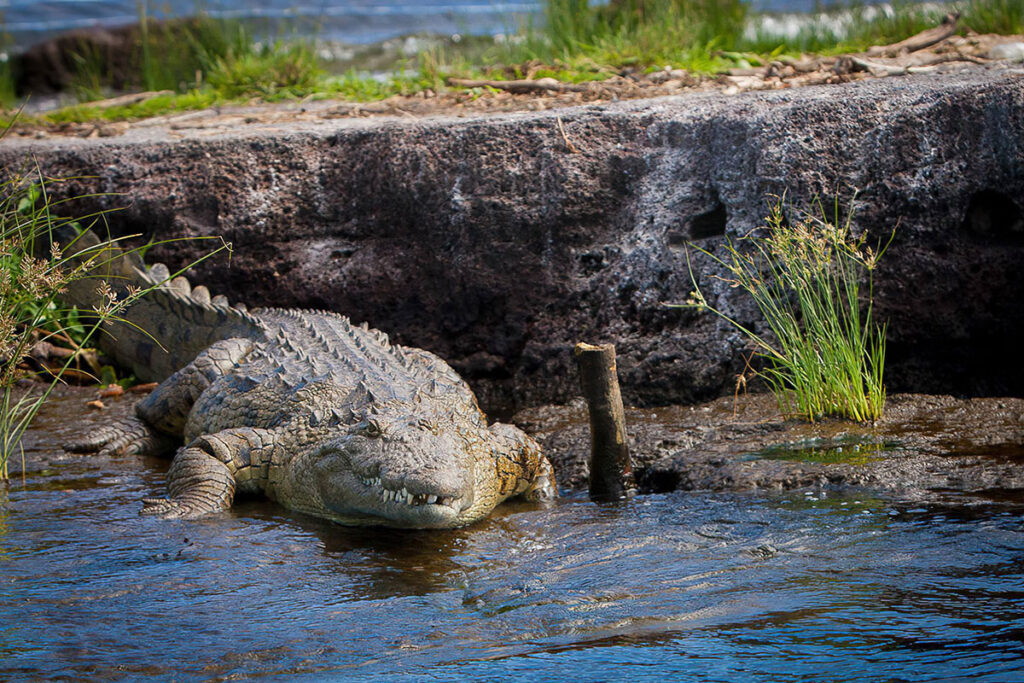
Mangrove-like vegetation, reed beds, sandy beaches and rocky promontories support otters, crocodiles, hippos, cormorants and kingfishers. These shorelines form the most important bird-nesting sites in Lake Victoria.
Wildlife of Rubondo Island National Park
Mammals
Rubondo’s mammal diversity includes both indigenous species and animals reintroduced as part of restoration programs. The absence of large predators such as lions or leopards allows populations to grow undisturbed.
- Chimpanzees: Introduced in the 1960s; now fully wild.
- Forest Elephants: Extremely elusive but ecologically important.
- Rothschild’s Giraffes: Graceful browsers in open glades.
- Sitatunga Antelope: Expert swimmers in papyrus swamps.
- Hippos
- Otters (Cape clawless & spotted-necked)
- Bushbuck
- Colobus & vervet monkeys
- Civets, genets, mongooses
- Pangolins (rarely seen)
The Chimpanzee Rewilding Story
Rubondo’s chimpanzee population is one of Africa’s greatest conservation achievements. Between 1966 and 1969, 16 rescued chimpanzees from European zoos were released into the island’s forests. Their adaptation was extraordinary. Without any rehabilitation training, they rapidly learned to forage, nest and live like wild chimpanzees. Over generations, the population expanded naturally. Today, Rubondo’s chimpanzees play a vital role in forest ecology and serve as a living model of primate reintegration.
Birdlife
With over 300 recorded species, Rubondo is one of Tanzania’s premier birdwatching destinations. Forest, swamp and freshwater birds coexist, creating exceptional avian diversity.
- African Fish Eagle: Among the highest densities anywhere in East Africa.
- Goliath Heron
- Saddle-billed Stork
- African Grey Parrot
- Papyrus Gonolek
- Ross’s Turaco
- Paradise Flycatcher
- Kingfishers & cormorants
- Bee-eaters, barbets & sunbirds
- Nightjars & owls
Many islands around Rubondo form critical breeding colonies for cormorants, making the area vital for Lake Victoria bird conservation.
Reptiles, Amphibians and Insects
Reptiles thrive in Rubondo’s warm, humid environment, including pythons, mambas, vine snakes, skinks, terrapins and Nile monitors. Amphibian diversity is high due to abundant rainfall: tree frogs, reed frogs, puddle frogs and toads call from swamps and streams. Insects include spectacular swallowtail butterflies, emperor moths, dragonflies, dung beetles and forest pollinators essential for seed dispersal.
Aquatic Life
Rubondo Island’s waters are among the richest in Lake Victoria. Key aquatic species include:
- Nile perch
- Tilapia
- Haplochromine cichlids
- Catfish
- Freshwater crabs
- Otters
The island’s sheltered bays and shallow deltas serve as crucial breeding grounds for fish, sustaining both lake ecology and Tanzania’s fishing heritage.
Unique Features of Rubondo Island National Park
- Africa’s largest protected island ecosystem
- Successful chimpanzee rewilding program
- High otter and fish eagle densities
- Rare combination of rainforest and freshwater biodiversity
- Complete absence of human settlement
- Vital fish nurseries for Lake Victoria
- High value for scientific research
Cultural and Historical Background
Before the park was created, the island was inhabited by local communities from the Suba, Zinza and Sukuma ethnic groups. These people lived by fishing, small-scale farming and beekeeping. They possessed deep ethnobotanical knowledge, using plants for medicine, weaving, boat-building and rituals. After relocation, the island’s ecosystems regenerated dramatically, providing a rare example of forest recovery when human pressure is removed entirely.
Conservation Importance
Rubondo Island plays a critical role in regional conservation:
- Protects one of the few intact lowland rainforests in East Africa
- Provides a secure refuge for forest elephants and chimpanzees
- Safeguards crucial fish breeding grounds
- Preserves unique island biodiversity and evolutionary processes
- Offers unparalleled opportunities for ecological and behavioral research
Threats and Challenges
- Illegal fishing pressure around park boundaries
- Risk of invasive species entering from mainland waters
- Gillnetting affecting otters and diving birds
- Climate change altering lake levels
- Occasional poaching attempts in surrounding districts
Research and Monitoring Programs
Rubondo serves as an important research hub. Scientific projects currently include:
- Chimpanzee habituation and social behavior studies
- Forest elephant movement monitoring
- Fish ecology research (perch, cichlids, tilapia)
- Bird breeding surveys on satellite islands
- Amphibian and reptile assessments
- Butterfly migration and pollination studies
Tourism Activities
- Chimpanzee tracking
- Forest walks and canopy exploration
- Birdwatching tours
- Catch-and-release sport fishing for Nile perch
- Boat safaris around the coastline
- Otter watching in shallow bays
- Kayaking and canoe excursions
- Night forest walks
- Beach relaxation and swimming
- Stargazing on the lakefront
Access and How to Get There
- By Air: Charter flights and scheduled flights land at Rubondo Airstrip from Mwanza and Serengeti.
- By Boat: Departures from Nkome and Kasenda on the mainland.
Due to the park’s remote nature, planning transport in advance is essential. Most movement inside the park is on foot or by boat.
Permits and Regulations
Park entrance fees are regulated by TANAPA. Special permits are needed for chimpanzee tracking, research activities and sport fishing. Visitors must follow all conservation guidelines.
Accommodation Options
- Rubondo Island Camp: An exclusive luxury lodge offering guided activities.
- TANAPA Campsites: Basic, affordable camping areas.
- Research Bandas: Simple accommodation for scientists and field teams.
Best Time to Visit Rubondo Island National Park
The best months to visit Rubondo are:
- June–September: Ideal for chimp tracking, hiking, birding and photography.
- December–February: Excellent for fishing, boating and wildlife viewing.
Rainy seasons provide lush greenery, dramatic skies and peak amphibian activity but can make forest trails slippery.
Why Rubondo Island National Park Is Unique
Rubondo Island National Park is a place where wild Africa exists in its purest form. Its volcanic forests, freshwater habitats, wild chimpanzees, secretive forest elephants, rare birds and pristine beaches make it one of Tanzania’s most breathtaking natural treasures. The combination of complete isolation, unparalleled biodiversity, a pioneering conservation history and limited tourism creates a wilderness experience found nowhere else in East Africa. For travelers seeking immersion in untouched nature, Rubondo Island is a sanctuary of silence, beauty and true ecological wonder.