
Virunga National Park
Virunga National Park, DR Congo – Africa’s Oldest Protected Wilderness, Mountain Gorillas, Active Volcanoes, Lava Lakes, Glaciers & The Biodiversity Capital of the Continent
Overview
Virunga National Park is a world-renowned ecological treasure — a protected landscape in the eastern Democratic Republic of Congo that holds more natural diversity than almost any other ecosystem on Earth. Founded in 1925, it is Africa’s oldest national park and a UNESCO World Heritage Site celebrated for its mountain gorillas, active volcanoes, vast savannahs, Rwenzori ice fields, rich wetlands and dense equatorial rainforest. The park covers approximately 7,800 km² and is home to more than 3,000 recorded plant and animal species, including over 700 bird species, making it one of the most biologically rich areas ever documented. Virunga is also one of the last sanctuaries for endangered mountain gorillas and a rare place where glaciers, fire and rainforest coexist — a living museum of evolution, climate and life.
Key Facts at a Glance
- Location: Eastern DR Congo, along the Albertine Rift
- Size: ~7,800 km² across mountains, rainforest & savannah
- Established: 1925 — First national park in Africa
- UNESCO World Heritage: Designated 1979 — currently “in danger”
- Species Count: Over 3,000 species with ~700+ bird species
- Famous For: Mountain Gorillas, Nyiragongo Lava Lake, Rwenzori Glaciers
- Management: ICCN + Virunga Foundation (Virunga Alliance)
Location & Geography
Virunga lies along the Albertine Rift, one of the most geologically active and biologically productive areas on Earth. The park extends from the shores of Lake Edward up to the Rwenzori Mountains and down to the Nyiragongo volcanic belt. Its landscapes are sharply diverse — within a single day a traveler may encounter swamp floodplains filled with hippos, bamboo forests echoing with primates, and icy peaks wrapped in mist. This varied geography allows species normally spread across entire countries to coexist inside one boundary. The convergence of equatorial climate, volcanic soils, altitudinal gradients and ancient water systems has created a perfect natural laboratory for evolution and ecological richness.
Volcanic Highlands: Land of Fire
The southern sector of Virunga contains two of the world’s most active volcanoes: Nyiragongo and Nyamuragira. Nyiragongo’s summit hosts the largest permanent lava lake ever recorded — a molten sea of energy and liquid stone glowing red against the night sky. Eruptions have repeatedly reshaped surrounding forests, burying old ecosystems beneath fresh basalt and creating new soils that quickly regenerate into fertile vegetation. These lava landscapes demonstrate the planet’s raw power and illustrate how destruction fuels renewal — a cycle at the heart of Virunga.
Rwenzori Mountains: Land of Ice
To the north, Virunga climbs into the Rwenzori Mountains — also known as the Mountains of the Moon, one of Earth’s most mystical alpine landscapes. Here, glaciers and snowcaps sit just above tropical rainforest — a climatic paradox found in very few places. Giant lobelias, everlasting flowers and moss forests dominate the highlands, while glacial meltwaters feed the Nile Basin. This Afro-alpine ecosystem is not only beautiful but hydrologically essential, helping regulate river systems that serve millions of people across East Africa.
Climate
Virunga’s climate is shaped by altitude, latitude and volcanic influence. Lowland zones are humid and warm with dense vegetation year-round, while the Rwenzori summits experience freezing temperatures, snow and thick cloud. Rainfall peaks in March–May and October–November, intensifying forest greening, wildlife movements, amphibian breeding and fruiting cycles. Dry seasons offer clearer trekking windows — June to September and December to February — ideal for gorilla tracking, hiking and volcano climbing. This climatic variability fuels extraordinary biodiversity and ensures that life in Virunga is constantly renewing itself.
Hydrology & Wetlands
Virunga contains one of Africa’s most important freshwater systems. Rivers such as Rwindi and Semliki feed extensive swamps and lakes where hippos historically reached the highest densities in the world. Wetlands form nursery grounds for fish and birds, attract elephants during dry periods, and sustain human communities with fresh water and livelihood resources. The Rwenzori glaciers function as frozen water banks — releasing meltwater gradually, ensuring year-round flow into lakes and rivers. Protecting these hydrological systems is vital not only for Virunga’s biodiversity, but for millions of people in DR Congo, Uganda and beyond.
Ecosystems & Habitats
Few parks on Earth hold ecosystem diversity equal to Virunga. Tropical rainforest dominates the south, bamboo thickets and cloud forest shelter mountain gorillas on mid-elevation slopes, while sweeping plains and wetlands host savannah species in the central region. Afro-alpine moorlands rise into cold, oxygen-thin peaks where evolution has produced giant flora and cold-adapted birds. Lava flows cut through woodland, creating young, nutrient-rich soils that rapidly sprout green shoots. This environmental layering gives Virunga ecological resilience — when one habitat declines temporarily, others may thrive. It is a living quilt of energy and life.
Montane & Bamboo Forests — Gorilla Heartland
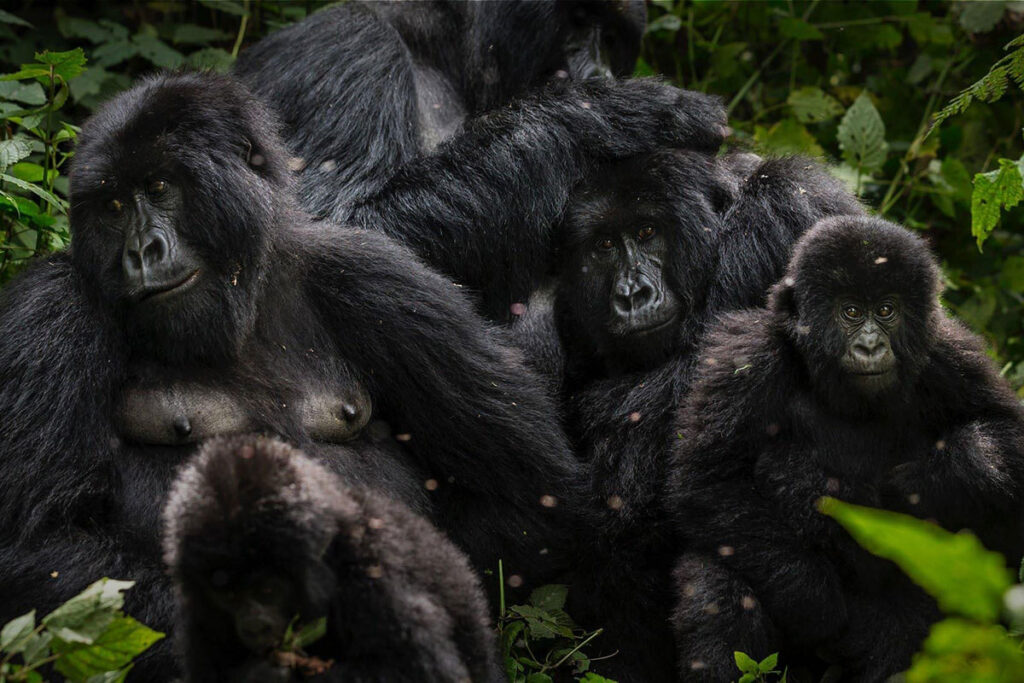
The montane forests are the core of gorilla territory. These forests are lush, humid and shadow-filled — a world of vines, moss, giant trees and bamboo stalks broken open by silverback hands. Gorilla families feed on vegetation all day, groom infants, build nests and maintain complex social bonds. The importance of these forests extends far beyond gorillas — they store vast amounts of carbon, support amphibians and insects, and keep air and water cycles stable across the Rift. Protecting these forests is synonymous with protecting the planet.
Savannah & Floodplains
Central sectors open into golden grass plains where buffalo, topi, Uganda kob and warthog graze. Predators such as lions and hyenas depend on these herds for survival, creating a dynamic food-web system. Floodplains transform dramatically with seasons: during rains they swell into shimmering lagoons filled with birds; during droughts they gather megafauna seeking water and forage. Their seasonal rhythm is one of nature’s greatest spectacles.
Afro-Alpine High Altitudes
Above 3,000 m, vegetation shrinks into ancient moorlands and moss meadows. Giant Senecio and Lobelia plants — resembling extraterrestrial forms — dominate fog-wrapped ridges. These landscapes are so unique that many species here are found nowhere else globally. They are also climate-sensitive — glacier retreat threatens long-term water security and biodiversity stability. Conservation in high-altitude Virunga is time-critical.
Flora & Vegetation
Virunga’s flora exceeds 2,000 species — from wild banana and orchid-shadowed rainforest to frost-tipped Rwenzori heather forests. Medicinal plants used by local communities grow in wadi streams and montane clearings. Giant Afro-alpine plants store water within sponge-like stems; rainforest canopies recycle nutrients endlessly via fungi, insects and soil bacteria. Vegetation in Virunga is not static — it is living architecture that breathes, cycles, stabilizes and evolves.
Wildlife
Mammals
Virunga is most famous for its mountain gorillas. Families roam forest corridors under the leadership of powerful silverbacks, raising infants, foraging, communicating through vocal calls and deep social intelligence. Visitors trek through mist and vine to meet them face-to-face — one of the world’s rarest and most emotional wildlife moments.
The park also shelters eastern chimpanzees, forest elephants (smaller and more elusive than savannah elephants), okapi (forest giraffes endemic to DR Congo), sitatunga, duiker antelope, warthog, hyena, leopard and forest buffalo. Nocturnal mammals — including genets, civets and giant fruit bats — thrive after dark. In lake regions, hippos once peaked at 29,000 individuals, forming the world’s largest recorded population.
Birdlife
Over 700 bird species make Virunga one of Africa’s most valuable ornithological destinations. Species include:
- Rwenzori Turaco
- Shelley’s Crimsonwing
- Black Bee-eater
- Wattled Ibis
- Crowned Crane
- Shoebill Stork in lake wetlands
Migration seasons transform Virunga into a theatre of wings, song and color — thousands of birds circling lakes, nesting in reeds and feeding on aquatic insects.
Reptiles, Amphibians & Insects
The park hosts numerous reptiles including forest cobras, pythons, vipers, geckos and monitor lizards. Amphibians thrive after rain, triggering mass breeding events in forest pools. Insects — beetles, butterflies, ants, moths — support cross-pollination and nutrient recycling. Life here is woven deeply from the soil upwards — nothing is isolated, everything feeds something else.
Unique Features
- World’s largest permanent lava lake at Nyiragongo.
- One of only three global mountain gorilla habitats.
- Glacier peaks + tropical rainforest in one park.
- Home to the highest biodiversity concentration in Africa.
- Historic mega-hippo wetlands that shape regional ecology.
Governance, Rangers & Virunga Foundation
Virunga is managed by ICCN (Institut Congolais pour la Conservation de la Nature) and supported by the Virunga Foundation through the Virunga Alliance — an innovative model linking conservation with development. Virunga rangers are among the most dedicated on Earth, operating in regions where armed groups and poachers are active. Over 200 rangers have died protecting this park, making their work some of the most dangerous conservation duty anywhere in the world. They patrol forests daily, guard gorilla families, dismantle poaching traps, disrupt illegal charcoal networks and maintain security for visitors. Virunga survives because its rangers do.
Local Communities, Livelihoods & Development
Millions of people live around Virunga’s boundaries, many facing poverty, displacement and reliance on natural resources for survival. Conservation here must work hand-in-hand with community development. The Virunga Alliance supports:
- Hydroelectric plants providing clean energy — replacing charcoal reliance
- Agricultural & fisheries livelihoods for income diversification
- Cocoa, coffee & craft cooperatives supporting local markets
- Schools, ranger training programs & peace-building outreach
Virunga is not just a park — it is a model for how conservation can improve lives rather than restrict opportunity. Protecting forests means protecting people.
Threats & Conservation Challenges
Virunga’s survival remains fragile. The park faces:
- Armed militia presence restricting ranger patrols & gorilla monitoring
- Illegal charcoal & logging for urban energy markets
- Oil exploration concessions threatening core ecosystems
- Poaching pressure targeting elephants, hippos & bushmeat species
- Human encroachment from refugees & displaced communities
Because of these pressures, Virunga remains on UNESCO’s List of World Heritage Sites in Danger — a warning and a plea for action.
Research, Conservation & Sustainability Efforts
Virunga is one of the most actively researched protected areas in Africa. Long-term studies track gorilla behavior, elephant migration corridors, hippo recovery, amphibian endemism, glacier recession and volcanic patterns at Nyiragongo. Anti-poaching squads monitor forest health and respond to threat patterns. Hydroelectric projects power thousands of homes, dramatically reducing charcoal extraction — saving trees and stabilizing the climate. Every year, data helps refine strategy, protect species and strengthen resilience.
Tourism Experiences
- Mountain Gorilla Trekking: among the most intimate wildlife experiences in the world
- Nyiragongo Crater Hike: overnight ascent to the legendary lava lake
- Chimpanzee Tracking in montane forest
- Rwenzori Glacier Expeditions for alpine climbers
- Lake Edward Boat Safaris for hippos, waterbirds & crocodiles
- Cultural village tours & craft encounters
- Photography, research & filmmaking itineraries
Access
Most travelers fly to Goma via Kigali or Kinshasa, then proceed with official Virunga staff and guides. Due to security dynamics, all itineraries are coordinated for ranger escort, safety monitoring and controlled route access.
Permits & Regulations
Gorilla permits are mandatory and limited for low-impact tourism. Volcano climbs require regulated guides and night-summit protocols. No off-trail travel, wildlife contact or vegetation harvesting is permitted. Responsible tourism is not a suggestion — it is the cornerstone of Virunga’s future.
Accommodation
Accommodations include eco-lodges, forest camps, crater shelters and community stays — many directly funding ranger salaries and conservation programs. Staying overnight contributes to habitat protection, ranger support and employment for families living near park boundaries.
Best Time to Visit
June–September and December–February offer ideal trekking visibility. Rainy seasons bring thick foliage, dramatic green color, active primate feeding and stronger waterfall flows — a beautiful but wetter adventure suited for experienced trekkers. Year-round, early mornings deliver the best light, wildlife movement and photographic clarity.
Why Virunga National Park is Unique
Because no other place on Earth combines active volcanoes, glaciers, mountain gorillas, hippo wetlands and tropical rainforest in one protected landscape. Virunga is a paradox made real — fire beside ice, rivers beneath lava, apes beside predators, danger beside beauty. It is a sanctuary born from resilience, guarded by extraordinary rangers, sustained by local communities and recognized as one of humanity’s last great natural strongholds. Virunga is Africa’s beating wild heart — alive, endangered and unforgettable.