
Volcanoes National Park
Volcanoes National Park, Rwanda – Africa’s Premier Mountain Gorilla Sanctuary, Mist-Shrouded Volcanoes, Afro-Alpine Forests & A Model of Conservation Success
Overview
Volcanoes National Park (Parc National des Volcans) is Rwanda’s most celebrated wilderness — a storied kingdom of emerald slopes, ancient volcanoes, bamboo forests and one of the last strongholds of endangered mountain gorillas. Established in 1925, it is among the earliest protected national parks in Africa, created at a time when gorilla populations were dangerously declining due to hunting, habitat loss and unchecked human encroachment. Today, it forms the Rwandan section of the Virunga Massif, a transboundary conservation landscape extending into Uganda and the Democratic Republic of Congo.
Covering approximately 160 km², Volcanoes National Park may be small on the map, but biologically it is vast — a living ark of high-altitude rainforest, bamboo thickets, montane woodland, Afro-alpine meadows and glacial volcanic peaks. The Rwandan government is expanding the park by roughly 27%, one of the most ambitious habitat restorations in modern Africa, aimed at increasing forage, decreasing human-wildlife conflict and future-proofing gorilla survival for decades to come.
This is a place where the earth breathes — where cloud wraps around volcanoes like flowing silk, where gorillas feed quietly between rain droplets, and where a trek through misted forest becomes a spiritual encounter with nature. What follows is one of the most complete travel and scientific breakdowns of Volcanoes National Park available online — crafted in clean SEO-optimized HTML, ideal for web publication, destination marketing and educational reference.
Key Facts at a Glance
- Country: Rwanda — Northern Province
- Size: ~160 km² (expanding by ~27% forest restoration)
- Established: 1925 — among Africa’s first national parks
- Coordinates: Along the Virunga Volcano Chain, Albertine Rift
- Main Attractions: Mountain gorillas, golden monkeys, volcanic trekking
- Highest Point: Mount Karisimbi — 4,507 m
- Other Peaks: Bisoke, Sabyinyo, Gahinga, Muhabura
- Nearest City: Musanze (Ruhengeri) — gateway town
- Travel Time from Kigali: 2.5–3 hours by road
- Biodiversity Highlight: Gorilla population increasing, not declining
Location & Accessibility
Volcanoes National Park is located in northwestern Rwanda, just south of the Uganda border and east of DR Congo. Its accessibility is one of the core reasons Rwanda became the world’s leading gorilla trekking destination — unlike other primate sanctuaries that require days of bush transfers, Volcanoes can be reached in under three hours from Kigali International Airport. Travelers often arrive one afternoon, trek gorillas the next morning, and still have time for culture, photography or transfers to nearby parks.
The gateway town of Musanze supports a thriving tourism economy with lodges, restaurants, cultural centers, craft markets, trekking gear suppliers and professional porters. The Kinigi Park Headquarters sits at the foot of the volcanoes and serves as the organizing point for all treks. Here, tourists gather for morning briefings, ranger allocations, permit verification and cultural dance performances before entering the forest.
The park also links seamlessly with Ugandan gorilla destinations such as Bwindi Impenetrable National Park and Mgahinga Gorilla National Park, allowing two-country multi-trek itineraries popular among wildlife photographers, primatologists and adventure travelers seeking deeper immersion.
Geography & Topography
The landscape of Volcanoes is shaped dramatically by volcanic geology. Five towering cones rise over the forest like sentinels — ancient, cloud-draped and alive with biodiversity. These volcanoes generate altitude variation, microclimates and soil fertility that allow an astonishing range of life to flourish within a compact area. Steep slopes, crater basins, lava rock, glacial remnants, alpine wetlands and moss forests form a near-vertical ecological museum.
The Virunga Volcanoes
- Karisimbi (4,507m): Snow-dusted in cold seasons, a demanding two-day summit for experienced hikers.
- Bisoke: Famous for its circular high-altitude crater lake — one of the most scenic summit hikes in East Africa.
- Sabyinyo: Rugged, tooth-shaped peak marking the meeting of Rwanda, Uganda & DR Congo — a symbol of tri-nation unity.
- Muhabura: A tall conical volcano visible from distant plains — steep ascent with sweeping Rift Valley views.
- Gahinga: Lower, gentler slopes rich in bamboo — excellent habitat for golden monkeys.
Between these great mountains lie deep valleys, ancient lava flows, forested saddles and ridgelines that channel wildlife movement. From farm boundary to moorland summit, one journey can feel like crossing worlds — each with its own climate, species and sensory atmosphere.
Climate & Weather Patterns
Volcanoes National Park is a cool, moist, often misty environment — an atmospheric rainforest shaped by elevation. Even on clear days the volcanoes often pull cloud toward their peaks like magnets, creating dramatic photography conditions and soft, diffused forest light.
- Peak Dry Season: June–September (best trekking conditions, clearer trails)
- Secondary Dry Season: December–February (excellent viewing, moderate trail moisture)
- Main Rains: March–May (lush vegetation, dense mist, fewer trekkers)
- Short Rains: October–November (dramatic photography, active gorilla feeding)
Because gorilla trekking occurs regardless of season, the experience remains reliable. However, wet seasons offer unexpected magic — silverbacks emerging from fog like myth, raindrops glinting off bamboo, and thick emerald carpets underfoot. Wildlife photographers often time visits during these months for mood, tone and cinematic depth.
Hydrology & Freshwater Systems
Volcanoes National Park is a crucial hydrological engine for Rwanda and the Virunga region. Forest canopy captures mist and rainfall, releasing it gradually into streams, marshlands and crater lakes. These waters feed into both the Nile Basin and Congo Basin — meaning this single park sustains water security on two sides of the continent.
Healthy hydrology depends on intact forest roots to retain soil, regulate runoff and prevent erosion. Without forest cover, rivers would flash-flood and lowland agriculture would suffer. Rwanda’s reforestation strategies, including the park expansion and buffer-zone tree planting, are therefore not just ecological decisions — they are national water-security investments.
Ecosystems & Vegetation Zones
Volcanoes National Park is one of the clearest examples of altitudinal ecological layering in Africa — a vertical tower of biodiversity where each band holds its own biological story.
- Lower Montane Forest (≈2,400–2,500m): Species-rich broadleaf forest, greatly reduced by historical agriculture.
- Bamboo Zone (≈2,500–3,200m): Dense swaying forest of bamboo — primary golden monkey habitat and key seasonal gorilla food belt.
- Hagenia–Hypericum Belt (≈2,600–3,600m): Moss-carpeted forest with medicinal herbs, lichens, ferns, fungi and high bird density.
- Afro-Alpine Zone (≈3,500–4,200m): Prehistoric volcano-top vegetation with giant Lobelia, Dendrosenecio, heather and wetlands.
This mosaic is so compact that trekkers often climb through several ecosystems in one morning — mist-chilled at dawn, bamboo-scented by mid-morning, and standing above the tree line by afternoon. The park is a biological staircase — every step revealing a new world.
Flora & Botanical Richness
More than 250 plant species thrive here, including lianas, orchids, wild herbs, medicinal shrubs and epiphytic mosses. Bamboo stands surge with nutrients during rains, attracting gorillas to feast on shoots. The Hagenia forest supports edible fruits, lichens for moisture retention, and fungi that decompose wood into nutrient-rich volcanic soil.
At high altitude, giant Lobelia and Dendrosenecio look alien against the mist — relics of an Ice Age Africa few modern travelers ever see. Their survival strategies are evolutionary engineering: heat-insulating fur on plant stems, water-holding cores and rosette-folding leaves to reduce frost.
Wildlife & Biodiversity
Volcanoes National Park is globally significant for its population of endangered mountain gorillas, one of the rarest primates on Earth. But the forest holds much more — forest buffalo, duikers, hyrax, serval, side-striped jackal, otters, civets, genet cats and a sweeping bird community dominated by Albertine Rift endemics.
Mountain Gorillas
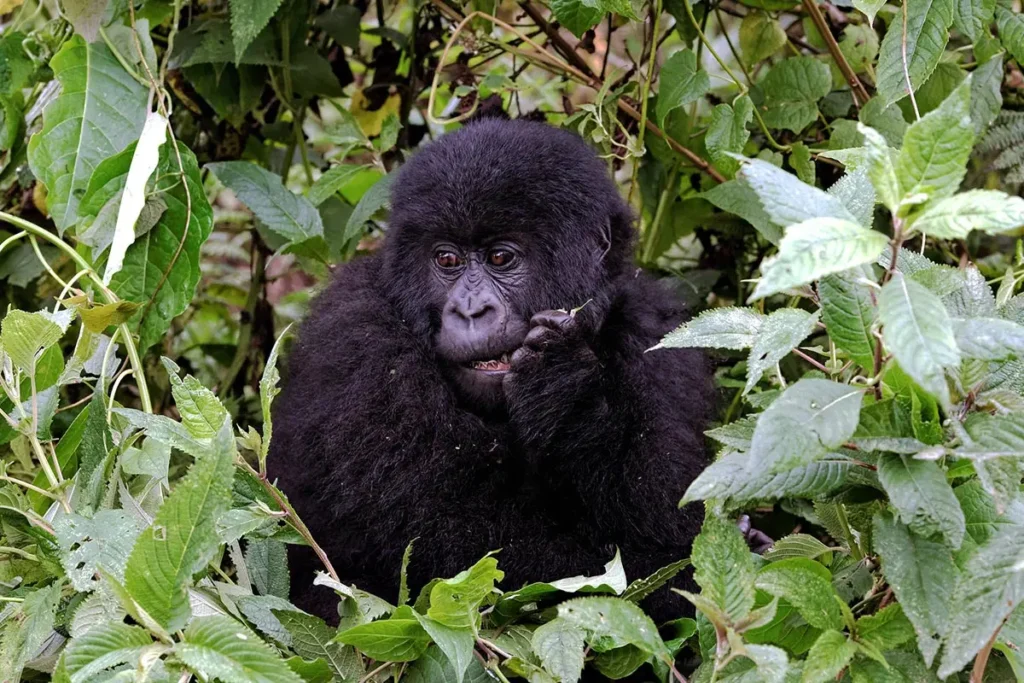
Several habituated families occupy the park, including Susa, Sabinyo, Umubano, Amahoro, Agashya and others. Each trek is unique — sometimes a gentle walk through bamboo, sometimes a steep hike through dense undergrowth. When the moment arrives and the first gorilla face appears from leaves, the forest holds its breath. One hour passes like seconds.
Golden Monkeys
Vibrant, playful and endemic to the Virunga Massif, golden monkeys bring speed and color to the bamboo canopy. They leap in coordinated motion, feed on fresh shoots, groom socially and respond with curiosity to trekking groups. Their movements provide an energetic complement to the calm, slow rhythm of gorilla behavior.
Other Mammals, Birds & Reptiles
Duikers vanish like ghosts into forest shadow. Hyrax sun on basalt rock. Birds flash emerald and scarlet in early light — Rwenzori Turaco, Paradise Flycatcher, Dusky Turtle Dove, Striped Crake, Scarlet-tufted Sunbird and many more. Reptiles hide beneath moss and bark — skinks, chameleons, tree snakes and rarely-seen vipers. Amphibians breed explosively after rain, their calls echoing through the mist.
Cultural Heritage & Local Communities
The Volcanoes landscape has been home to human societies for centuries — the Twa (hunter-gatherers), Hutu (farmers) and Tutsi (pastoralists). The Batwa, forest-based people, once lived inside the park before conservation boundaries were set. Modern Rwanda now prioritizes community benefit and cultural dignity, ensuring tourism revenue strengthens livelihoods rather than excludes them.
The Iby’Iwacu Cultural Village presents traditional dance, gorilla-mask performance, blacksmithing, pottery, herbal medicine demonstration, story cycles and banana beer brewing. When visitors engage with culture, tourism becomes shared wealth — not just an ecological economy, but a social one.
Conservation Importance & Expansion Strategy
Volcanoes is a powerful conservation success story. Gorilla populations that once hovered at dangerous lows now show steady growth — a result of ranger patrols, veterinary monitoring, community engagement and regulated ecotourism. The current 27% expansion restores degraded farmland back to gorilla habitat — a generational investment.
- Beehive fences and trench lines reduce wildlife-crop conflict.
- Local employment programs turn former poachers into porters, rangers and artisans.
- Veterinary teams track respiratory risks, infant survival and injury responses.
- Revenue sharing funds schools, roads, health centers and water infrastructure.
Research & Monitoring
In 1967 Dian Fossey founded the Karisoke Research Center, changing the course of gorilla conservation forever. Her work revealed gorilla culture — family bonds, play behavior, death rituals, silverback politics — and brought the world’s attention to their vulnerability. Today, Karisoke remains one of Earth’s most advanced primate research facilities.
Ongoing studies track behavior, genetics, vegetation change, disease dynamics and climate impact. Rwanda’s annual Kwita Izina Gorilla Naming Ceremony celebrates newborns with national pride — a cultural tradition merging science and identity like no other.
Tourism Activities
- Gorilla Trekking: 1 hour with a habituated family — life-changing experience.
- Golden Monkey Tracking: Fast-paced, photogenic primate encounter.
- Bisoke Crater Hike: Emerald summit lake in a volcanic bowl.
- Karisimbi 2-Day Climb: High-altitude ascent for peak seekers.
- Dian Fossey & Karisoke Trail: A historical pilgrimage through conservation legacy.
- Forest Walks: Birds, orchids, medicinal plants and bamboo ecology.
- Cultural Experiences: Music, storytelling, craft and community interaction.
Permits & Rules
- Gorilla Permit: ~$1,500 pp
- Golden Monkey: ~$100
- Bisoke Hike: ~$75
- Karisimbi 2-day: ~$400
- Dian Fossey Trail: ~$75
Groups are limited to protect gorillas from stress and respiratory illness. Visitors must maintain distance, speak calmly, avoid strong scents and abstain from trekking if ill. Ethical tourism is the foundation of Gorilla conservation — the rules protect the very beings we come to witness.
Accommodation
Lodges around Musanze and Kinigi range from ultra-luxury volcanic-view villas with private decks and fireplaces to mid-range eco-cottages and community guesthouses. Many properties support conservation through tree planting, school building, clean-water programs and employment for locals.
Safari Extensions
- Volcanoes + Nyungwe Forest: Chimpanzees, canopy walk and 13 primate species.
- Volcanoes + Akagera: Big Five, savannah lions & boat safaris.
- Volcanoes + Bwindi: Two-nation gorilla double-trek.
- Volcanoes + Mgahinga: Golden monkeys across the massif.
What to Pack
- Waterproof trekking boots + gaiters
- Warm layered clothing & gloves
- Raincoat + dry bag for electronics
- Camera + extra batteries
- Electrolytes + energy snacks
- Cash for porters (essential support)
Best Time to Visit
Year-round access — gorilla sightings are consistently strong.
June–September / December–February = Best weather
March–May / October–November = Lush, moody, photogenic atmosphere
Why Volcanoes National Park is Extraordinary
- One of the world’s last mountain gorilla refuges.
- Mist forests, volcano peaks & Afro-alpine worlds in one park.
- A living proof that conservation + community can succeed.
- Birthplace of modern great-ape research — Karisoke legacy.
- Emotionally transformative — travel meets meaning.
Volcanoes National Park is not simply a travel destination — it is a triumph of protection, a sanctuary of life and a future in motion. In its mist, conservation breathes. In its forests, gorillas grow. And in every trekker’s memory, Rwanda’s miracle remains — wild, ancient, tender and unforgettable.