
Mosi-oa-Tunya National Park
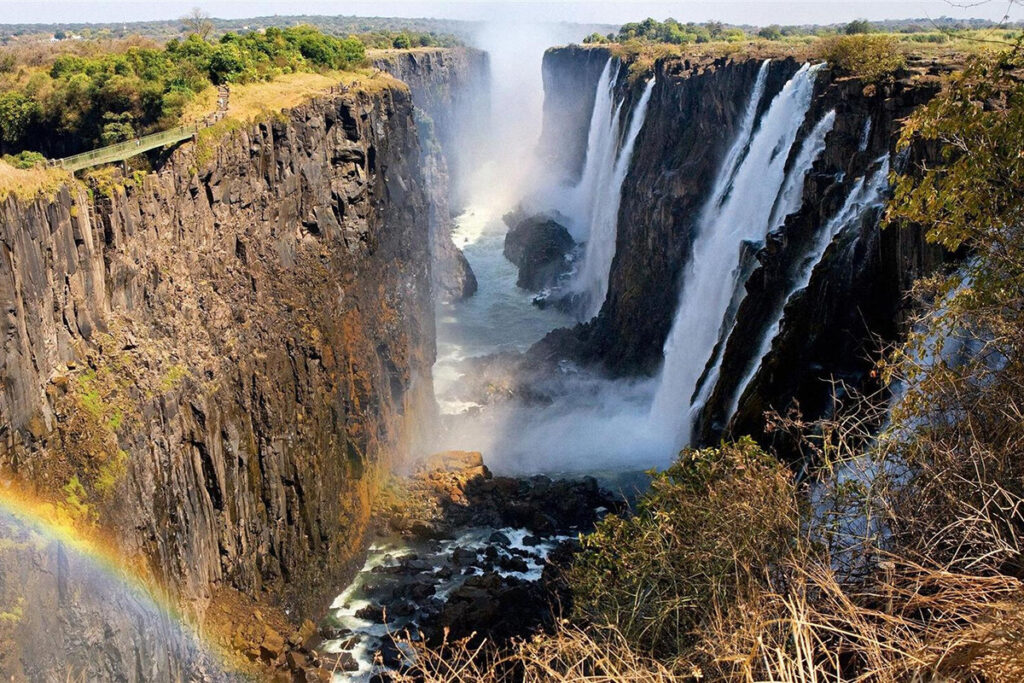
Mosi-oa-Tunya National Park – Victoria Falls, Zambezi River Wilderness, White Rhino Sanctuary and the Legendary “Smoke That Thunders”
Mosi-oa-Tunya National Park is one of Africa’s most spectacular and historically significant protected landscapes. Stretching along the upper Zambezi River in Zambia’s Southern Province and encompassing the Zambian side of Victoria Falls, the park covers approximately 66 km² of rainforest, riverine forest, miombo woodland, mopane woodland, open grassland and dramatic basalt gorges. Its name—Mosi-oa-Tunya, “The Smoke That Thunders”—captures the power, sound and spectacle of Victoria Falls, one of the world’s largest waterfalls and a UNESCO World Heritage Site. Alongside this geological wonder, the park also protects Zambia’s only population of white rhinos, thriving herds of plains game, rare raptors of the Batoka Gorge and important remnants of Zambezi Valley cultural history.
Despite its compact size, Mosi-oa-Tunya offers one of the most varied wildlife and scenic experiences in Southern Africa. Visitors can explore rainforest paths dripping with spray from the falls, walk among rhinos under armed protection, watch elephants crossing the river, drift past hippos on sunset cruises, and scan Black Basalt cliffs for Taita falcons—all within minutes of Livingstone town. This article integrates geology, ecology, hydrology, wildlife, cultural history, conservation management and tourism into a complete guide to this extraordinary park.
Location, Size and Key Setting
The park lies along Zambia’s border with Zimbabwe in the Southern Province and forms part of the greater Victoria Falls World Heritage Site. It consists of two distinct management zones:
- The Falls Section: Rainforest footpaths, Knife-Edge Bridge, gorge viewpoints, Boiling Pot trail, Livingstone Statue and access to Livingstone Island.
- The Wildlife/Game Drive Section: A fenced but natural area upstream, where rhino walks and game drives take place among woodland, riverine forest and grazing lawns.
Mosi-oa-Tunya is Zambia’s most accessible national park, located less than 10 minutes from Livingstone town and just 6 km from Harry Mwanga Nkumbula International Airport. Its position along the Zambezi River gives it rich biodiversity and scenic beauty unmatched for a park of its size.
Geology – Origin, Basalt Plateau and Gorge Formation
Victoria Falls is not just a waterfall—it is a geological process millions of years in the making. The Zambezi River flows over a broad basalt plateau formed by ancient lava flows. Over time, cracks and faults formed across the basalt, creating zones of weakness. The river exploited these fissures, carving the First Gorge. As water eroded backward into the basalt, it abandoned each old gorge and formed a new one upstream. This process created the famous zig-zag chain of gorges extending downstream from today’s falls.
The basalt layers, composed of stacked lava flows, vary in hardness. Softer layers erode faster, causing undercutting and eventual cliff collapse. This cyclical process ensures Victoria Falls is constantly retreating upstream. The falls today drop 108 m into a chasm more than 1.7 km wide, sending spray high into the air and sustaining a rare rainforest ecosystem on the cliff tops opposite the Eastern Cataract.
Downstream, the Batoka Gorge showcases vertical basalt walls, rocky ledges, collapsed blocks and narrow channels. These features form important habitats for cliff-nesting raptors, specialist plants clinging to rock faces and animals adapted to the extreme heat and wind conditions within the gorge.
Climate and Seasonal Patterns
The park experiences a warm subtropical climate with clear seasonal distinctions:
- Rainy Season (Nov–Mar): Hot, humid and lush. The Zambezi swells, increasing spray, feeding the rainforest and creating intense thunderous flow.
- Peak Water (Apr–Jun): The falls reach maximum volume. Knife-Edge Bridge becomes a drenching corridor of mist; rainbows bloom constantly in the spray.
- Dry Season (Jul–Oct): Clear skies, excellent wildlife viewing, reduced river flow revealing more geological structure. Devil’s Pool becomes accessible during very low flow.
The river moderates temperatures near the falls and wildlife section, and mist from the falls cools the surrounding rainforest even in the hottest months.
Hydrology – The Zambezi River’s Power and Ecology
The Zambezi River is the lifeline of Mosi-oa-Tunya National Park. As it flows toward Victoria Falls, the river broadens into braided channels, islands and grassy floodplains that support hippos, crocodiles, elephants, aquatic birds and nutrient-rich grasses. Seasonal floods maintain soil fertility and determine wildlife movement patterns throughout the year.
Upstream, calm channels and riparian forests create habitat for breeding birds, otters, insects and amphibians. After the plunge at the falls, the river becomes a deep torrent through Batoka Gorge, with powerful rapids, whirlpools and boulder-strewn channels. Hydrological studies show that the Zambezi’s seasonal flow patterns have varied significantly with climate cycles, impacting both vegetation and the structure of the falls. Long-term climate projections indicate shifts in rainfall distribution that may affect future flow levels.
Ecosystems and Habitat Diversity
Mosi-oa-Tunya’s ecosystems are surprisingly diverse given the park’s small footprint. They include:
- Spray Rainforest: A rare evergreen forest sustained solely by the mist of the falls, featuring dense undergrowth, moss-covered trunks, ferns and lianas.
- Riverine Forest: Tall trees along the Zambezi—jackalberry, sausage tree, Natal mahogany and figs—providing shade and food for elephants and primates.
- Miombo Woodland: Open woodland dominated by Brachystegia species, home to browsers, birds and smaller carnivores.
- Mopane Woodland: Dry, heat-tolerant mopane stands favored by elephants and impala.
- Grasslands: Open grazing patches supporting zebra, wildebeest and antelope.
- Gorge Habitat: Extreme cliffs and rocky slopes supporting raptors, klipspringers and specialized plants.
Each habitat is shaped by climate, soil, hydrology and the influence of the river. Volcanic basalt enriches soils, while the falls’ spray maintains pockets of evergreen vegetation even in dry months.
Vegetation – From Rainforest Spray Zones to Drought-Hardy Woodlands
The spray zone around Victoria Falls supports trees and plants rarely found in the region’s drier climate. Constant moisture allows evergreen trees to thrive in an otherwise seasonally dry landscape. The rainforest hosts:
- Pod mahogany
- Ebony
- Ivory palm
- Wild date palm
- Waterberry
Heavy mist feeds mosses, ferns, orchids and epiphytes. The soil here remains moist year-round, creating a micro-ecosystem found almost nowhere else in southern Zambia.
Elsewhere in the park, vegetation includes:
- Miombo woodland with Brachystegia species
- Mopane trees in drier areas
- Grass plains near floodplains
- Riverine figs, sausage trees and palms
Down in Batoka Gorge, vegetation is sparse but highly adapted to extreme heat and dryness. Cliff plants cling to basalt faces, anchoring roots in cracks and thriving on the cool microclimates created by shade and nighttime condensation.
Wildlife of Mosi-oa-Tunya National Park
Mammals
The park contains a predator-free wildlife section, making it ideal for relaxed game viewing. Key species include:
- White Rhinos: Zambia’s only population, protected under intensive surveillance.
- Elephants: Regular cross-border movement from Zimbabwe; often seen feeding along the river.
- Giraffes: Frequently found near riverine forest edges.
- Zebra and Wildebeest: Grazing in open plains.
- Buffalo: Small herds using woodland shade.
- Antelope: Waterbuck, bushbuck and impala.
- Hippos and Crocodiles: Along riverbanks and pools.
- Baboons and Vervet Monkeys: Common near forest edges and viewpoints.
Behavioral ecology: Elephants commonly cross through the park during the dry season as they forage between islands and floodplain edges. Rhinos follow predictable patterns, grazing early morning and late afternoon in clearings and resting in shaded thickets near midday. Hippos establish distinct territorial pools, while crocodiles patrol sandbanks and channels.
Birdlife
Mosi-oa-Tunya is an Important Bird Area and one of Africa’s finest raptor viewing sites. Birdlife is abundant around the river, rainforest, woodlands and especially Batoka Gorge.
- Taita falcon – extremely rare and often seen in Batoka Gorge.
- African black swift – nests in large colonies behind the falls.
- Verreaux’s eagle, peregrine falcon, augur buzzard.
- Fish eagles, herons, kingfishers and bee-eaters along the river.
- Trumpeter hornbill and various woodland birds.
- Black storks during seasonal movements.
High cliffs offer ideal nesting ledges for raptors, while the spray forest attracts species adapted to constant moisture and dense canopy cover.
Reptiles, Amphibians and Insects
The Zambezi supports crocodiles, monitor lizards, frogs, toads and a diverse array of aquatic insects. Gorge habitats shelter amphibians that depend on shaded cracks and seepage zones. The river attracts dragonflies, butterflies and seasonal insect swarms that feed birds, fish and reptiles.
Unique Features and Highlights
- Victoria Falls: One of Earth’s great natural spectacles.
- Only White Rhinos in Zambia: Protected by armed scouts.
- Batoka Gorge Raptors: One of Africa’s richest cliff-raptor habitats.
- Old Drift Cemetery: A poignant reminder of early European settlement.
- Knife-Edge Bridge: The closest viewpoint to the main curtain of water.
- Rainforest Microclimate: A moisture-driven forest found nowhere else in Zambia.
Few other protected areas combine geology, wildlife, culture and accessibility so seamlessly.
Cultural and Historical Significance
For centuries, the Tonga people viewed Victoria Falls as a sacred site, home to spirits and ancestral presence. Oral histories describe the falls’ mist as the “breath of the ancestors,” and ceremonies were traditionally held at key points along the river. The river’s islands were used for fishing, rites of passage and seasonal gatherings.
In 1855, Scottish explorer David Livingstone became the first recorded European to view the falls. He landed on what is now Livingstone Island and later named the falls after Queen Victoria. The Old Drift Cemetery, found in the wildlife section, marks the early colonial settlement before the town was moved to healthier ground upstream.
Conservation Importance
Mosi-oa-Tunya National Park protects:
- A critical part of the Victoria Falls World Heritage Site.
- Zambia’s only white rhino population—a crucial regional stronghold.
- Key Zambezi habitats that support elephants, hippos, antelope and rare birds.
- Riverine and spray rainforest ecosystems found nowhere else in Zambia.
- Habitat corridors that may one day link to the larger KAZA (Kavango–Zambezi) Transfrontier Conservation Area.
Its location next to a growing city requires intensive, continuous conservation planning, making it a model for urban–wildlife coexistence.
Threats and Environmental Challenges
- Poaching: Particularly for rhinos and bushmeat species.
- Urban expansion: Encroachment pressures from Livingstone.
- Climate variability: Reduced river flow in drought years impacts the falls’ volume and vegetation productivity.
- Tourism pressure: Wear on rainforest paths and cliff edges at high visitation periods.
- Wildfire: Accidental burns occasionally threaten woodland habitats.
Anti-poaching patrols, rhino monitoring, community engagement and heavy ranger presence at boundaries help reduce threats. Sustainable tourism guidelines, boardwalk maintenance and vegetation rehabilitation protect the falls’ sensitive rainforest.
Research and Monitoring
Scientific studies focus on:
- Rhino population health, genetics and security.
- Hydrological monitoring of Zambezi water levels and climate trends.
- Raptor breeding studies in Batoka Gorge.
- Vegetation response to drought cycles.
- Visitor-impact studies around the falls.
Long-term research partnerships assist Zambia’s Department of National Parks and Wildlife in managing both the natural and cultural values of this World Heritage landscape.
Tourism Activities
- Victoria Falls Viewing: Knife-Edge Bridge, Eastern Cataract viewpoints, Livingstone Statue, Boiling Pot trail and seasonal Livingstone Island access.
- Game Drives: Easy wildlife viewing of zebra, giraffe, antelope, buffalo and elephants.
- White Rhino Tracking: Guided foot-walks with armed scouts offering close but safe encounters.
- Zambezi River Cruises: Popular sunset and birding cruises.
- Gorge Walks: Trails descending into the Batoka Gorge to view rapids and raptors.
- Cultural Heritage Walks: Old Drift Cemetery and historical plaques.
Because everything lies within minutes of Livingstone, it is easy to combine multiple activities in a single day.
Access to the Park
- By Air: Harry Mwanga Nkumbula International Airport is 10–15 minutes from the park.
- By Road: Good roads connect Livingstone with Lusaka (6–7 hours) and Botswana/Zimbabwe borders.
- Cross-Border: Victoria Falls Bridge links Livingstone with Victoria Falls Town in Zimbabwe.
Permits and Park Rules
- Separate fees apply to the falls and wildlife sections.
- Rhino tracking must be conducted with authorized guides.
- Stay on designated walkways near the falls.
- No feeding or disturbing wildlife.
- Respect all cultural monuments and historical sites.
Accommodation Options
- Riverside Lodges: Luxury safari-style properties along the Zambezi.
- Tented Camps: Stylish mid-range camps close to the falls or river.
- Hotels and Guesthouses: A wide selection within Livingstone town.
Visitors can choose accommodations directly on the Zambezi or stay in town with quick access to gate entrances.
Best Time to Visit
- April–June: Most dramatic waterfall views; lush vegetation.
- July–October: Excellent wildlife viewing; clear skies; lower water for certain activities.
- November–March: Rainy season birding and green scenery but more humidity.
Each season offers unique photographic and wildlife opportunities, making the park a rewarding year-round destination.
Why Mosi-oa-Tunya National Park Is Unique
Mosi-oa-Tunya is unlike any other park in Africa. It brings together the natural phenomenon of Victoria Falls, the tranquility of the upper Zambezi, woodland wildlife viewing, cliff ecosystems, significant cultural history and Zambia’s only rhino sanctuary—all within a compact, easily accessible landscape. The park’s combination of geological marvel, ecological diversity and cultural depth makes it a jewel of the Zambezi Valley and one of Southern Africa’s most compelling destinations.
Whether marveling at the “Smoke that Thunders,” walking among protected rhinos, cruising past hippos or exploring basalt gorges rich in birdlife, visitors encounter a world where water, rock, wildlife and history meet in unforgettable harmony.