
Bouhedma National Park
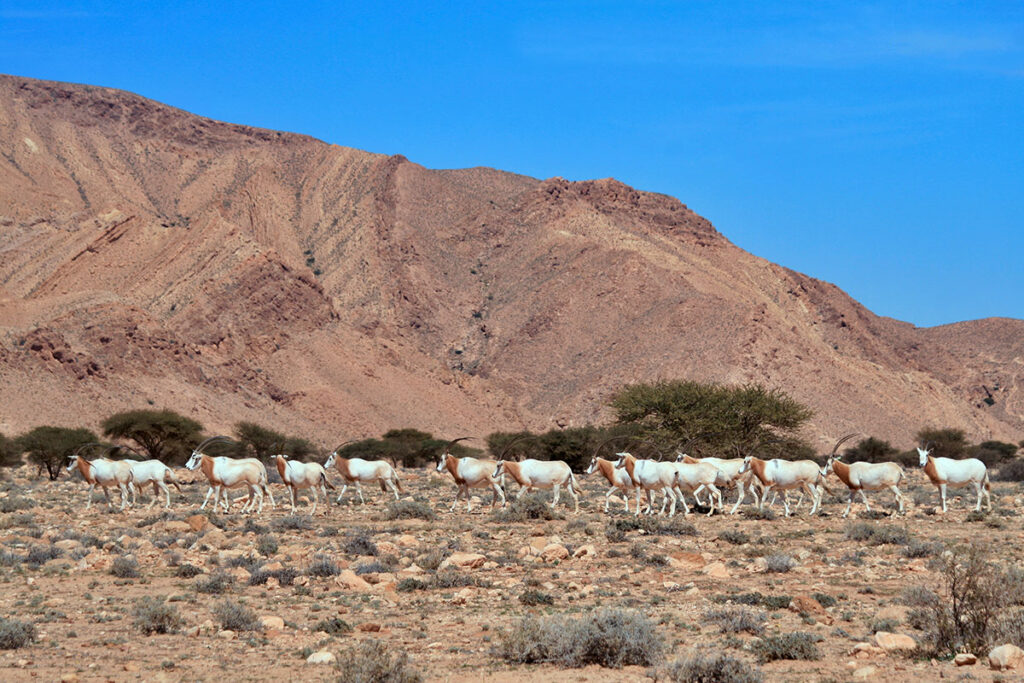
Bouhedma National Park – Tunisia’s Last Sahelian Wilderness and a Stronghold for Endangered North African Wildlife
Bouhedma National Park, located in central Tunisia between Gafsa and Sidi Bouzid, is one of North Africa’s most ecologically important protected areas and a critical sanctuary for endangered Sahelian and Saharan wildlife. Established in 1980, the park preserves one of the last surviving stretches of the Acacia-Argania savanna, an ecosystem that once covered vast portions of the Maghreb but has nearly vanished due to agriculture, overgrazing, and desertification.
Today, Bouhedma stands as an irreplaceable refuge for species such as the scimitar-horned oryx, addax, dama gazelle, and Barbary sheep. It offers an untouched wilderness experience for travelers seeking authentic nature, conservation, and quiet desert beauty.
Bouhedma forms part of the UNESCO Mediterranean Biosphere Reserve Network, recognized globally for its exceptional biodiversity and cultural heritage. Its landscapes blend semi-desert grasslands, rocky mountain ridges, biological corridors, and ancient archaeological sites, making it one of Tunisia’s most remarkable natural environments.
Overview and Location
Covering approximately 16,448 hectares, Bouhedma National Park lies around 85 km southeast of Gafsa and 50 km west of Sidi Bouzid. Positioned between Tunisia’s Mediterranean north and the Sahara Desert to the south, it sits at a unique ecological transition zone. This gives the park a rich mix of steppe, savanna, and rocky semi-arid habitats.
The park protects one of the last functional examples of North African savanna dominated by Acacia tortilis. Once widespread from Morocco to Libya, this ecosystem now survives in significant form only within Bouhedma, making the park a critical area for scientific study and conservation.
Landscape, Ecosystems, and Climate
Bouhedma’s landscapes include sweeping grasslands, acacia-dotted plains, rocky plateaus, and the rugged slopes of Djebel Bouhedma, which rises to about 800 meters above sea level. This elevation range creates microhabitats that support a variety of plant and animal species adapted to dry, semi-arid conditions.
Flora and Ecological Significance
The park’s signature species, Acacia tortilis, forms the backbone of the savanna ecosystem. These trees stabilize fragile soils, enrich the ground with nitrogen, and provide essential shade for wildlife during extreme summer heat. Their deep taproots allow them to access groundwater far below the surface, enabling them to remain green even during long drought periods.
Bouhedma’s grasslands—dominated by Stipa tenacissima, Artemisia herba-alba, Euphorbia, and Atriplex shrubs—are important grazing zones for endangered antelope. After rare rainfall events, these grasses germinate quickly, producing short bursts of high-quality forage critical for herbivore survival.
The combination of savanna, steppe, and rocky shrubland makes Bouhedma one of the most botanically diverse semi-arid landscapes in North Africa, supporting pollinators, birds, reptiles, and mammals uniquely adapted to harsh environments.
Climate
Bouhedma experiences a semi-arid climate, characterized by very hot, dry summers and mild winters with limited rainfall. Annual precipitation ranges between 150 and 300 mm. Despite low rainfall, the park’s vegetation survives through drought-resistant species and careful management of natural water sources.
History and Conservation Importance
Bouhedma National Park was established to combat habitat loss and the decline of native wildlife caused by overgrazing and climate pressures. Since its creation, it has become one of Tunisia’s most successful wildlife reintroduction sites.
Reintroduced and Protected Species
The park safeguards several critically endangered species, including the scimitar-horned oryx, addax, dama gazelle, and Barbary sheep. Many of these species were once extinct or nearly extinct in the wild.
Current estimated population ranges include:
- Scimitar-horned oryx: 80–150 individuals
- Addax: 20–40 individuals
- Dama gazelle: 10–20 individuals
- Barbary sheep: several hundred
These numbers highlight the park’s vital role in preserving North Africa’s endangered desert fauna.
Wildlife Behavior and Ecology
The scimitar-horned oryx can tolerate internal body temperatures much higher than most mammals. This allows it to conserve water by reducing sweating, a key adaptation for desert survival.
The addax, often called the “Saharan ghost,” is among the world’s most desert-adapted antelopes. It can survive months without drinking, obtaining moisture from dew and desert vegetation. Its pale coat reflects sunlight and minimizes heat absorption.
The dama gazelle prefers open plains, where its long legs and slender build help it reach leaves that other herbivores cannot. It is most active during dawn and dusk when temperatures are lowest.
Predators and Other Wildlife
Bouhedma is home to several predator species, including the caracal, Rüppell’s fox, and the occasionally sighted striped hyena. These predators help maintain ecological balance by controlling rodent and herbivore populations.
Other mammals include the fennec fox, golden jackal, wild cat, cape hare, and various desert rodents and reptiles.
Birdlife
Bouhedma is a rewarding destination for birdwatchers, with species such as Bonelli’s eagle, Egyptian vulture, Barbary partridge, desert larks, kestrels, and hoopoes commonly seen. Bird migration peaks in spring and autumn.
Archaeological and Cultural Heritage
Bouhedma contains numerous tumuli, or prehistoric burial mounds, built by early nomadic cultures thousands of years ago. Many remain unexcavated and offer significant potential for future archaeological study.
Roman-era remains, including stone foundations, pottery, and ancient irrigation traces, reveal that the region once supported agricultural settlements during wetter climatic periods. These ruins demonstrate how ancient communities adapted to and thrived in this landscape.
Prehistoric stone tools scattered across the park provide evidence of human occupation dating back to the Stone Age, giving Bouhedma a unique blend of natural and cultural heritage.
Top Activities and Things to Do
1. Wildlife Viewing and Photography
Bouhedma is ideal for observing rare antelope species, especially during early mornings when temperatures are low and animals are most active. The months of March to May and September to November offer excellent visibility and comfortable conditions.
2. Guided Safari Tours
Ranger-led tours offer the best chance of spotting rare species such as the addax and dama gazelle. Guides also provide valuable insight into the park’s conservation programs and wildlife behavior.
3. Hiking and Nature Walks
Trails across Djebel Bouhedma offer sweeping views of the savanna, rocky slopes, and wildlife habitats. Hiking is most enjoyable during the cooler months.
4. Birdwatching
The park’s acacia groves, open plains, and rocky ridges make it a prime birdwatching destination, particularly during migration seasons.
5. Archaeological Exploration
Visitors can explore tumuli burial mounds, Roman remnants, and Stone Age artifacts, enriching their understanding of Tunisia’s ancient history.
Visitor Information, Permits, and Regulations
Bouhedma is a sensitive protected area, and strict regulations ensure the safety of wildlife and visitors. Entry permits are required and can be obtained at the park gate. Off-road driving is prohibited as it damages fragile vegetation and disturbs wildlife.
Drones are strictly forbidden without government authorization, as they can cause stress to antelopes and nesting raptors. Flash photography near wildlife is discouraged, and visitors must maintain a respectful distance from all animals.
The park is open daily from 8:00 AM to 6:00 PM. During breeding seasons, certain areas may be restricted to minimize disturbances.
Accommodation and Tourism Infrastructure
There is no permanent accommodation inside Bouhedma National Park. Visitors typically stay in Gafsa or Sidi Bouzid, where hotels, guesthouses, and inns are available.
Inside the park, facilities include ranger stations, shaded picnic sites, and marked trails. Visitors must bring their own food, water, and supplies, as there are no shops or restaurants within the park. Fuel, groceries, and services are available only in the towns outside Bouhedma.
Road conditions vary throughout the year. During rainy periods, internal tracks may become muddy or inaccessible, making a high-clearance vehicle advisable.
Best Time to Visit Bouhedma National Park
The best months to visit are October to April, when weather conditions are mild and wildlife activity is high. Summer visits (June–August) are possible but require careful planning due to extreme heat.
How to Get There
Bouhedma is accessible by road from nearby cities:
- Gafsa: 85 km
- Sidi Bouzid: 50 km
- Tunis: approx. 300 km
Most travelers arrive by private vehicle or organized eco-tour. Internal tracks are suitable for regular vehicles in dry seasons.
Conservation Challenges and Ongoing Efforts
Bouhedma faces several conservation challenges, including illegal grazing from neighboring communities, climate-driven water shortages, and habitat degradation. Poaching, while reduced, still poses a threat to vulnerable species.
Park authorities and conservation partners work to address these issues through anti-poaching patrols, habitat restoration, erosion control, water management projects, and community education programs. These efforts have allowed several endangered species to recover and reproduce within the park.
Practical Travel Tips
- Carry plenty of drinking water, especially during warmer months.
- Wear breathable clothing, hats, and sun protection.
- Bring binoculars for wildlife and birdwatching.
- Use a high-clearance vehicle during or after rainy periods.
- Early mornings offer ideal conditions for photography and wildlife sightings.
Why Visit Bouhedma National Park?
Bouhedma National Park offers an unforgettable wilderness experience where endangered wildlife, ancient history, and dramatic scenery come together. It is one of Tunisia’s most important conservation areas and a must-visit destination for travelers passionate about nature, wildlife, and desert landscapes.
Conclusion
Bouhedma National Park stands as a vital refuge for North Africa’s rarest wildlife and one of the last protected examples of the Sahelian savanna ecosystem. With its endangered antelope species, rich archaeological sites, dramatic mountain scenery, and essential conservation programs, the park remains one of Tunisia’s greatest natural treasures and an inspiring destination for eco-conscious travelers.