
Chambi National Park
Chambi National Park – Tunisia’s Highest Peak, Mountain Biodiversity Haven, and a Stronghold for the Endangered Barbary Sheep
Chambi National Park, located in western Tunisia near the Algerian border, is one of North Africa’s most ecologically and geographically important protected areas. Established in 1980 and covering over 6,700 hectares, the park is home to Jebel Chambi—Tunisia’s tallest mountain at 1,544 meters. Its rugged mountain landscapes, Mediterranean forests, steep limestone cliffs, and rare steppe vegetation make it a biodiversity hotspot. The park is especially renowned as one of the last safe refuges for the Barbary sheep (Ammotragus lervia), a species that has vanished from many parts of the Maghreb due to habitat loss and hunting.
Set within the Tunisian Dorsal Mountain Range, Chambi National Park represents a vital ecological corridor between the Mediterranean coastline and the semi-arid regions of central Tunisia. Its diverse habitats support rare wildlife, stabilize soils, store carbon, regulate water flow, and protect culturally significant landscapes shaped by centuries of Berber and Roman influence. For hikers, naturalists, and conservationists, Chambi is one of Tunisia’s most rewarding wilderness destinations.
Location, Terrain, and Scenic Landscape
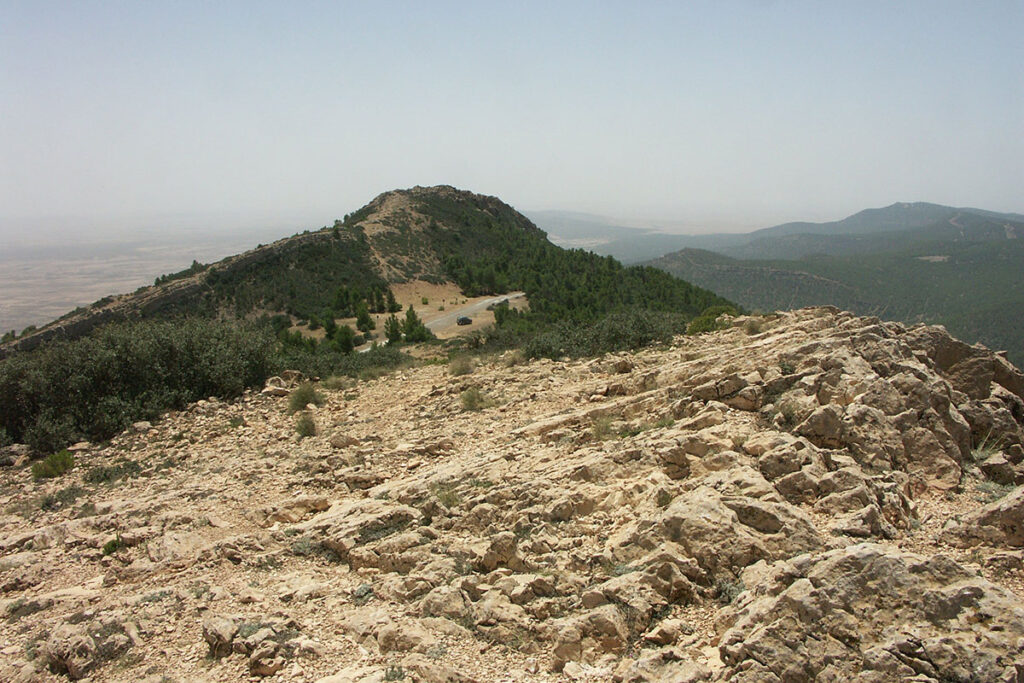
The park lies within the Kasserine Governorate, only 7 km from the city of Kasserine and not far from the Tunisian–Algerian border. Sitting at the intersection of the Atlas Mountains and the Mediterranean climatic zone, Chambi features dramatic terrain that includes limestone massifs, sharp ridgelines, eroded sandstone cliffs, rocky gorges, terraced slopes, and lush mountain valleys. These features give the park some of the most spectacular alpine landscapes in Tunisia.
From the summit of Jebel Chambi, visitors can enjoy sweeping views across western Tunisia, the Kasserine plain, and the distant mountains of Algeria. The park’s rugged topography also creates natural wildlife refuges—steep rock faces, cliffs, and secluded valleys that offer critical security and feeding grounds for mountain ungulates and birds of prey.
Geology and Natural Formation
The geology of Chambi National Park reflects millions of years of tectonic uplift along the Atlas Mountain belt. The region is dominated by Jurassic limestone and Cretaceous sandstone formations shaped by erosion, frost action, and ancient watercourses. Karst features—such as caves, fissures, and underground drainage systems—are common throughout the park.
These geological traits create a mosaic of microhabitats. Limestone cliffs support nesting raptors, while weathered sandstone slopes shelter aromatic shrubs and drought-resistant plants. Fossil traces found in certain rock layers reveal that much of Chambi was once submerged under ancient seas, emphasizing its deep geologic history.
Climate and Ecological Zones
Chambi National Park experiences a semi-arid Mediterranean climate, with hot, dry summers and cool winters. Higher elevations receive significantly more precipitation compared to surrounding lowlands, often including occasional snowfall. This elevation-driven climate gradient results in distinct ecological zones:
- Montane forests rich in pines and evergreen oaks
- Mid-altitude shrublands with aromatic herbs, junipers, and wild olive
- Semi-arid steppe vegetation at lower elevations
These ecological variations create ideal conditions for species diversity, making Chambi a natural laboratory for studying climate adaptation in Mediterranean and North African ecosystems.
Flora of Chambi National Park
Chambi supports a remarkable variety of plant life for a semi-arid region. Its forests and slopes are covered with:
- Aleppo pine (Pinus halepensis) – the dominant forest species
- Holm oak (Quercus ilex) – forming dense evergreen stands
- Juniper (Juniperus oxycedrus) – common at higher elevations
- Pistacia terebinthus – a key component of Mediterranean woodlands
- Wild olive trees
- Mountain herbs – thyme, rosemary, sage, lavender, and wild mint
The combination of forest cover and shrubland vegetation not only supports wildlife but also plays a crucial role in water retention, soil stabilization, and preventing erosion in an area highly vulnerable to desertification.
Wildlife in Chambi National Park
Chambi National Park is one of Tunisia’s most important wildlife refuges. Its rocky cliffs, forested valleys, and mountain slopes support species that have disappeared from much of the country.
1. Mammals
The park’s most iconic species is the Barbary sheep, also known as the aoudad. Classified as Vulnerable by the IUCN, this mountain-dwelling ungulate thrives among steep cliffs and rugged terrain. Chambi is one of its last significant strongholds in Tunisia.
Other mammals include:
- Striped hyena – a secretive nocturnal predator
- Red fox
- Genet
- Wild boar
- Hedgehog species
- Various rodents and shrews
2. Birds
With its cliffs, forests, and open slopes, Chambi National Park is a major raptor habitat and migration rest stop. Notable species include:
- Golden eagle
- Bonelli’s eagle
- Eurasian eagle-owl
- Long-legged buzzard
- Barbary partridge
- Woodpeckers and forest passerines
The cliffs around Jebel Chambi provide ideal nesting platforms for eagles and owls, while forest habitats support smaller woodland species.
3. Reptiles and Amphibians
Chambi hosts a variety of reptiles such as lizards, tortoises, and snakes adapted to Mediterranean and semi-arid climates. Seasonal pools and mountain springs provide breeding sites for amphibians during wetter months.
Cultural and Historical Heritage
The Chambi region has a long history of human occupation. Ancient Berber tribes shaped much of the cultural landscape, while Roman ruins found near Kasserine—including fortifications, military roads, and settlement remnants—highlight the area’s historical significance as a strategic passage between North African territories.
Traditional pastoralism still exists in surrounding communities, preserving cultural knowledge about mountain ecology, grazing practices, and herbal medicine.
Park Governance and Conservation Management
Chambi National Park is managed by Tunisia’s Direction Générale des Forêts (DGF), which oversees ecosystem protection, wildfire management, reforestation, and wildlife monitoring. Key conservation efforts include:
- Barbary sheep population monitoring
- Anti-poaching patrols and ranger presence
- Rehabilitation of degraded slopes
- Fire prevention programs
- Community partnerships for sustainable grazing
The park collaborates with local and international organizations to study climate change impacts, habitat fragmentation, and species conservation.
Recreation, Hiking Trails, and Visitor Experience
Chambi National Park is one of Tunisia’s top mountain hiking destinations. Its trails vary from easy forest walks to more challenging alpine climbs.
- Jebel Chambi Summit Trail – the park’s main attraction, offering panoramic views
- Forest Circuit Trail – a gentle loop suitable for families and birdwatchers
- Cliff Ridge Adventure Route – ideal for experienced hikers seeking rugged terrain
Visitors can enjoy wildlife observation, photography, birdwatching, forest walks, aromatic herb identification, and visits to scenic viewpoints. Ranger stations, picnic sites, and basic signage assist visitors, though a local guide is recommended for safety and interpretation.
Accessibility, Transport, and Entry Requirements
The park is easily accessible from Kasserine city, with travel times of:
- 4 hours from Tunis
- 3 hours from Sousse
- 2 hours from Sfax
Access roads are generally in good condition, but mountainous terrain requires caution. Entry fees are modest and contribute to conservation activities. Special permits may be required for research or restricted areas.
Ecotourism Benefits and Community Impact
Chambi National Park provides local employment for guides, rangers, craft producers, and tourism workers. Community-based conservation programs promote sustainable forest use, grazing management, and fire prevention. Ecotourism revenue helps support nearby villages while reducing pressure on the park’s natural resources.
Threats and Conservation Challenges
Despite its importance, Chambi faces several ecological threats:
- Illegal hunting and poaching, especially targeting Barbary sheep
- Forest fires during dry summer months
- Overgrazing in buffer zones
- Climate change causing increased drought and vegetation stress
- Habitat fragmentation from agriculture
Effective conservation is critical to ensure the survival of sensitive mountain species and preserve Tunisia’s montane ecosystems.
Ecosystem Services and Environmental Importance
Chambi National Park delivers essential natural services, including:
- Water catchment and aquifer recharge
- Soil stabilization on erosion-prone slopes
- Carbon sequestration through forests
- Biodiversity conservation for rare species
- Climate regulation for surrounding communities
Best Time to Visit
The most pleasant seasons for visiting Chambi are spring (March–May) and autumn (September–November), when temperatures are mild, wildlife is active, and flowers bloom across the mountains. Winter offers fresh mountain air and occasional snow, while summer can be hot in lower areas but pleasant at higher elevations.
Why Visit Chambi National Park?
Visitors choose Chambi National Park for its breathtaking mountain scenery, diverse wildlife, challenging trekking routes, and its role as Tunisia’s highest point. The park’s unique blend of Mediterranean forests, Atlas Mountain geology, and rare species like the Barbary sheep make it a top destination for nature lovers, photographers, hikers, and conservation enthusiasts.
Conclusion
Chambi National Park stands as a crown jewel of Tunisia’s natural heritage—a place where mountain ecosystems flourish, rare wildlife survives, and traditional cultures coexist with dramatic alpine landscapes. As environmental pressures increase across North Africa, Chambi’s protected status is more important than ever, ensuring that future generations can continue to explore, appreciate, and learn from Tunisia’s highest and most biologically significant mountain sanctuary.