
Comoé National Park
Comoé National Park – West Africa’s Largest National Park and the World’s Most Biodiverse Savanna Ecosystem
Comoé National Park, in northeastern Côte d’Ivoire, is one of Africa’s most remarkable protected areas and a UNESCO World Heritage Site and Biosphere Reserve. Covering around 11,500 km², it is West Africa’s largest national park and protects what scientists describe as the most biodiverse savanna ecosystem in the world, thanks to an exceptional transition from dry Sudanian savanna in the north to more humid Guinean forest in the south.
Named after the Comoé River, which flows for more than 200 km through the park, this vast wilderness shelters over 1,200 plant species, about 160 mammal species, more than 500 bird species, at least 71 reptiles, 35 amphibians, and 60+ fish species—an extraordinary level of biodiversity for a savanna landscape.
Overview, Location, and Conservation Status
Comoé National Park lies in the country’s remote northeast, bordering Burkina Faso, in a region shaped by gently undulating plains, rocky inselbergs up to 600 m, and an intricate network of rivers and seasonal streams. Established as a protected area in 1968 and inscribed as a World Heritage Site in 1983, the park was later also recognized as a UNESCO Biosphere Reserve because of its exceptional ecological gradients and intact savanna–forest mosaic.
Civil unrest and poaching led to Comoé being placed on the UNESCO “List of World Heritage in Danger” in 2003. Following years of intensive protection, anti-poaching, and ecological monitoring, wildlife populations began to recover, and in 2017 the park was officially removed from the Danger List as elephants, chimpanzees, and other flagship species were confirmed to be reproducing again. This recovery story is now one of Africa’s most encouraging conservation turnarounds.
Landscape, Ecosystems, and Hydrology
The defining feature of Comoé National Park is the Comoé River itself. Flowing year-round through the park, it creates broad floodplains, oxbow pools, sandbanks, and lush riverine forests. Numerous tributaries and streams—along with a scattering of permanent and seasonal ponds—support aquatic life and provide critical dry-season water sources for wildlife.
From north to south, the park transitions through several major habitat types:
- Sudano-Guinean savanna with tall grasses and scattered trees.
- Open and wooded savannas dominated by Combretum, shea, and Terminalia species.
- Gallery and riverine forests lining rivers and streams with evergreen and semi-deciduous trees.
- Seasonal floodplains and wetlands that become prime feeding areas for hippos and waterbirds.
- Rocky plateaus and inselbergs hosting specialized plants and refuges for wildlife.
This blend of dry savannas, woodland, and moist forest patches within a single protected area explains the park’s extraordinary biodiversity and its importance for both West African savanna and forest species.
Flora – The Green Engine of the Park
Botanists have documented over 1,200 vascular plant species in Comoé National Park, making it one of the richest savanna floras in Africa. Typical vegetation includes tall elephant grass, acacia stands, shea trees, and mixed woodland, while the gallery forests feature lianas, palms, and evergreen tree species more typical of tropical rainforest.
During the rainy season, the savannas explode into color as wildflowers, fresh grasses, and herbaceous plants carpet the plains. These flushes of new growth attract large herbivores and support complex food chains involving insects, birds, and predators.
Wildlife of Comoé National Park
Comoé’s wildlife reflects its status as a crossroads between forest and savanna ecosystems. Species typical of both zones coexist here, creating unusual and scientifically valuable communities.
Large Mammals and Rare Antelopes
The park holds around 160 mammal species, including iconic and threatened species. Notable large mammals include:
- African elephant – a vulnerable but recovering population concentrated around the river and forests.
- Hippopotamus – common along the Comoé and major pools.
- African buffalo – grazing herds on floodplains and in savannas.
- Bongo and yellow-backed duiker – forest antelopes near their northern range limit.
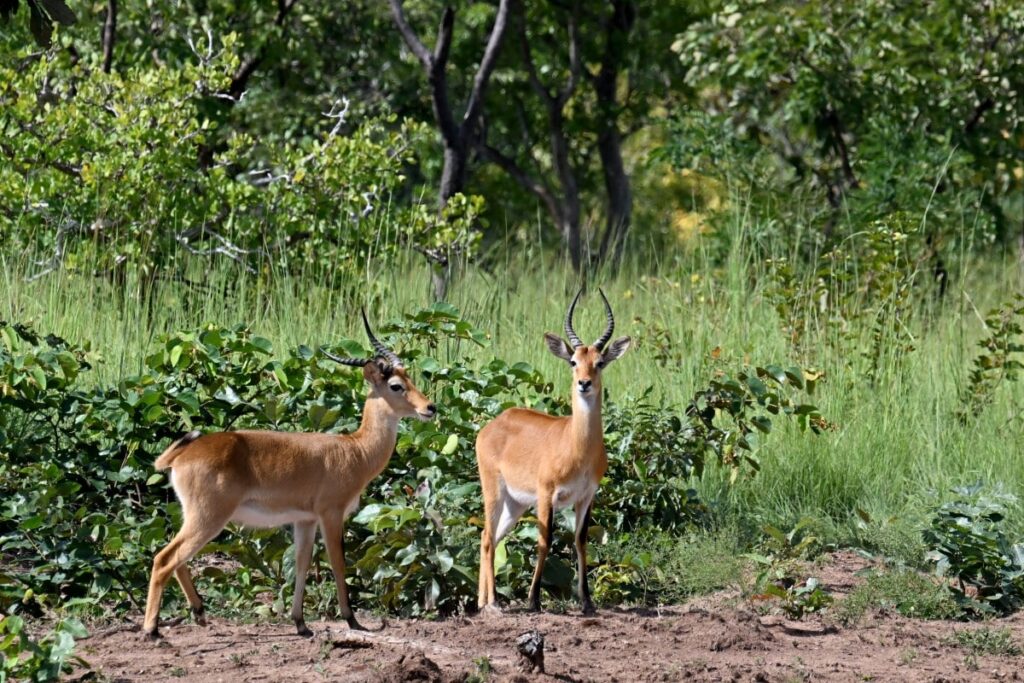
- Roan antelope, kob, Defassa waterbuck, bushbuck, oribi, and red-flanked duiker – widespread in open and wooded savannas.
Predators
Comoé supports at least 17 carnivore species, though some have declined. Current and historically recorded predators include:
- Leopard – still present but elusive, especially in forested and rocky areas.
- Spotted hyena – an important scavenger and hunter in open savannas.
- African golden cat – a rare forest predator.
- Lion and African wild dog – historically present; now considered locally extinct or extremely rare, with occasional unconfirmed reports.
The park’s carnivore community remains a focus of ongoing monitoring and conservation work.
Primates – Including Savanna Chimpanzees
Comoé is exceptionally rich in primates, with at least 11–14 species recorded, including:
- Western chimpanzee (Pan troglodytes verus)
- Olive baboon and patas monkey
- Diana monkey and Mona monkey
- Black-and-white colobus and olive colobus
- White-collared mangabey and other forest-linked species
The Comoé Chimpanzee Conservation Project (CCCP) has revealed a resident chimpanzee population living in a savanna–woodland mosaic east of the Comoé River. These chimpanzees show unique behaviors, including a specialized water-dipping tool culture, where they use brush-tipped sticks to extract water from tree holes—behaviour not documented anywhere else.
Birds – Over 500 Species in a Single Park
Comoé is a premier West African birding destination with more than 500 recorded bird species, including 36 of the 38 Sudan–Guinean savanna “biome-restricted” species found in Côte d’Ivoire. The park has also been designated an Important Bird Area (IBA) by BirdLife International.
Notable species include:
- Denham’s bustard
- Yellow-casqued and brown-cheeked hornbills
- Saddle-billed stork and other West African stork species
- Five vulture species, including white-backed and hooded vultures
- African fish eagle and numerous raptors
Reptiles, Amphibians, and Fish
Comoé’s river systems and wetlands support at least 71 reptile species, 35 amphibian species, and over 60 fish species.
- Three crocodile species – the vulnerable dwarf crocodile, the West African crocodile, and the critically endangered slender-snouted crocodile.
- Nile monitors and several snake species, including pythons and cobras.
- Diverse amphibians thriving in seasonal pools and floodplains.
Research, Monitoring, and the Comoé National Park Research Station
Comoé is one of the best-studied protected areas in West Africa. The Comoé National Park Research Station, established by researchers from the University of Würzburg, provides modern facilities for long-term ecological and behavioral studies.
Research at the station helped confirm that elephants and chimpanzees—once feared extinct in the park—were still present and reproducing. These findings played a key role in demonstrating the park’s conservation value and contributed to its removal from the UNESCO Danger List.
The Comoé Chimpanzee Conservation Project, working with the station and the management authority, has documented previously unknown chimpanzee tool-use behaviors and supports local community training, environmental education, and scientific capacity-building.
Management, Communities, and Conservation Partnerships
Comoé National Park is managed by the Office Ivoirien des Parcs et Réserves (OIPR), Côte d’Ivoire’s national parks agency. OIPR leads anti-poaching patrols, ecological monitoring, and fire management, and increasingly works with local communities around the park to align traditional land use, sacred site protection, and ecotourism opportunities with conservation goals.
Recent initiatives include enhanced aerial surveillance and planned aerial wildlife surveys in collaboration with partners such as Aviation Sans Frontières, designed to monitor large mammal populations and illegal activities across the park’s vast area.
Visitor Experience, Safaris, and Activities
Unlike heavily developed safari destinations in East and Southern Africa, Comoé remains a remote, low-impact wilderness with very limited tourism infrastructure. This offers a rare feeling of true exploration but also means visits need to be carefully planned, usually with specialist operators or research-linked expeditions.
Depending on current security, access, and permissions, potential activities can include:
- Guided game drives through savanna and woodland landscapes.
- Birdwatching along riverbanks, wetlands, and forest edges.
- River observation of hippos, crocodiles, and waterbirds on the Comoé.
- Interpretive walks in designated safe zones near research or management bases.
- Specialist photographic and research trips focusing on elephants, antelopes, primates, and birds.
Because facilities inside the park are minimal, most visitors overnight in basic camps, research accommodations (by arrangement), or simple guesthouses in surrounding towns, making Comoé best suited to adventurous travelers, scientists, and conservation-minded visitors.
Best Time to Visit Comoé National Park
- Dry Season (roughly December–April) – Wildlife concentrations around permanent water sources are highest, visibility is excellent, and access is generally easier.
- Wet Season (May–October) – The park becomes a lush green landscape; bird activity peaks; amphibians and insects are abundant, but some tracks may become difficult or impassable.
For general wildlife viewing, late dry season is usually best; for birdwatching and lush scenery, early to mid-wet season is ideal.
Key Conservation Challenges
Despite its recovery, Comoé still faces several pressures:
- Poaching of antelopes and occasional targeting of elephants.
- Encroachment and grazing by livestock at the park’s periphery.
- Uncontrolled fires set by poachers or herders, altering vegetation patterns.
- Potential future impacts of climate change on river flows and savanna dynamics.
Ongoing monitoring by OIPR, international NGOs, research institutions, and community partners is crucial to maintaining the positive conservation trajectory achieved since the end of civil unrest.
Why Comoé National Park Matters – And Why to Visit
Comoé National Park is much more than a remote wildlife area. It is:
- West Africa’s largest national park and a rare intact savanna–forest mosaic.
- A stronghold for elephants, chimpanzees, bongos, crocodiles, and rare antelopes.
- A global hotspot for savanna chimpanzee research and unique tool-use cultures.
- A living laboratory for understanding biodiversity, climate resilience, and ecosystem restoration.
- A powerful conservation success story, rising from conflict and the World Heritage Danger List to ecological recovery.
Conclusion
For travelers and conservationists seeking one of Africa’s last truly wild, under-visited, and scientifically important landscapes, Comoé National Park is an outstanding choice. Its immense size, extraordinary biodiversity, recovering elephant and chimpanzee populations, and pioneering research projects make it a flagship for West African conservation and an unforgettable destination for those willing to venture off the typical safari trail.