
Kasanka National Park
Kasanka National Park – Zambia’s Lush Wetland Wilderness of Bat Migrations, Rare Sitatunga Antelopes, Swamp Forests, and Spectacular Biodiversity
Kasanka National Park is one of Zambia’s most extraordinary protected areas—an unspoiled wetland sanctuary where pristine swamp forests, shimmering rivers, seasonally flooded grasslands, and miombo woodlands blend seamlessly into one of Africa’s most biologically dynamic ecosystems. Although relatively small at 390 km², Kasanka is globally celebrated for hosting the largest mammal migration on Earth: a breathtaking annual gathering of more than eight million straw-colored fruit bats. This unmatched natural event draws wildlife lovers, filmmakers, and researchers from every corner of the world.
Beyond its bat spectacle, Kasanka is a haven for rare and elusive wildlife such as the sitatunga antelope, blue monkeys, puku, and abundant birdlife. Its tranquil landscapes, intimate wildlife encounters, and pioneering conservation model make it a shining example of how community partnerships and ecological protection can succeed hand in hand. For eco-tourists, photographers, students, and nature enthusiasts, Kasanka offers a uniquely peaceful and enriching safari experience that showcases the wonders of Zambia’s Central Province.
Overview of Kasanka National Park
Kasanka National Park was established in 1972 but came close to collapse in the decades that followed due to poaching, habitat degradation, and lack of funding. Its revival began in the late 1980s when private conservationists partnered with the Zambian government to form the Kasanka Trust—one of Africa’s first long-term public–private conservation initiatives. This collaborative effort transformed Kasanka into a model of sustainable, community-driven conservation.
Today, Kasanka stands as a testament to successful ecological restoration. Wildlife populations have rebounded dramatically, swamp forests have regenerated, and the park has become a world-renowned center for bat ecology, wetland conservation, and low-impact tourism. Visitors enjoy well-maintained hides, carefully designed trails, and responsible safari activities that protect and respect the delicate wetland ecosystems.
Location and Size
Kasanka National Park is located in Zambia’s Central Province, near the border of the Democratic Republic of Congo. It lies within the expansive Bangweulu Basin, one of the most significant wetland complexes in Africa. Its proximity to the Bangweulu Wetlands and Northern Province makes it an ideal destination for travelers combining Kasanka with Shoebill sightings or cultural experiences in surrounding regions.
Though the park spans only 390 km², its ecological importance far exceeds its size. The compact nature of the park allows visitors to explore multiple ecosystems within short distances, maximizing wildlife encounters and showcasing the region’s exceptional biodiversity.
Geography and Geology
The park’s landscape features gentle topography shaped by ancient river systems, peat-rich marshlands, and extensive groundwater-fed forests. Much of the terrain is flat, punctuated by dambos—seasonally flooded grassland depressions typical of Zambia’s central plateau.
- Mushitu swamp forests: Evergreen forests fed by perennial springs and underground water.
- Floodplain grasslands: Highly productive grazing zones during rainy months.
- Miombo woodlands: Dominated by Brachystegia and Julbernardia trees.
- Peat soils and hydric substrates: Supporting moisture-loving flora.
This geological diversity makes Kasanka a vital refuge for species that depend on both dryland and wetland ecosystems, especially rare forest specialists.
Climate
Kasanka experiences a tropical climate with well-defined seasons that shape wildlife behavior and vegetation patterns. The rainy season (November–April) ushers in lush growth, swelling rivers, and a dramatic influx of migratory birds and bats. This is when the park is at its greenest and most vibrant.
The dry season (May–October) brings cooler temperatures, clearer skies, and excellent visibility for wildlife safaris. Water levels recede, drawing animals toward permanent water sources such as Lake Wasa and the Luwombwa River. For walking safaris, canoe trips, and general wildlife viewing, this season provides the perfect conditions.
Hydrology and Rivers
Kasanka’s entire ecosystem revolves around water. The park is fed by an intricate network of rivers, lakes, marshlands, and swamps that support some of the richest biodiversity in Zambia. These wetlands are vital not only for wildlife but also for surrounding human communities that depend on them for fisheries, agriculture, and groundwater recharge.
- Luwombwa River: The lifeline of the park, ideal for canoe excursions and full of aquatic life.
- Lake Wasa: A scenic freshwater lake surrounded by grasslands and woodlands.
- Meteor Pools: Crystal-clear spring pools hidden within swamp forests.
- Mshitu and Fibwe swamps: Prime sitatunga habitats rich in birdlife.
These water bodies play a crucial role in regional hydrological cycles and support the unique Mushitu swamp forests found only in select parts of Zambia.
Ecosystems and Habitats
Kasanka’s habitats form a diverse mosaic of interconnected ecosystems, each contributing to the park’s exceptional biodiversity. The wetlands and Mushitu forests are especially important as they are rare in this part of Africa and support species not commonly seen elsewhere.
- Mushitu swamp forests: Evergreen habitats crucial for bats, monkeys, and forest specialists.
- Miombo woodlands: Home to elephants, antelopes, and woodland birds.
- Riverine forests: Ideal for otters, bushbucks, and primates.
- Dambo wetlands: Seasonal grasslands attracting grazers and wetland birds.
- Open lakes and marshes: Rich in fish, amphibians, and waterbirds.
Vegetation
Kasanka boasts an impressive variety of vegetation ranging from evergreen swamp forests to tall grasses and woodlands. The Mushitu forests are particularly significant—they are among the last remaining groundwater forests in Zambia and support unique species found nowhere else in the country.
- Mushitu tree species: Ebony, wild date palm, raffia palm, mahogany.
- Miombo species: Brachystegia, Isoberlinia, and Julbernardia.
- Wetland vegetation: Papyrus, reeds, sedges, water lilies.
- Grasslands: Guinea grass, star grass, and marsh herbs.
This botanical diversity provides essential food, nesting sites, and shelter for mammals, birds, amphibians, and insects.
Wildlife of Kasanka National Park
Mammals
Kasanka is home to over 114 mammal species, many of which are adapted to swampy and woodland environments. Although not a traditional “Big Five” park, Kasanka excels in sightings of rare and specialized species.
- Sitatunga: One of Africa’s best populations, often visible at dawn in marshlands.
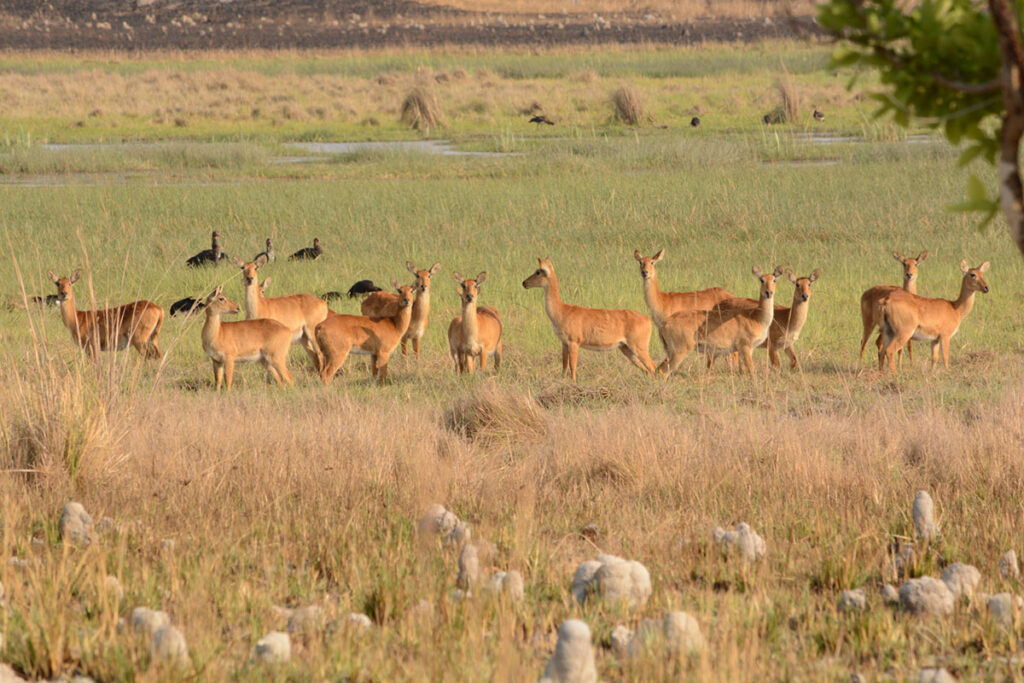
- Puku and reedbuck: Common grazers around dambos and lake edges.
- Blue monkeys and vervet monkeys: Abundant in forested areas.
- Buffalo, bushpigs, warthogs: Frequently sighted across the park.
- Elephants: Occasionally passing through from larger ecosystems.
- Otters: Thriving in rivers and swamp pools.
The Iconic Bat Migration
The straw-colored fruit bat migration is the most famous event in Kasanka—a globally significant wildlife spectacle that takes place every year from late October to December. Between 8 and 10 million bats descend on the Mushitu swamp forests, forming dense colonies that blanket the canopy.
- Largest mammal migration on Earth.
- Bats arrive from hundreds of kilometers away: DRC, Uganda, Tanzania, and beyond.
- Dawn and dusk flights fill the skies with millions of silhouettes.
- Vital ecological role: Bats disperse seeds and pollinate forest plants.
This migration alone makes Kasanka one of the most extraordinary wildlife destinations in Africa.
Birdlife
Kasanka is a premier birdwatching destination with more than 470 recorded species. Its position within the Bangweulu Basin and its diverse habitats attract resident, migratory, and breeding birds.
- Wattled cranes – rare wetland specialists.
- Pels fishing owl – often seen near rivers.
- Ross’s turaco – striking forest-dwelling species.
- Kingfishers, herons, storks, jacanas – abundant in wetlands.
- Böhm’s bee-eater – a colorful miombo woodland native.
Reptiles, Amphibians, and Insects
- Crocodiles and monitor lizards along rivers and lakes.
- Pythons and other snakes in forests and grasslands.
- Frogs and toads that thrive after rains.
- Dragonflies, butterflies, beetles supporting the park’s food chains.
Unique Features of Kasanka National Park
Kasanka’s uniqueness lies in its extraordinary combination of rare forest ecosystems, massive wildlife migrations, and peaceful wetland landscapes. Few parks in Africa can match its diversity within such a small footprint.
- World’s largest mammal migration.
- Rare Mushitu swamp forests.
- Premier sitatunga observation destination.
- Eco-friendly walking and canoe safaris.
- Exclusive, low-impact tourism experience.
Cultural and Indigenous Communities
The park is surrounded by Bemba, Lala, and Bisa communities, whose traditions, agriculture, and fishing practices have shaped local culture for generations. These communities rely on the wetland resources and maintain cultural beliefs tied to rivers, forests, and wildlife.
Community projects run by the Kasanka Trust support:
- Education programs and village schools.
- Healthcare outreach initiatives.
- Sustainable tourism employment.
- Women’s groups and craft cooperatives.
Conservation Importance
Kasanka National Park is a conservation stronghold due to its rare ecosystems, iconic migrations, and biodiversity-rich wetlands. The Kasanka Trust’s work ensures the protection of:
- Mushitu swamp forests – irreplaceable groundwater forests.
- Sitatunga populations – among the best protected in Africa.
- Millions of fruit bats essential for seed dispersal.
- Critical bird habitats including breeding wetlands.
The park’s conservation success has become a model replicated across Zambia and the region.
Threats and Challenges
Kasanka faces several ecological challenges that require ongoing monitoring and community support:
- Encroachment into buffer zones.
- Poaching affecting antelopes and forest species.
- Wetland draining for agriculture in surrounding areas.
- Deforestation threatening swamp forest continuity.
- Climate change impacting rainfall and hydrology.
Research and Monitoring
Kasanka is a scientific hotspot where researchers study wetland ecology, bat behavior, primate populations, and long-term habitat change. Ongoing studies include:
- Bat migration monitoring and roost health.
- Sitatunga population tracking.
- Hydrological mapping of swamps and floodplains.
- Vegetation surveys in Mushitu forests.
- Bird migration and breeding studies.
Tourism Activities
Kasanka offers a variety of low-impact activities tailored to eco-tourists and wildlife enthusiasts. The park’s quiet trails and waterways provide a refreshing alternative to traditional vehicle-based safaris.
- Bat migration viewing from canopy hides and platforms.
- Walking safaris through forests and floodplains.
- Canoeing along the Luwombwa River.
- Birdwatching excursions in multiple habitats.
- Photography tours focusing on bats, sitatunga, and scenery.
Access and Getting There
Reaching Kasanka is straightforward, with options for self-drive and air travel:
- By Road: From Lusaka via Serenje (approx. 5–6 hours).
- By Air: Charter flights to Kasanka’s airstrip.
The final approach passes through rural landscapes rich in culture and natural beauty.
Permits, Fees, and Park Rules
Visitors must comply with DNPW and Kasanka Trust regulations to ensure ecological protection:
- Entry fees payable at the park.
- No disturbing bat colonies or roosts.
- No off-road driving.
- Walking safaris permitted only with guides.
- No littering or damaging vegetation.
Accommodation
Kasanka offers eco-friendly accommodation designed to preserve the park’s natural tranquility:
- Wasa Lodge: Comfortable chalets overlooking Lake Wasa.
- Luwombwa Lodge: Wooden chalets situated along the Luwombwa River.
- Campsites: Rustic, scenic sites for adventurous travelers.
All accommodations prioritize sustainability and harmony with surrounding habitats.
Best Time to Visit
The ideal time to visit Kasanka depends on your interests:
- Bat migration: Late October–mid December.
- Wildlife viewing: June–October (dry season).
- Birdwatching: November–April (wet season with migratory arrivals).
Why Kasanka National Park Is Unique
Kasanka National Park is truly unique—an ecological jewel combining rare swamp forests, diverse ecosystems, peaceful wetlands, and the largest mammal migration on Earth. Its intimate scale, community-driven conservation approach, and unparalleled wildlife experiences set it apart from every other protected area in Zambia.
For travelers seeking authentic wilderness, rare species, and remarkable natural events, Kasanka delivers an unforgettable safari experience defined by beauty, biodiversity, and serenity. It is, quite simply, one of Africa’s most magical and inspiring national parks.