
Nki National Park
Nki National Park – Untouched Congo Basin Rainforest, Forest Elephants, Western Lowland Gorillas and Mineral-Rich Bais in Cameroon’s Wild Southeast
Nki National Park is one of the most remote, untouched and ecologically significant rainforest landscapes in all of Central Africa. Situated in southeastern Cameroon and spanning approximately 3,093 km² of dense primary rainforest, Nki is a sanctuary for forest elephants, western lowland gorillas, chimpanzees, bongos, forest buffalo, sitatunga and hundreds of bird and amphibian species. It is commonly described as one of the last fully intact Congo Basin rainforests in Cameroon, with no permanent human settlement, no major roads, and virtually no modern development inside its boundaries.
Nki forms part of the larger TRIDOM conservation landscape, an immense transboundary forest block linking Cameroon’s Nki and Boumba-Bek National Parks with the Republic of Congo’s Nouabalé-Ndoki National Park and Gabon’s Minkébé National Park. This tri-national corridor is one of the most important ecological strongholds in Africa, offering safe migration routes for elephants and great apes while preserving ancient rainforest systems that have remained stable for thousands of years.
Despite its isolation, Nki is globally renowned for its wildlife-rich bais—natural forest clearings where elephants, buffalo, gorillas and antelope gather to access mineral-rich soils and water. These openings in the forest canopy serve as windows into rainforest life, allowing visitors and researchers to observe species that normally remain hidden in dense vegetation. With its extraordinary biodiversity, pristine habitats and critical conservation role, Nki National Park stands as one of Cameroon’s most celebrated wild spaces.
Location, Size and Geographic Setting
Nki National Park is located in Cameroon’s East Region, near the border with the Republic of Congo. The park lies within a remote part of the Congo Basin, surrounded by vast expanses of forest and flanked by the Boumba-Bek National Park to the west. Together, these forest blocks form a contiguous, undisturbed ecosystem essential for sustaining large mammals and birds that require extensive, unfragmented ranges.
- Country: Cameroon
- Region: East Region
- Total Area: ~3,093 km²
- Ecosystem: Congo Basin lowland rainforest
- Nearest towns: Yokadouma and Moloundou
Nki’s geographic position makes it a critical ecological bridge between Cameroon’s protected areas and the forest reserves of the Republic of Congo. Its isolation, difficult terrain, and lack of infrastructure have helped preserve its ecological integrity, making it one of the least disturbed national parks in Central Africa.
Geology and Landscape Formation
Nki National Park lies atop ancient Precambrian rock formations that have weathered over millions of years to create deep, nutrient-poor soils typical of mature rainforests. This geological stability has allowed dense evergreen forests to flourish, reaching exceptional heights and structural complexity. The park’s landscape features rolling hills, river valleys, swamp forests and open bais—each shaped by a combination of hydrology, soil chemistry and wildlife activity.
- Precambrian bedrock: Forms the ancient geological foundation of the region.
- Lateritic soils: Deeply weathered soils supporting tall hardwood trees.
- Alluvial valleys: Fertile riverbanks rich in sediments.
- Bais: Mineral-rich forest clearings shaped by elephants and groundwater.
These landscapes create habitat complexity necessary for species such as western lowland gorillas, forest elephants, sitatunga and bongos, which depend on distinct vegetation types at different times of the year. Treefall gaps created by storms or elephant activity also contribute to biodiversity by allowing sunlight to reach the forest floor and stimulate new plant growth.
Climate and Seasonal Patterns
Nki National Park lies in an equatorial rainforest climate zone characterized by high humidity, substantial rainfall and relatively stable temperatures throughout the year. The climate supports evergreen vegetation and drives seasonal cycles of fruiting, flowering and animal movement.
- Rainy seasons: March–June and September–November
- Drier periods: December–February and July–August
- Annual rainfall: 1,600–2,000 mm on average
- Temperature: Typically ranges from 20°C to 29°C
Rainfall patterns affect river dynamics, flooding cycles and fruit availability. During heavy rains, amphibians emerge in abundance and bais become flooded, altering wildlife behavior. During dryer months, elephants and buffalo concentrate around mineral clearings, making wildlife observation easier for researchers.
Hydrology – Rivers, Wetlands and the Bai System
The hydrology of Nki National Park is dominated by a network of rivers—most notably the Boumba, Dja and Nki rivers—that drain into the Congo Basin. These waterways are exceptionally clear because they flow over sandy substrates rather than carrying sediment-rich runoff. Numerous tributaries, streams and swamp forests add to the complexity of the park’s wetland ecosystems.
- Boumba River: A major ecological corridor linking wildlife across the region.
- Nki River: Known for its calm reaches and biodiversity-rich riparian zones.
- Swamp forests: Fish nurseries and amphibian-rich ecosystems.
- Mineral bais: Crucial wildlife aggregation points.
Bais are shallow depressions where groundwater rises close to the surface, creating mineral-rich soils that animals seek out for essential nutrients. Repeated elephant visits, digging, wallowing and feeding gradually enlarge these clearings over centuries. As a result, bais in Nki are among the region’s most biologically active sites—offering unparalleled visibility for wildlife observation.
Ecosystems and Habitat Diversity
The park contains one of the most diverse rainforest ecosystems in Cameroon, shaped by variations in moisture, soil type and topography. This diversity allows a wide range of species—each with distinct ecological requirements—to coexist within the same landscape.
- Terra firme rainforest: Tall hardwood forests with dense canopies.
- Riverine forest: Moist habitats dominated by riparian plant species.
- Swamp forest: Waterlogged areas supporting sitatunga and amphibians.
- Seasonally flooded forest: Rich feeding grounds for buffalo and duikers.
- Bais: Forest clearings that host extraordinary wildlife gatherings.
This habitat mosaic supports complex predator-prey relationships, primate communities and seasonal wildlife migrations. It also ensures ecological resilience in the face of climate fluctuations and natural disturbances.
Flora – Botanical Richness of the Nki Rainforest
Nki’s flora is representative of mature Congo Basin rainforest, with high tree diversity, thick understory vegetation and abundant epiphytes. Towering canopy trees create a shaded understory dominated by Marantaceae and Zingiberaceae plants—important resources for gorillas, elephants and duikers.
- Canopy trees: Gilbertiodendron, Entandrophragma, Terminalia.
- Understory plants: Marantaceae leaves used for gorilla nesting and feeding.
- Lianas and vines: Provide habitat and food for primates.
- Epiphytes: Orchids, mosses, lichens and ferns thriving in humid canopy zones.
- Wetland flora: Raffia palms and aquatic plants in swamp forests.
This botanical assemblage creates multiple layers of habitat and supports rich food webs. Many tree species produce fruits at staggered intervals, ensuring that frugivores such as monkeys, hornbills and gorillas have food resources year-round.
Wildlife of Nki National Park
Nki is one of Cameroon’s most significant refuges for large mammals and primates. The park’s remoteness, low human disturbance and intact forest structure provide ideal conditions for species heavily threatened in other regions.
Western Lowland Gorillas
Nki hosts a healthy population of western lowland gorillas, a species critically important to the ecological health of the rainforest. Gorillas feed on fruits, leaves, stems, pith and bark, and rely heavily on Marantaceae vegetation to build nests and forage.
Though not as heavily habituated to human presence as gorillas in nearby Mondika (Republic of Congo), the gorillas of Nki are frequently observed at bais and are monitored through regular research surveys. Their population stability is an encouraging sign for conservation in the TRIDOM landscape.
Forest Elephants
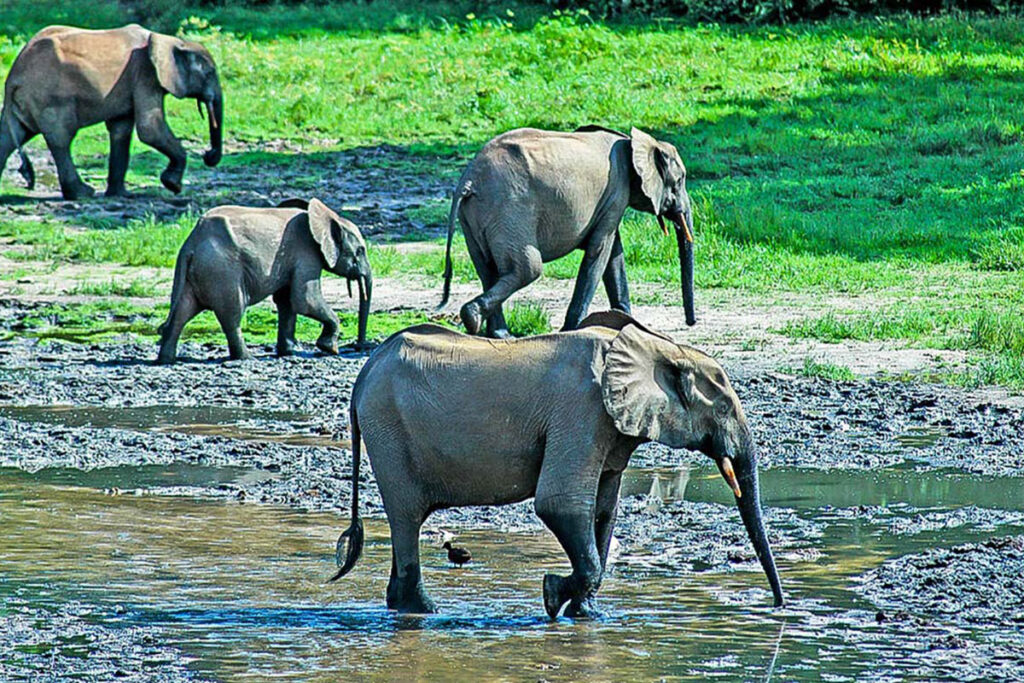
Forest elephants are key ecosystem engineers in Nki National Park. Their movements maintain forest trails, promote seed dispersal and create clearings that increase ecological diversity. Elephants rely on bais for mineral supplementation, often visiting in large family groups.
Their presence helps explain why Nki’s bais are so dynamic—elephants dig pits, enlarge clearings over generations and change soil structure in ways that attract many other animals. Forest elephant conservation here is particularly vital due to severe declines in other parts of Central Africa.
Forest Buffalo, Sitatunga and Bongos
Nki’s bais and swamp forests provide ideal conditions for forest buffalo, sitatunga and bongos. Forest buffalo graze openly in mineral clearings, while sitatunga glide through swamp forests with ease. Bongos, the largest and one of the most striking antelope species in Africa, are elusive but occasionally emerge in clearings or river edges, especially during early morning and late afternoon.
Primates
The park supports exceptional primate diversity. Chimpanzees use forest corridors to travel between feeding sites, while De Brazza’s monkeys patrol riverbanks and mangabeys forage noisily in mid-story trees. Red colobus and black-and-white colobus monkeys add to the forest’s complex primate community.
- Chimpanzees
- Grey-cheeked mangabeys
- Putty-nosed monkeys
- Red colobus monkeys (localized)
- Allen’s swamp monkeys
- De Brazza’s monkeys
- Black-and-white colobus
Mixed-species primate groups are common, particularly along fruiting trees and forest edges.
Birdlife
Nki National Park is a haven for birds, with more than 300 recorded species. Swamp forests, rivers and bais create habitat for waterbirds, while the canopy hosts hornbills, parrots, turacos and forest eagles. Birds are easier to observe around bais due to the open visual space and concentration of insects.
- African grey parrots
- Great blue turacos
- White-crested tiger herons
- Hornbills
- Shining-blue kingfishers
- Forest eagles
Reptiles, Amphibians and Insects
Nki’s hydrological features support reptiles such as dwarf crocodiles, Nile crocodiles, forest cobras, pythons and a variety of lizards. Amphibian diversity is especially high during rainy seasons, with frogs and toads congregating near streams and marshes.
Insect diversity is immense—thousands of species of butterflies, beetles, ants, dragonflies and moths inhabit the rainforest. Many species occupy highly specialized ecological niches found only in intact primary forest.
Unique Features – Bais, Pristine Forest and Congo Basin Wilderness
Nki National Park is best known for its bais—natural forest clearings where animals gather for minerals, water and social interactions. These clearings are essential for wildlife health and provide unparalleled visibility for observing species typically concealed by dense forest cover. Elephant trails radiate from these bais, demonstrating their long-term ecological importance.
The park also contains some of Cameroon’s most pristine primary rainforest, with towering hardwood trees, thick understory vegetation, and deep silence broken only by birds, primates and the movement of large mammals. This level of ecological purity is extremely rare in modern Africa.
- Elephant-dominated bais: Centers of animal activity.
- Unbroken canopy forest: True old-growth rainforest.
- Clear-water rivers: Ideal for canoe exploration and wildlife spotting.
Indigenous Communities and Cultural Heritage
The region surrounding Nki National Park is home to Indigenous communities such as the Baka, Kounabembe and Bakwele peoples. While there are no settlements inside the park, these communities maintain deep cultural ties to the rainforest, relying on traditional knowledge for survival.
The Baka are particularly renowned for their sophisticated ecological understanding—interpreting animal tracks, predicting weather patterns, identifying medicinal plants and constructing forest shelters. Their knowledge plays a vital role in research, conservation and monitoring efforts.
Conservation Importance
Nki National Park is a critical conservation zone for many reasons: it protects endangered species, preserves large-scale ecological processes and serves as an essential refuge for wildlife facing increasing pressure across the Congo Basin. The park’s intact forests store vast amounts of carbon, contributing to global climate regulation. Its location within the TRIDOM landscape ensures essential connectivity for elephants, gorillas and chimpanzees migrating across borders.
- Essential refuge for forest elephants and western lowland gorillas.
- Core part of a tri-national ecological corridor.
- High biodiversity across mammals, birds, reptiles and insects.
- Large carbon sink for global climate stability.
Threats and Environmental Challenges
- Poaching: Historically a major threat, especially for elephants.
- Logging concessions near the park: Pressure on buffer zones.
- Climate change: Potential impacts on rainfall and river cycles.
- Bushmeat hunting: A concern in areas outside the park.
Strong conservation partnerships, anti-poaching patrols and community engagement help reduce these threats, preserving the park’s ecological integrity.
Research and Monitoring Programs
Nki is a valuable center for scientific research due to its pristine condition and unique wildlife. Research teams monitor elephants, great apes and other species while collecting long-term data essential for conservation.
- Forest elephant population monitoring.
- Great ape surveys and nest counts.
- Camera trap studies of predators and nocturnal species.
- Biodiversity inventories across multiple taxa.
Tourism Activities in Nki National Park
Tourism in Nki is minimal but highly rewarding for adventurers seeking untouched wilderness. The park offers raw, immersive rainforest experiences where wildlife encounters feel authentic and intimate.
- Bai viewing: Observe elephants, buffalo and gorillas in open clearings.
- Forest hikes: Guided exploration of pristine rainforest.
- Birdwatching: Outstanding opportunities in riverine and swamp habitats.
- River exploration: Canoeing and wildlife viewing along clear-water rivers.
Access – How to Reach the Park
- By road: Long 4×4 journeys from Yokadouma (seasonal).
- By river: Motorized boat travel along the Boumba or Dja rivers.
- By air: Charter flights to nearby conservation bases.
Due to its remoteness, Nki is best visited during drier months when routes are more accessible.
Permits and Regulations
- Park entry permits required from Cameroon’s Ministry of Forests and Wildlife.
- Research permits mandatory for scientific studies.
- No off-trail walking without professional guides.
- Strict wildlife viewing distance rules apply.
Accommodation Options
- Research camps: Basic accommodation for scientists and conservationists.
- Tented expedition camps: Used by specialized tour groups.
- Forest shelters: Simple structures for extended field stays.
Best Time to Visit Nki National Park
- December–February: Best wildlife viewing around bais.
- June–September: Good access and comfortable conditions.
- March–May & September–November: Rainy seasons with lush vegetation.
Why Nki National Park Is Unique
Nki National Park is one of Africa’s last truly wild places—a vast rainforest ecosystem untouched by modern development and alive with secretive species that depend on intact forest. Its mineral-rich bais provide an unparalleled window into the behavior of forest elephants, buffalo, gorillas and sitatunga, while its clear-water rivers and towering canopy forests evoke the ancient majesty of the Congo Basin.
For conservationists, scientists and wilderness enthusiasts, Nki offers an extraordinary glimpse into a world where nature remains supreme—raw, remote, biologically rich and breathtakingly pure.