
Richtersveld Transfrontier National Park
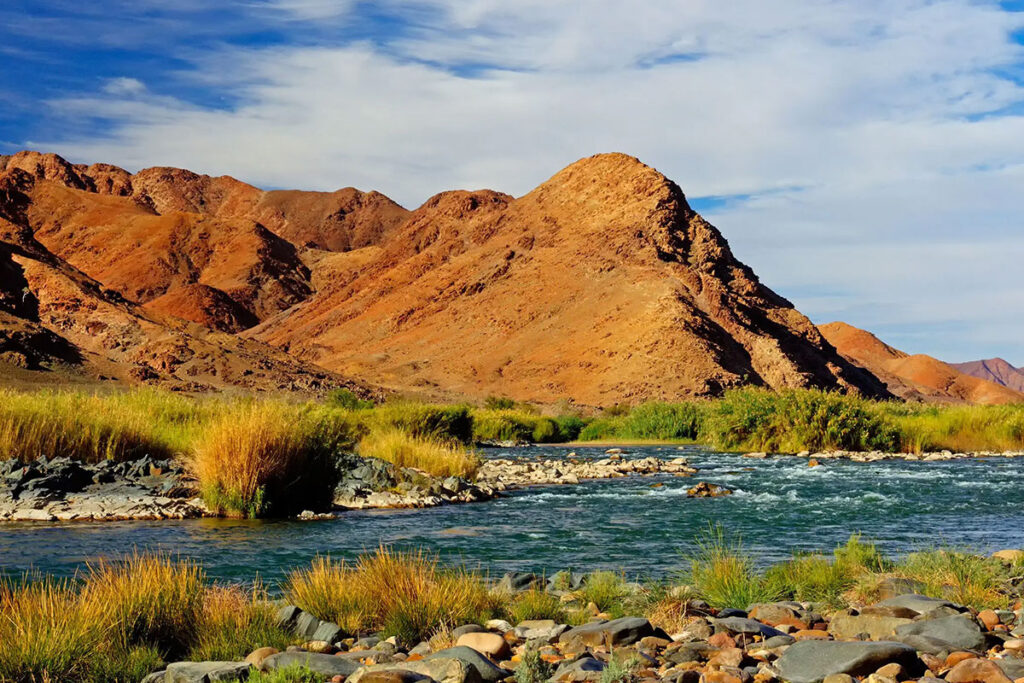
Richtersveld Transfrontier National Park – Rugged Desert Mountains, Succulent Karoo Biodiversity, Orange River Oases and the Ancient Nama Cultural Landscape
Richtersveld Transfrontier National Park is one of Africa’s most mesmerizing and geologically extraordinary wilderness areas—a sweeping desert kingdom of jagged mountain ranges, volcanic ridges, deep river gorges, vast gravel plains, surreal quartz fields, and thriving succulent ecosystems found nowhere else on Earth. Straddling the border between South Africa and Namibia, this immense transboundary conservation area forms the beating heart of the Succulent Karoo, the world’s only arid-region biodiversity hotspot and an ecological treasure of global importance. Richtersveld is a land of extreme contrasts: blistering daytime heat cooled by morning fog, barren mountain slopes that reveal spectacular wildflower displays after rare rains, and vast desert plains cut suddenly by lush green river oases along the Orange River. It is a place where ancient geology meets living culture, where silence stretches across endless horizons, and where nature thrives through some of the most remarkable survival adaptations known to science.
The moment you enter the Richtersveld, the landscape overwhelms your senses. Sharp, serrated mountains shimmer under the sun, their rocks displaying layers of volcanic reds, charcoal blacks, copper browns, and pale granites that shift colors with the daylight. The desert floor is decorated with astonishing succulents—living stones that camouflage perfectly against quartz pebbles, towering quiver trees that withstand scorching summers, and the iconic halfmens trees whose silhouettes rise like watchful guardians over the land. When you approach the Orange River, the environment transforms dramatically: palms, reeds, tamarisk, and fig trees greet you with cool shade, creating vibrant oases filled with birdlife and desert mammals. As night falls, the Richtersveld reveals one of the clearest night skies in Africa—an astronomical wonderland ideal for stargazing and astrophotography. This is a landscape that feels ancient, primeval, and deeply spiritual.
Overview of Richtersveld Transfrontier National Park
Richtersveld Transfrontier National Park was formally established in 2003 when South Africa’s Richtersveld National Park joined with Namibia’s Ai-Ais Hot Springs Game Park, creating a vast bi-national conservation landscape exceeding 6,000 km². On the South African side, the park encompasses the UNESCO-inscribed Richtersveld Cultural and Botanical Landscape, a globally unique region where extraordinary biodiversity coexists with centuries-old Nama pastoralist traditions. Unlike most protected areas, the Richtersveld is legally owned by the local Nama communities through a pioneering land rights settlement. The land is leased to SANParks, allowing for a co-management model that integrates traditional land use, sustainable tourism, wildlife protection, and long-term ecological stewardship.
This partnership ensures that the Nama people continue practicing transhumance—ancient seasonal livestock migration routes that have shaped the landscape for generations—while simultaneously preserving one of the most fragile and botanically rich desert ecosystems on Earth. The Richtersveld is therefore more than a national park: it is a living cultural landscape, a scientific sanctuary, and a stunning natural heritage area.
Location, Size and Key Facts
Situated in South Africa’s remote Northern Cape Province, near the Namibian border, Richtersveld Transfrontier National Park offers one of the most isolated and dramatic desert-mountain environments in Africa. Its remoteness enhances its wilderness character, making it a paradise for explorers, photographers, geologists, botanists, and travelers seeking raw unspoiled landscapes.
- Protected area (South Africa): approx. 1,624 km²
- Total transfrontier park: over 6,000 km²
- Coordinates: roughly 28–29°S, 16–17°E
- Elevation: 150 m (Orange River banks) to >1,350 m on mountain summits
- Nearest towns: Alexander Bay, Port Nolloth, Eksteenfontein, Rosh Pinah (Namibia)
- UNESCO World Heritage Status: Richtersveld Cultural and Botanical Landscape (2007)
Geology, Terrain and Landscape
The geology of the Richtersveld is among the oldest and most fascinating on the planet. Much of the region belongs to the Namaqua Metamorphic Province, an ancient bedrock system estimated at 1.0–2.0 billion years old. These rocks pre-date the breakup of supercontinents and record some of the earliest geological processes that shaped Earth’s crust. Over billions of years, tectonic uplift, volcanic eruptions, folding, faulting, and relentless desert wind erosion sculpted the dramatic mountain ranges, sharp ridges, steep valleys, and weathered rock formations we see today.
The landscape is marked by striking features such as deep canyons, towering basalt cliffs, rugged sandstone escarpments, rocky tors, balancing boulders, and extensive quartz plains that shimmer under the desert sun. The Cockscomb Mountains, Cornellsberg, Helskloof Mountains, and Snoekloof formations are particularly notable, offering remarkable geological diversity and panoramic viewpoints. Outcrops display vivid color contrasts—from iron-rich reds to dark volcanic blacks and pale granitic tones—creating a natural gallery of geological art shaped over unimaginable time.
Climate and Weather Patterns
Richtersveld Transfrontier National Park experiences one of the harshest climates in Africa. Summers are extremely hot, with daytime temperatures frequently climbing above 40°C and occasionally exceeding 50°C in sheltered valleys. Winters are significantly cooler, with comfortable daytime temperatures and cold nights that may approach freezing at higher altitudes. Rainfall is scarce, unpredictable, and primarily associated with winter cold fronts, resulting in annual rainfall totals between 50 and 150 mm.
Despite the dryness, the region supports remarkable biodiversity thanks to the influence of Atlantic Ocean fogs, known locally as malmokkies. These fogs drift inland in the early morning, condensing on plants and rock surfaces, providing a crucial moisture source for fog-dependent succulents and other desert flora. Fog harvesting—through leaf hairs, waxy coatings, or specialized plant geometry—is one of the most remarkable survival strategies found in the park.
- Extreme summer heat: 35–50°C
- Winter temperatures: 10–25°C during the day, near freezing at night
- Rainfall: Highly variable, mostly winter
- Fog season: April–September
Hydrology and Water Systems
The Orange River is the single most important hydrological feature in the Richtersveld, sustaining life in an otherwise parched desert. Flowing for over 2,000 km across southern Africa, the river forms the park’s northern boundary and creates a remarkable green oasis of lush riparian forest, marshes, reedbeds, and fertile floodplains.
The river moderates temperatures, increases humidity, and provides habitat for a wide range of wildlife—from kingfishers and herons to baboons, antelopes, reptiles, and insects. It also supports recreational activities such as canoeing, rafting, and riverside camping. Seasonal tributaries, although dry most of the year, carve dramatic channels during rare rainfall events, redistributing sediment and shaping the desert floor.
Hydrological features include:
- Orange River Gorge with deep vertical cliffs
- Seasonal streams that activate after rare rains
- Springs and seep zones essential for wildlife
- Floodplains that nurture birdlife
Ecosystems and Vegetation Zones
Though it is a desert, the Richtersveld contains one of the most diverse floral landscapes in the world. The Succulent Karoo biome is globally recognized for its extraordinary concentration of succulent species—far surpassing any other arid region on Earth. Vegetation is extremely slow-growing, often centuries old, and adapted to survive minimal rainfall, intense sunlight, and nutrient-poor soils.
Mountain and Plateau Ecosystems
Rocky slopes host drought-resistant shrubs, euphorbias, aloe species, and hardy grasses. Plants anchor themselves in cracks and crevices where moisture is retained longer than on exposed open ground.
Quartz Fields
These bright white plains reflect sunlight and provide cooler microhabitats that support tiny succulents such as Conophytum, Gibbaeum, Lithops, and Fenestraria. Many of these plants mimic surrounding stones as camouflage.
Riparian Forest
Along the Orange River, the vegetation transforms into dense oases of fig trees, reeds, palm stands, tamarisk, and acacia trees. These lush zones form crucial wildlife corridors between desert habitats.
Coastal Desert Fringe
Fog-fed zones along the western edges support species specialized in fog harvesting. These plants rely almost entirely on dew and fog moisture.
Vegetation and Botanical Richness
Richtersveld is a global hotspot for succulent diversity and home to numerous endemic and threatened species. The region is particularly famous for its rare aloe species and for being one of the last strongholds of ancient plant lineages.
Major plant families represented include:
- Aizoaceae: Living stones such as Lithops and Conophytum
- Crassulaceae: Crassulas, Cotyledons, Tylecodons
- Aloaceae: Aloe dichotoma, Aloe pillansii
- Apocynaceae: Pachypodium namaquanum (Halfmens)
- Euphorbiaceae: Euphorbias adapted to drought
Notable plant species include:
- Quiver Tree (Aloe dichotoma): Traditional source of arrow quivers for hunters
- Giant Quiver Tree (Aloe pillansii): One of the rarest tree aloes on Earth
- Halfmens (Pachypodium namaquanum): Sacred to the Nama people, resembling human figures
- Living stones: Masterpieces of desert adaptation
Wildlife of Richtersveld Transfrontier National Park
Mammals
Most mammals in the Richtersveld are desert specialists with behavioral adaptations to intense heat and scarce water. Common species include:
- Hartmann’s mountain zebra
- Oryx (gemsbok)
- Springbok
- Klipspringer
- Rock hyrax
- Leopard (rare)
- Caracal
- Bat-eared fox
- Baboons and vervet monkeys near river areas
Birdlife
The park is a desert birding paradise with more than 200 species.
- Verreaux’s eagle
- Goliath heron
- Rosy-faced lovebird
- Orange River white-eye
- Karoo lark
- Black-headed canary
Reptiles
- Namaqua chameleon
- Puff adder
- Sand lizards
- Geckos and skinks
Amphibians
- Common river frog
- Sand frogs (seasonal)
Insects and Arthropods
The Richtersveld’s insect life is diverse and uniquely adapted to the desert.
- Fog-basking beetles
- Darkling beetles
- Scorpions
- Ant-lions
- Butterflies along riverine corridors
Cultural and Indigenous Communities
The Richtersveld is the ancestral homeland of the Namas, one of the world’s oldest surviving pastoralist cultures. Their lifestyle is intimately connected to the land through seasonal movement patterns, spiritual beliefs, traditional architecture, and deep knowledge of medicinal plants. The Nama’s matjieshuis—portable domed huts made from woven reed mats—are iconic symbols of their mobile heritage.
Nama culture includes:
- oral storytelling tied to landscapes and animals
- traditional herbal medicine practices
- seasonal livestock migration (transhumance)
- songs, poems, and musical instruments unique to Nama communities
- rituals linked to mountains and ancestral spirits
Conservation Importance
The Richtersveld protects some of Earth’s most fragile and slow-growing ecosystems. Its conservation value lies in preserving:
- globally important succulent biodiversity
- endangered quiver trees and halfmens populations
- Nama cultural landscapes and pastoralist heritage
- critical desert and riparian habitats
- unique geological formations
Threats and Conservation Challenges
- Climate change: Decline in fog moisture threatening fog-dependent species
- Illegal succulent trade: Removal of endangered species for collectors
- Mining pressure: Diamonds and copper extraction near park boundaries
- Habitat fragmentation: Outside protected areas
- Overgrazing: In community lands beyond regulated zones
Scientific Research and Monitoring
Richtersveld attracts international researchers studying:
- succulent adaptation to extreme aridity
- fog-harvesting mechanisms
- Nama cultural anthropology
- Orange River hydrology
- desert reptile and insect ecology
Tourism Activities in Richtersveld Transfrontier National Park
4×4 Adventure Routes
- Akkedis Pass
- Helskloof Pass
- Domorogh Pass
- Three Sisters Route
Hiking and Wilderness Trails
- Kokerboomkloof
- Violet Valley
- Snoekloof
- Cornellsberg circuits
Orange River Activities
- rafting expeditions
- canoe safaris
- riverside walks
- birdwatching
Botanical, Geological and Photography Tours
Guided tours showcase the Richtersveld’s spectacular succulents, ancient rock formations, geological history, and extraordinary photographic opportunities.
Star-Gazing and Night Sky Experiences
With almost no light pollution, the Richtersveld offers some of the clearest dark skies in Africa, ideal for astrophotography, Milky Way viewing, and meteor shower observation.
Access and How to Get There
Richtersveld Transfrontier Park is accessible via gravel roads from:
- Alexander Bay
- Port Nolloth
- Eksteenfontein
- Sendelingsdrif border post (link to Namibia)
Permits and Park Rules
- 4×4 vehicles recommended
- No off-road driving
- No firewood collection
- Respect Nama cultural sites
- Stay on designated routes
- Camping only in approved areas
Accommodation Options
- Sendelingsdrif Rest Camp – chalets and amenities
- Kokerboomkloof – wilderness rock formations
- De Hoop – riverside camping
- Richtersberg – scenic riverbank campsite
- Potjiespram – accessible near park entrance
Best Time to Visit
The best time to visit Richtersveld is during the cooler months of April to September. Winter offers mild temperatures, fog moisture for photography, blooming succulents after rainfall, and ideal conditions for hiking and 4×4 exploration. Summer (November–March) brings extreme heat and is best suited only for river-based activities.
Why Richtersveld Transfrontier National Park Is Unique
Richtersveld Transfrontier National Park is one of the world’s most exceptional natural landscapes—a rare combination of ancient geology, unrivaled succulent diversity, dramatic desert scenery, and vibrant Nama cultural heritage. It is the only place on Earth where halfmens trees grow naturally, where fog-fed succulents live in quartz deserts, and where traditional pastoralist societies maintain their ancient way of life within a protected area. Its rugged mountains, lush river oases, brilliant night skies and geological wonders create a wilderness experience unlike anything else in Africa.
For travelers seeking authentic solitude, unforgettable desert scenery, botanical wonders, cultural richness, and powerful natural beauty, the Richtersveld is not just a national park—it is a profound and transformative desert experience.