
Skeleton Coast National Park
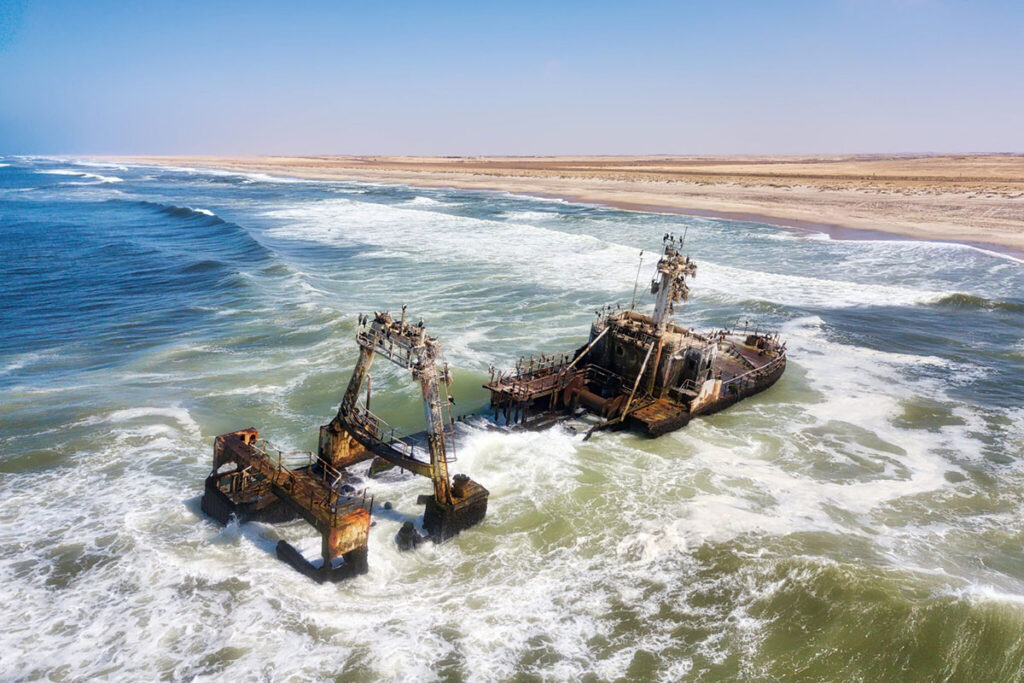
Skeleton Coast National Park, Namibia – The World’s Wildest Shoreline, Desert–Ocean Wilderness and a Sanctuary of Shipwrecks, Seals and Fog-Driven Life
Overview
Skeleton Coast National Park is one of the most hauntingly beautiful and remote wilderness areas on Earth—a place where the icy Atlantic Ocean collides with the towering dunes and gravel plains of the Namib Desert. For hundreds of kilometres, rugged shores, roaring surf, swirling fog and shifting sands create a landscape so harsh that early sailors called it “The Land God Made in Anger.” Yet beneath this forbidding reputation lies a remarkably rich and finely balanced ecosystem.
Named for the skeletal remains of shipwrecks and whales that once lined its beaches, the Skeleton Coast today protects a vast, largely untouched coastal desert. Fog-dependent lichens paint the gravel plains with subtle colours; desert-adapted elephants and lions roam the dry riverbeds; brown hyenas and jackals patrol seal-strewn beaches; and some of the world’s largest Cape fur seal colonies thrive along the shore. The park offers a truly elemental experience—raw, remote, powerful and utterly unlike any other destination in Africa.
Key Facts
- Location: Northern Atlantic coast of Namibia
- Latitudinal Range: Approx. 19°S to 15°S
- Size: ~16,845 km²
- Established: Proclaimed as Skeleton Coast National Park in 1971
- Protection Status: Part of a larger coastal conservation landscape linked with the Namib Desert and Kaokoveld
- Main Ecosystems: Coastal desert, dune fields, gravel plains, ephemeral river systems, rocky shores, fog-dependent habitats
- Climate: Cold coastal desert, dense fog, strong winds, very low rainfall
- Average Rainfall: Typically < 50 mm per year along the coast
- Key Rivers: Ugab, Uniab, Koigab, Hoanib, Hoarusib, Khumib, Kunene (ephemeral or intermittent)
- Flagship Species: Desert-adapted elephants, desert lions, brown hyenas, oryx, Cape fur seals, Damara terns
- Unique Features: Shipwrecks, whale bones, massive seal colonies, dunes meeting the ocean, fog-harvesting life forms
- Best Time to Visit: May–October (cool, dry, most suitable for 4×4 travel and photography)
Location and Geography
Skeleton Coast National Park occupies the northern third of Namibia’s Atlantic coastline, stretching from the Ugab River in the south to the Kunene River on the Angolan border. It is divided into a southern section with limited controlled access and a northern “wilderness zone,” which is extremely remote and accessible only via fly-in safaris or special permits.
Geographically, the park forms a narrow but immensely varied band where ocean and desert meet. To the west lies the cold Benguela Current, driving powerful waves and coastal upwelling; to the east, the Namib Desert rises into dune fields, gravel plains and rocky escarpments. The interplay of oceanic and desert processes shapes a landscape of:
- High coastal dunes that sometimes plunge directly into the sea.
- Vast gravel plains that seem to stretch endlessly inland.
- Deep, dry river valleys such as the Hoarusib and Hoanib, which occasionally carry floodwater to the ocean.
- Rocky headlands and promontories that trap sand and generate unique microhabitats.
This strip of land is narrow in places, but its complexity of landforms and microclimates makes it a globally significant desert–coastal ecosystem.
Geological History
The Skeleton Coast lies within the Namib Desert, often described as the world’s oldest desert, with origins dating back tens of millions of years. Over geological time, tectonic uplift, wind erosion, sea-level changes and the action of the Benguela Current have sculpted the coastline into its present form.
Ancient dune systems, some fossilized and partially cemented, testify to climatic fluctuations over long time scales. The relentless northward drift of sand, driven by prevailing winds and currents, traps wrecked ships and gradually buries them, creating the eerie scenes for which the Skeleton Coast is famed. Inland, basalt outcrops, sandstone layers and salt pans further reflect the region’s complex geological history and ancient marine and riverine environments.
Climate
The climate of Skeleton Coast National Park is an extreme cold coastal desert regime, dominated not by rainfall but by fog and wind. Key climatic characteristics include:
- Very low rainfall: Often less than 50 mm annually along the coast, with slightly higher values inland.
- Persistent fog: Formed when warm, moist air from inland meets the cold Benguela Current, producing dense banks of fog that drift far inland.
- Cool temperatures: Typically between 5°C and 20°C along the coast, far cooler than interior desert regions.
- Strong winds: Predominantly southwesterly, shaping dunes, redistributing sand and creating challenging travel conditions.
Fog—more than rainfall—is the primary source of moisture in this system. Many plants and animals have evolved to harvest or endure this fog, making Skeleton Coast one of the world’s best examples of fog-driven ecological adaptation.
Hydrology
On the Skeleton Coast, rivers are ephemeral lifelines. Originating in higher inland plateaus, rivers such as the Ugab, Uniab, Koigab, Hoanib, Hoarusib, Khumib and Kunene carve deep valleys through the desert as they flow—periodically or rarely—toward the sea.
Most of these rivers only carry surface water during brief flood events after distant rains. However, subsurface water persists beneath the sand, supporting ribbons of vegetation along the riverbeds. These “linear oases” support trees, shrubs and grasses that in turn sustain desert-adapted elephants, giraffes, antelopes, lions and other wildlife. Fog also contributes to hydrology by condensing on dune surfaces and vegetation, gradually infiltrating soils and providing a hidden but vital moisture source.
Ecosystems and Habitats
Skeleton Coast National Park contains a surprising variety of habitats, each shaped by interactions between sand, rock, ocean, fog and wind. Major ecosystems include:
- Coastal dune fields: Towering dunes that run parallel or perpendicular to the coastline, some plunging dramatically into the waves.
- Gravel plains: Vast, seemingly barren expanses of pebbles and stones, often carpeted with fragile lichens.
- Rocky shores and tidal zones: Support intertidal life, seabirds and marine mammals.
- Ephemeral river corridors: Lined with acacia, Tamarix, Salvadora and other hardy trees, forming critical wildlife refuges.
- Salt pans and clay pans: Created by evaporation, sometimes used by animals as mineral licks.
- Inland desert and escarpment foothills: Transitional zones where desert fauna and flora diversify.
These habitats support an intricate food web, from fog-dependent lichens and beetles to desert-adapted megafauna and marine predators offshore.
Vegetation
Plant life along the Skeleton Coast is sparse but highly specialised. Many species rely on fog or groundwater rather than rainfall. Important vegetation types include:
- Lichens: Among the most distinctive components of the flora, forming colourful mats on rocks, soils and stones; extremely sensitive to trampling and pollution.
- Halophytic shrubs and succulents: Tolerant of saline and sandy conditions, stabilising dunes and providing cover for small animals.
- Riparian trees: Acacias, Salvadora and Tamarix along riverbeds, drawing on subsurface water and providing shade and browse.
- Grasses and annuals: Briefly flourish after rare rainfall, offering short-lived but important grazing.
Further south in the Namib, the ancient Welwitschia plant dominates some areas; while not a hallmark of the core Skeleton Coast shoreline, the broader desert context underscores the region’s botanical uniqueness.
Wildlife of Skeleton Coast National Park
Biodiversity Statistics
Although not as species-rich as savanna parks, Skeleton Coast National Park supports:
- Mammals: Around 40–50 species, including several large desert-adapted mammals.
- Birds: 200+ species, ranging from pelagic seabirds to desert-adapted land birds.
- Reptiles: Numerous geckos, lizards and snakes typical of arid environments.
- Marine mammals: Cape fur seals in huge numbers, plus offshore whales and dolphins.
- Invertebrates: Diverse beetles, spiders, scorpions and fog-harvesting insects.
Terrestrial Mammals
The Skeleton Coast is famed for its population of desert-adapted large mammals that have learned to survive in extreme aridity. Notable species include:
- Desert-adapted elephants: Long-legged, wide-ranging elephants that follow ephemeral rivers, feeding on riparian vegetation and surviving on sparse water sources.
- Desert lions: Lions that use riverbeds, dunes and shoreline, sometimes scavenging seal carcasses and hunting oryx and other desert antelope.
- Brown hyenas: Iconic scavengers of the coast, adept at feeding on marine carrion and seal pups.
- Oryx (gemsbok): Superb desert antelopes with efficient thermoregulation and water-conserving physiology.
- Springbok, Hartmann’s mountain zebras and giraffes: Found in and around river corridors and inland desert.
- Black-backed jackals and bat-eared foxes: Common along the coastline and plains.
Smaller mammals such as rodents and hares also inhabit the desert, forming an important prey base for carnivores and raptors.
Cape Fur Seals and Marine Mammals
One of the most spectacular wildlife features of the Skeleton Coast is its immense Cape fur seal colonies. Thousands of seals gather at rookeries along the shore, using beaches and rocky outcrops for resting, breeding and moulting. Seal colonies are noisy, crowded and highly dynamic; they also support a rich predator community of brown hyenas, jackals and occasionally lions.
Offshore, the cold Benguela Current supports:
- Whales – including humpback and southern right whales during migration seasons.
- Dolphins – such as bottlenose and Heaviside’s dolphins.
- Abundant fish stocks – which underpin the entire coastal food web.
Birdlife
The Skeleton Coast is an important region for seabirds, shorebirds and desert-adapted land birds. Among the highlights:
- Damara tern: A rare and vulnerable seabird that breeds on coastal gravel plains.
- African black oystercatcher: Often seen feeding along rocky shores.
- Cape cormorants, pelicans, gulls and terns: Abundant along the shoreline.
- Flamingos: Occasionally feeding in coastal lagoons and estuarine areas.
- Rüppell’s korhaan and larks: Desert specialists on gravel plains.
- Raptors: Such as lanner falcons and peregrine falcons, hunting along cliffs and dunes.
Migratory species seasonally augment the region’s bird diversity, particularly during the austral summer months.
Reptiles, Amphibians and Invertebrates
Reptiles and invertebrates are well adapted to the Skeleton Coast’s aridity. Common elements include:
- Geckos and lizards: Many species are nocturnal and sand-adapted, using burrows and camouflage.
- Sidewinder-like snakes: Specialised dune climbers leaving sinuous tracks across the sand.
- Scorpions and spiders: Occupying burrows or hiding beneath rocks.
- Fog-basking beetles: Utilizing body posture to condense fog droplets and channel them to their mouths.
These small creatures form the foundation of desert food chains and demonstrate remarkable physiological and behavioural adaptations.
Marine Ecosystems and the Benguela Current
The cold Benguela Current offshore is one of the world’s most productive marine upwelling systems. Nutrient-rich waters support:
- Huge schools of fish and squid.
- Abundant zooplankton and phytoplankton.
- Large populations of seals and seabirds.
This marine productivity stands in striking contrast to the near rainless desert on land, yet the two systems are ecologically intertwined through seals, scavengers and nutrient transfers onto the beaches.
Unique Features
- Shipwrecks: Rusting hulks stranded on beaches and partially buried in dunes.
- Whale and seal bones: Historical relics from whaling and natural strandings.
- Dunes meeting the ocean: Among the most dramatic dune–sea interfaces on Earth.
- Fog-dependent ecosystems: Where moisture arrives horizontally rather than from rain clouds above.
- Extreme sense of remoteness: One of the least populated and least disturbed coasts in the world.
Cultural and Indigenous Context
While no major settlements occur within the park itself, the wider region forms part of the historical range of Himba and Herero pastoralists, as well as earlier hunter–gatherer communities. Archaeological sites, old trading routes and remnants of early coastal resource use can be found in parts of the landscape.
Modern conservation efforts increasingly engage with community conservancies in adjacent areas, integrating traditional knowledge, sustainable livelihoods and wildlife protection.
Establishment and Protection History
The Skeleton Coast’s reputation as a graveyard for ships—and its stark beauty—drew early attention from conservation-minded explorers and officials. In 1971, Namibia (then South West Africa) proclaimed Skeleton Coast National Park, initially protecting a broad strip of shoreline and inland desert. Over time, zoning refined the park into:
- A southern tourism zone where limited self-drive access is allowed under strict conditions.
- A northern wilderness zone with tightly controlled access, primarily via fly-in lodges and specialist operators.
Today, the park forms part of a wider coastal conservation mosaic that includes the Namib Desert, adjacent conservancies and, in the future, potential transfrontier links with Angola’s Iona National Park.
Park Management and Governance
Skeleton Coast National Park is managed by Namibia’s Ministry of Environment, Forestry and Tourism (MEFT). The park’s management strategy emphasises:
- Strict access control in the northern wilderness zone to maintain ecological integrity and a truly wild character.
- Low-impact, high-value tourism through concessions for specialist lodges and operators.
- Close collaboration with neighbouring community conservancies, NGOs and research institutions.
- Monitoring and enforcement to prevent illegal off-road driving, poaching and other damaging activities.
By limiting visitor numbers and concentrating development in a few carefully managed sites, Namibia protects fragile ecosystems while still generating revenue for conservation and local communities.
Human Pressures and Tourism Impacts
Though relatively low compared to many other parks, human pressures on the Skeleton Coast must be carefully managed due to its extreme fragility. Key concerns include:
- Off-road driving: Vehicle tracks can destroy lichens and leave scars that last for decades.
- Disturbance to seal colonies: Excessive noise or proximity can disrupt breeding and resting behaviour.
- Marine pollution: Fishing gear, ghost nets and plastic can harm seabirds and seals.
- Uncontrolled visitation: Can degrade wilderness values and disturb wildlife.
Strict regulations, permits, guided access and visitor education aim to minimise these impacts and keep the Skeleton Coast as undisturbed as possible.
Conservation Importance
Skeleton Coast National Park is globally significant because it:
- Protects a large, intact stretch of coastal desert with minimal human development.
- Safeguards unique fog-dependent ecosystems and desert-adapted wildlife.
- Forms part of a larger coastal conservation corridor, linking marine and terrestrial habitats.
- Preserves critical breeding sites for seals and seabirds.
- Provides an unparalleled natural laboratory for studying climate, fog ecology and desert adaptation.
Threats and Future Outlook
Looking ahead, key threats and challenges include:
- Climate change: Potential shifts in fog frequency, Benguela Current dynamics and storm intensity could alter ecological patterns.
- Increasing tourism demand: Requiring careful zoning and capacity management to avoid degradation.
- Offshore activities: Fishing pressure and potential resource exploration must be managed to protect marine life.
Future conservation priorities involve strengthening transboundary links with Angola, expanding marine protection, and continuing the high-value, low-volume tourism model that has served Namibia’s parks so well.
Research and Monitoring
The Skeleton Coast serves as a living research platform for:
- Desert lion and elephant ecology and movement patterns.
- Cape fur seal population trends and breeding success.
- Lichen growth rates and sensitivity to disturbance.
- Fog dynamics, climate change indicators and coastal erosion.
- Marine–terrestrial nutrient flows via carrion and scavengers.
Findings from these studies inform adaptive management strategies and highlight the park’s importance as a global reference site for coastal desert ecosystems.
Tourism in Skeleton Coast National Park
Safari and Exploration Activities
Visiting the Skeleton Coast is less about tick-list game viewing and more about experiencing one of the wildest, most atmospheric landscapes on Earth. Popular activities include:
- Fly-in scenic flights: Offering breathtaking aerial views of dunes, shipwrecks and river canyons.
- Guided 4×4 expeditions: Exploring accessible sections of the southern park and adjacent deserts.
- Seal colony visits: Witnessing thousands of Cape fur seals and their interactions with predators.
- Desert wildlife tracking: Following the subtle signs of elephants, lions, hyenas and oryx in the sand.
- Photography safaris: Capturing minimalistic landscapes, foggy horizons and stark textures.
- Historical and cultural excursions: Learning about shipwrecks, early explorers, whalers and coastal traders.
Visitor Practical Information
The Skeleton Coast is remote and potentially hazardous for unprepared travellers. Practical considerations include:
- Vehicle: Reliable 4×4 required; self-drivers should have experience in sand and remote travel.
- Fuel and supplies: Limited availability; stock up before entering remote areas.
- Navigation: Fog, featureless plains and unmarked tracks can cause disorientation—GPS and maps are essential, but guided travel is strongly recommended.
- Clothing: Layered warm clothing, windproof jacket, hat, sunglasses and sturdy closed shoes.
- Health: Dehydration and exposure to wind and cold are risks; carry ample water and sun protection.
Access and How to Get There
Main access points to Skeleton Coast National Park include:
- Southern gates: Such as Ugab Gate and Springbokwasser Gate, reachable via gravel and salt-surface roads from Swakopmund or Henties Bay.
- Fly-in airstrips: Servicing exclusive lodges and safari operations in the northern wilderness zone.
Most visitors combine the Skeleton Coast with other Namibian highlights such as Swakopmund, Damaraland, Etosha National Park and the central Namib dunes, often using a mixture of road transfers and light aircraft flights.
Permits, Fees and Regulations
To protect this fragile landscape, Namibia enforces strict regulations:
- Park entry permits and vehicle fees are required at gates.
- Access to the northern wilderness area is limited to permitted operators and lodge guests.
- Off-road driving is prohibited except on authorised routes.
- Removing stones, bones, plants, lichens or artefacts is strictly forbidden.
- Visitors must adhere to guidelines around seal colonies and wildlife viewing distances.
Accommodation Options
Accommodation options in and around Skeleton Coast National Park focus on low-impact, high-quality experiences:
- Exclusive fly-in lodges: Situated in the northern wilderness, offering guided activities and all-inclusive stays.
- Designated campsites and basic facilities: In and near the southern section of the park.
- Coastal towns: Such as Swakopmund and Henties Bay, serving as gateways for day trips and scenic flights.
Best Time to Visit
The best time to visit Skeleton Coast National Park is during the cool, dry months from May to October. During this period, skies are often clearer, road conditions are more reliable, and temperatures are comfortable for exploration. Fog is present year-round but its intensity and inland penetration can vary seasonally.
Why Skeleton Coast National Park Is Unique
Skeleton Coast National Park is a place of superlatives and paradoxes: one of the driest places on Earth sustained by fog, a deadly shoreline teeming with life, and a landscape that looks empty yet reveals extraordinary adaptations at every scale. Shipwrecks, bones, dunes, seals, lions, elephants and lichens all tell intertwined stories of survival and change in an environment that is both harsh and fragile.
For travellers, photographers, conservationists and scientists, the Skeleton Coast offers a rare chance to experience a truly wild coastal desert—one of the last of its kind. Protecting this enigmatic landscape ensures that the world retains a powerful example of nature’s resilience and beauty at the edge of land and sea.