
Tsavo West National Park
Tsavo West National Park, Kenya – Volcanic Wilderness, Mzima Springs, Maneless Lions, Rhino Sanctuary, Black Lava Deserts & One of Africa’s Last Great Big Five Strongholds
Overview
Tsavo West National Park is a vast ecological empire of red earth, volcanic chaos and palm-lined springs — a wilderness that feels raw, ancient and untouched by time. Established in 1948 and covering 9,065 km², it forms one half of the Tsavo ecosystem — together with Tsavo East, one of the largest protected wildlife landscapes remaining on the African continent. This is a land where elephants roam unfenced across thousands of kilometers, where lions have evolved with unique sparse manes, where black rhinos survive behind guarded sanctuary walls, and where fire-black lava flows stretch like frozen rivers across the plains.
What makes Tsavo West extraordinary is its diversity — open plains, jagged volcanic ridges, subterranean aquifer-fed oases, palm wetlands, mountainous horizons, extinct craters, obsidian lava seas and Big Five wildlife at every scale of the landscape. It is one of the most visually dramatic safari terrains on Earth — powerful, cinematic, mysterious — a place where sunrise lights the land in red and gold and where silence spreads wider than horizon itself. For safari travelers seeking something wilder and less polished than mainstream reserves, Tsavo West is a pilgrimage experience.
This expanded reference is one of the most complete Tsavo West resources published online — covering its geology, wildlife, hydrology, tourism, ecology, conservation strategy, cultural heritage, scientific research, safari routes, accommodation zones and sample itineraries — all written in clean, SEO-rich HTML for direct implementation into a website.
Key Facts at a Glance
- Country: Kenya — Coast & Rift Valley Regions
- Size: 9,065 km² (Tsavo ecosystem > 22,000 km²)
- Established: 1948
- Big Five Present: Yes — lion, leopard, elephant, buffalo, rhino
- Special Features: Mzima Springs, Shetani Lava Flow, Rhino Sanctuary
- Elephant Population: One of Kenya’s largest & most natural
- Lion Morphology: Sparse / no-mane trait common in Tsavo males
- Gateways: Mtito Andei, Chyulu, Tsavo River, Maktau, Jipe
Historical Background & Formation
Before official protection, the Tsavo region was lived in and traversed by the Taita, Maasai, Kamba and Orma communities — pastoralists and hunter-gatherers who followed seasonal rains and wildlife along ancient migration paths. Colonial settlement followed the railway line in the late 19th century, culminating famously in the Tsavo Man-Eater lion attacks of 1898. Although these events centered nearer Tsavo East, the entire Tsavo lion population shares genetic lineage, contributing to global interest and behavioral research that continues today.
Tsavo National Park was formally designated in 1948 — later split administratively into East and West for management efficiency. Decades of intensive poaching during the 1970s/80s nearly destroyed elephant and rhino numbers, but Tsavo has rebounded because of anti-poaching units, aerial surveillance, ranger patrols, fencing of critical rhino areas, and long-term ecological recovery. Tsavo West is now one of Africa’s greatest comeback stories — wilderness restored, wildlife returning, hope surviving.
Location, Roads & Safari Access
Tsavo West sits strategically along the Nairobi–Mombasa highway and railway line, giving it unmatched logistical accessibility. Travelers can drive from either direction, connect by air into internal airstrips, or combine Tsavo West as a linking safari between Amboseli National Park, Chyulu Hills, Tsavo East and the Kenya Coast. Few protected areas in Africa are this large yet this easy to reach.
Major access gates:
- Mtito Andei Gate: Ideal for northern and central circuit routes.
- Chyulu Gate: Close to lodges, rhino sanctuary and springs.
- Maktau / Jipe Gates: Scenic wetlands and Tanzania boundary region.
- Tsavo River Gate: Southern wilderness & predator-rich terrain.
Internal roads vary from smooth laterite tracks to rugged volcanic routes — making 4×4 vehicles highly recommended for deep-circuit exploration. The reward is total immersion in a wilderness where you can drive for hours and see nothing but pure Africa.
Geography & Landscape Character
The scenery of Tsavo West is deeply geological — volcanic cones rise like black pyramids, ancient basalt flows lie frozen like oceans, and red plains glow like embers under evening light. The Ngulia escarpment defines the skyline with sharp cliffs and rocky ledges, while the Chyulu Hills in the north form one of the youngest volcanic mountain chains on Earth — still geologically active in prehistoric timelines.
This immense contrast makes Tsavo West feel like multiple parks inside one boundary: a lava desert in the morning, a spring oasis by noon, a rhino sanctuary in afternoon shade, and a lion hunt scene by sunset.
Signature Geological Monuments
- Shetani Lava Flow: A haunting 8-km black basalt field — eerie, silent, moonlike.
- Chaimu Crater: Steep, charcoal-black volcanic cone — climbable with wide-angle views.
- Ngulia Hills: Eagle-ridden rock faces, perfect for sunset silhouette photography.
- Roaring Rocks: Natural echo chambers overlooking savannah.
Climate & Seasonal Conditions
Tsavo West has a warm, semi-arid climate — hot days, cool dawns, and dramatic light that transforms the land into a canvas of gold, red and black. Seasonal rainfall shapes animal movement and photographic tone:
- June–Oct (Dry Peak): Sparse vegetation, best predator viewing, elephants cluster.
- Nov–Dec (Short Rains): Green flush, migratory birds return, brilliant color.
- March–May (Long Rains): Emerald grasslands, heavy dramatic skies — high photography value.
The rainy season paints Tsavo into rich green — rivers swell, herbivores calve, and bloom cycles carpet lava rock in wildflowers. Dry season concentrates game at waterholes for intense sightings.
Mzima Springs — Water from Stone
Nowhere in East Africa is water so miraculous as Mzima Springs. Rain falling on the Chyulu Hills seeps underground through volcanic rock for 20–50 years, filtering naturally before rising again as clear, sapphire-blue pools. Over 250 million litres surge from the ground daily — nourishing riverine forests, hippos, crocodiles, fish and thousands of animals that depend on this oasis in dry months.
A glass-walled underwater observation chamber allows visitors to watch fish and hippos swimming in slow-motion, lit by refracted sunlight. Palm forests, sycamore fig, fever tree and wild date palms line the streams — and early mornings bring incredible birdlife, vervet monkeys, waterbuck and crocodile motion in perfect photogenic light.
Habitats & Vegetation Zones
Tsavo West is an ecological mosaic shaped by lava, rainfall and soil age. Recently cooled basalt supports sparse pioneer vegetation such as lichen and sansevieria, while older soils sustain acacia woodland, whistling thorn, baobab and soapberry. Riparian zones are lush with shade, birdsong and primate movement.
- Acacia-Commiphora Woodland: Elephant browsing corridors, predator ambush hunts.
- Semi-Desert Scrub: Drought-resistant succulents and oryx habitat.
- Riverine Forest: Bird-rich green belt at Mzima, Tsavo River & Jipe wetlands.
- Open Grassland: Zebra, buffalo, hartebeest, wildebeest and cheetah country.
- Volcanic Highlands: Moist slopes of Chyulu and Ngulia.
Wildlife & Biodiversity
Tsavo West is one of the most naturally functioning wildlife ecosystems in Africa — no fences, massive open range, and predator-prey cycles unchanged for generations. Elephants roam in the thousands, buffalo dominate the plains, lions patrol territorial ridges, cheetahs chase gazelles like desert wind, and black rhinos endure their guarded fight for survival.
Elephant Strongholds
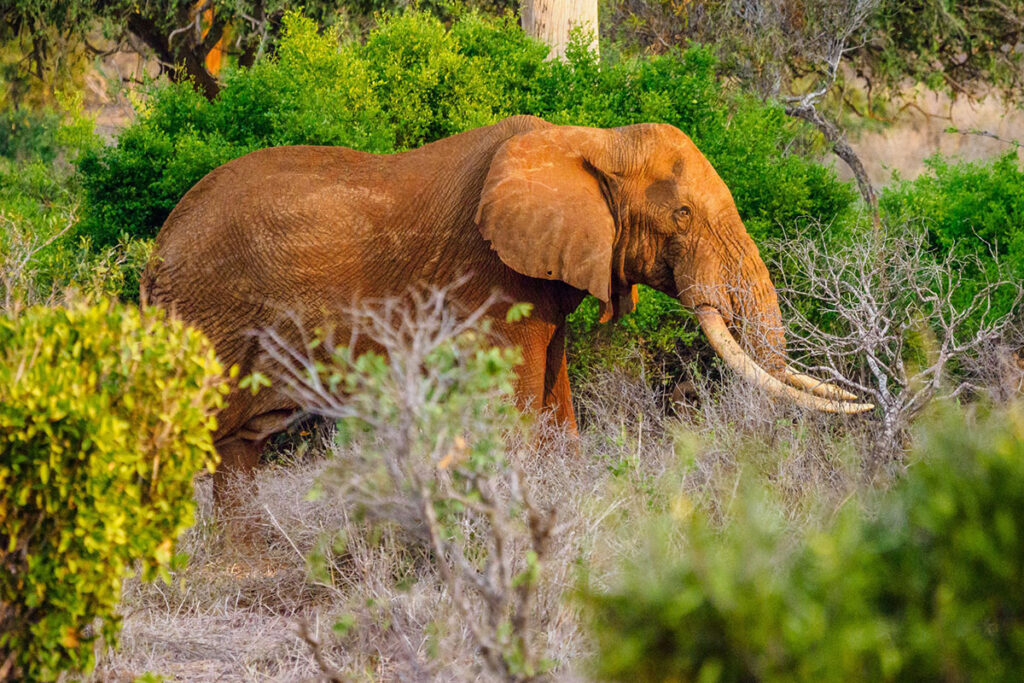
Tsavo is famous for its red elephants — coated with iron-oxide soil that glows brilliantly in sunlight. Herds migrate seasonally between Tsavo West, Tsavo East, Chyulu and community lands, forming some of the most genetically resilient elephant populations in East Africa.
The Lions of Tsavo
Unlike most African lions, many Tsavo males have no mane or only partial growth — a rare evolutionary adaptation believed to reduce heat stress and avoid snagging on thorn scrub. These lions are large, powerful and historically bold — a predator lineage that continues to intrigue scientists and filmmakers.
The Ngulia Black Rhino Sanctuary
Tsavo’s rhino population was almost eradicated by poaching in the 1970s/80s. The Ngulia Rhino Sanctuary now protects the species within a fenced, high-security breeding zone, with rangers, dog units and aerial patrols guarding every hectare. Rhino recovery here is one of Kenya’s greatest triumphs — proof that extinction is not inevitable if protection is relentless.
Other Mammals, Reptiles & Amphibians
- Leopard, cheetah, spotted & striped hyena, jackal
- Giraffe, impala, eland, gazelle, kudu, oryx
- Nile crocodile, monitor lizards, pythons, cobras
- Tree frogs & seasonal amphibian explosions in wet months
Birdlife — Rift Migration Corridor
Tsavo West hosts 400+ bird species, including Palearctic migrants funneling against Ngulia escarpment in one of Africa’s greatest migration passages. November–December is peak season for migration trapping studies — one of the longest-running bird monitoring programs on Earth.
- Pangani longclaw, African finfoot, martial & crowned eagle
- Bee-eaters, rollers, hornbills, sunbirds
- Kingfishers and palm swifts at Mzima Springs
People of Tsavo — Culture & Coexistence
Around the park live the Taita, Kamba and Maasai, custodians of oral storytelling, cattle rituals, spear culture, beadwork and pastoral life. Cultural tours reveal how local communities coexist with lions, how plants become medicine, and how livestock traditions adapt in presence of predators. Tourism revenue and conservation funding support schools, clinics, livestock compensation schemes and sustainable grazing plans.
Conservation Importance
Tsavo West is essential for elephant movement between ecosystems, for rhino survival, for lion genetic diversity, for bird migration and for long-term African landscape integrity. Without it, elephant herds would be trapped, predators isolated, and rhinos likely lost forever. Tsavo is not just a park — it is a backbone of East African wildlife security.
- Rhino sanctuary rescue program
- Aerial anti-poaching surveillance
- Community conflict-mitigation teams
- Migration corridor preservation
Threats & Climate Pressures
- Legacy poaching — now reduced but always a risk
- Climate-driven drought affecting river flow & forage
- Boundary pressure from settlement expansion
- Corridor narrowing risks population isolation
Future conservation success depends on maintaining open migration pathways, improving community support and scaling climate-adaptive management strategies.
Tourism Activities
- Game Drives: Big Five sightings, predator hunts, elephant herds.
- Mzima Springs Walk: Underwater hippo & fish observation.
- Ngulia Rhino Sanctuary: Critical black rhino conservation zone.
- Birding Expeditions: Escarpment migration & wetland species.
- Chaimu Crater Ascent: Trek volcanic summit with panoramic views.
- Shetani Lava Field Exploration: Walk surreal obsidian landscapes.
- Poacher’s Lookout: One of Africa’s most expansive viewpoints.
Safari Circuits & Best Routes
- Mzima → Rhino Sanctuary → Ngulia Ridge: Elephants, rhino & sunset silhouettes.
- Shetani → Chaimu → Jipe Wetlands: Lava deserts + birding + aquatic wildlife.
- Southern Loop: Leopard, hyena & lion-rich territory.
Suggested Itineraries
- 1-Day Safari: Mzima Springs → Rhino Sanctuary → Shetani Lava → Escarpment sunset.
- 2-Day Safari: Add Chaimu Crater climb + night drive where permitted.
- 3-Day Safari: Combine with Tsavo East → elephant super-herds & open savannah.
- 4-Day Circuit: Tsavo West + Amboseli + Chyulu Hills (Kilimanjaro backdrop).
Access & Travel Logistics
- By Road: 240 km from Nairobi, 250 km from Mombasa.
- Internal Airstrips: Kilaguni, Finch Hattons, Ziwani, Kamboyo, Jipe.
Accommodation
Accommodation ranges from ultra-luxury cliff lodges and tented bush villas to mid-range camps and affordable public campsites. Many offer waterhole viewpoints, night-camera monitoring, guided walking safaris, open-vehicle drives and lantern-lit bush dining beneath star-dense African sky.
- Luxury: Premium tented lodges near springs & escarpment vantage.
- Mid-Range: Tented safari camps with guided activities & sundowners.
- Budget: Public campsites, overlanding bush zones, eco-cabins.
Best Time to Visit
Year-round access, with seasonal benefits:
- Dry Season (June–Oct): Best game concentration & predator viewing.
- Green Season (Nov–Dec & Mar–May): Lush landscapes, dramatic skies, peak birding.
Why Tsavo West is Unforgettable
- One of Africa’s largest surviving wild ecosystems — no fences, no boundaries of horizon.
- Red-dust elephants, black-lava deserts, maneless lions — nowhere else the same.
- Mzima Springs — a miracle of groundwater, life from stone.
- Rhino sanctuary success proving conservation is still winnable.
- Silence, scale, volcanic memory — Africa at its purest form.
Tsavo West is a land that humbles you — a place where rock remembers fire, where water glows from beneath the earth, where lions move like ghosts through dusk, and where wilderness stretches wider than imagination. It is Africa before intervention, Africa that breathes, Africa that endures — a park not merely visited, but felt in the soul.