
Udzungwa Mountains National Park
Udzungwa Mountains National Park, Tanzania – The Enchanted Eastern Arc Rainforest, Evolutionary Laboratory & Waterfall Kingdom of Endemic Life
Overview
Udzungwa Mountains National Park stands among the most biodiverse and ecologically irreplaceable landscapes on the African continent — a montane rainforest so ancient and isolated that evolution has flourished uninterrupted for millions of years. Encompassing roughly 1,990 km² of dense jungle, escarpments, bamboo groves, mist-covered plateaus and cascading waterfall corridors, this park is often called the “Galápagos of Africa” because of its extraordinary concentration of plant and animal endemism. Unlike the wildlife savannahs of Serengeti or Tarangire, Udzungwa offers a different kind of safari — one experienced on foot, beneath towering hardwood giants, through river-fed gorges, and across trails where primates leap overhead like moving shadows.
Where most national parks were founded to protect megafauna, Udzungwa was established in 1992 primarily to secure its forest biodiversity — an ecological heritage that includes over 2,500 plant species, more than 400 recorded bird species, 50+ amphibians, and at least 12 primate species, including two that exist nowhere else in the world. Many scientists believe that Udzungwa still holds undiscovered species — especially insects, frogs and flowering plants — marking it as one of the last great biological frontiers on Earth.
Location & Geography
Positioned just southwest of Mikumi National Park and bordering the Kilombero Valley, Udzungwa rises sharply from lowlands that stretch into rice fields and sugar plantations. This sudden elevation shift — from 250m to over 2,576m above sea level — creates a vertical universe of forest zones, each distinct in climate, vegetation structure and biological inhabitants. The Udzungwa Mountains form part of the Eastern Arc — a 30 million-year-old chain older than Mt. Kilimanjaro or the Rift Valley — making it one of the most evolutionarily persistent forest systems on the planet.
Deep sandstone cliffs tower across trail horizons, and hidden between them lie narrow canyons, riverbeds and fern-lined ravines. On clear days, summits offer sweeping views over endless green that dissolves into the Kilombero floodplain, where elephants roam, rice grows thick in irrigated fields, and sunlight bends across wetlands like shimmering gold. To walk here is to enter living time — a forest older than history itself.
Climate
The park maintains a warm, humid and evergreen climate due to constant Indian Ocean moisture, making Udzungwa lush even in the driest months. Rainfall peaks during March–May and November–January, when the forest floor sprouts fresh fungi, frogs call from leaf pools, and orchids burst in silent, colorful explosions from moss-covered bark. These wet seasons are loud, alive and ecological — ideal for biologists and photographers who seek the rainforest at full pulse.
The dry season (June–October), in contrast, creates excellent trekking conditions. Trails firm up, birdwatching becomes easier and waterfalls — though slightly lower in volume — appear clearer, silver, and dramatically sculptural. Temperature gradients across elevation also mean one can hike from warm, butterfly-filled lowlands into cool, cloud-enveloped plateaus within a single day — a climatic transition that nurtures layered biodiversity like few places on Earth.
Hydrology, Waterfalls & Rivers
Udzungwa is a hydrological lifeline, acting as a water tower for the Kilombero and Rufiji River systems. These rivers irrigate vast agricultural basins, sustain freshwater fisheries, and feed hydropower networks downstream. The forest canopy moderates rainfall by capturing and slowly releasing water — preventing destructive flooding during wet months and sustaining stable flow during dry periods. Without Udzungwa, much of southeastern Tanzania’s rural water supply would collapse.
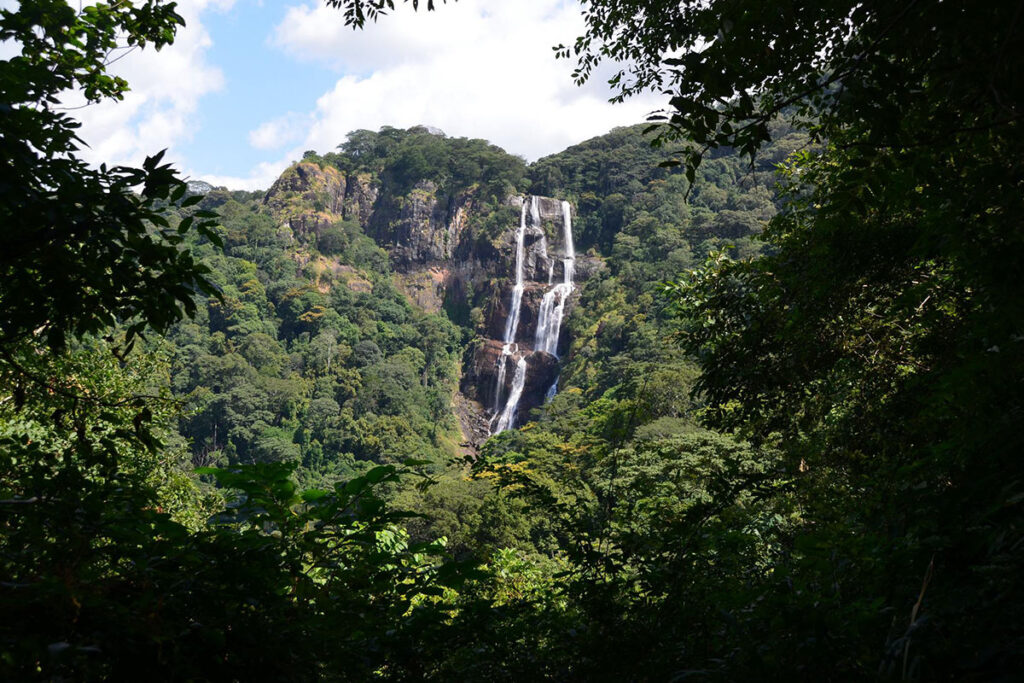
The most iconic feature of the park is the legendary Sanje Waterfall — a multi-tier cascade that plummets more than 170 meters through ancient rock, disappearing into rainbows, spray and emerald-green pools. The hike to Sanje is demanding yet rewarding, passing butterflies, wild banana groves and lookout ledges that open to sweeping, dream-like panoramas. Other major falls — including Mwaya and Prince Bernard Falls — lie deeper inland, reachable only via multi-day treks where one steps into pure silence, broken only by moving water and primate calls echoing across the valley.
Ecosystems, Vegetation Zones & Forest Structure
Udzungwa’s ecological fabric is defined by altitudinal layering — each forest band functioning as its own world of plants, insects and vertebrates. The park includes:
- Lowland sub-tropical rainforest: humid, thick canopy, rich in butterflies and primates
- Mid-elevation evergreen forest: towering hardwoods, orchids, tangled lianas
- Bamboo forests: cool, mist-bathed, home to highland frogs and chameleons
- Montane grasslands: wide, open vistas above treeline — ideal for expeditions
- Miombo woodland: transition zone linking Udzungwa to savannah ecosystems
Botanists have documented over 2,500 flora species, but many remain undescribed scientifically — proof that Udzungwa is not only ancient, but still actively evolving. Giant Podocarpus trees tower like pillars of old kingdoms, while lichen hangs in threads like silver rain from branches. The forest is a cathedral — quiet, humid, infinite.
Wildlife Richness & Endemism
What makes Udzungwa unlike any other national park is not the presence of lions or herds, but the intense density of forest-dependent species found nowhere else. The park shelters highly specialized mammals, amphibians, insects and birds that evolved in isolation for millions of years — making it a critical global reservoir of genetic diversity.
Primates
Udzungwa is considered one of the world’s greatest primate strongholds, home to 12 species including:
- Udzungwa Red Colobus – chestnut-backed, arboreal and endemic
- Sanje Crested Mangabey – critically endangered and restricted to Udzungwa
- Blue monkeys, vervets, baboons, Angolan colobus & galagos
Troops move in family units across canopy arches — one moment silent, next alive with barks, chirps and branch crashes. Tracking them is immersive, slow-paced and rewarding; this is primate viewing at its purest.
Mammals
Although Udzungwa is not dominated by large savannah mammals, forest antelopes such as **suni**, **Harvey’s red duiker** and **bushbuck** roam river valleys. Elephants occasionally migrate across lowland corridors, leaving footprints sunk deep into forest mud. Leopard, serval and genet prowl silently, evidence of a predator-prey dynamic that persists unseen in the shadows — a reminder that wildness here runs ancient and deep.
Birdlife
With over 400 bird species, including many range-restricted and globally rare species, Udzungwa is a premier ornithological destination. Endemics such as the **Udzungwa Forest Partridge**, **Rufous-winged Sunbird**, **Iringa Akalat** and **Olive-headed Weaver** draw birders from across the world. The forest canopy vibrates with sound in the early morning — turaco calls, hornbill wingbeats, and sunbirds flashing iridescent green as they feed on nectar in shafts of filtered gold.
Reptiles, Amphibians & Invertebrates
At least **50+ amphibian species** thrive here — many unknown to science until recently. Frogs cling to moss-wet leaves, some no larger than a fingernail. Chameleons shift slowly across vines, their skin glowing emerald or bronze in soft light. More than **250 butterfly species** shimmer through glades — swallowtails, charaxes, leaf-mimics and jewel-wing varieties. Udzungwa remains a discovery frontier, especially for entomologists seeking new species.
Unique Attributes
- A forest ecosystem older than the Himalayas
- Two primates found nowhere else on Earth
- Sanje Waterfall — 170-meter multi-tier rainforest descent
- Among the highest floral endemism rates in Africa
- A living evolutionary record spanning millions of years
Governance & Protection
The park is managed by TANAPA (Tanzania National Parks Authority), supported by rangers, research partnerships and NGO-led conservation projects. Anti-logging patrols, ecological monitoring and community-based resource management ensure that Udzungwa’s biodiversity remains intact. Enforcement challenges persist due to surrounding population growth, making long-term conservation funding, education, and tourism revenue crucial for survival.
Local Communities & Cultural Landscape
Hundreds of villages lie outside park boundaries, and their relationship with the forest shapes its future. Traditionally reliant on honey harvesting, herbal medicine and wood fuel, many communities now engage in **eco-tourism employment, sustainable irrigation agriculture, beekeeping programs and conservation education**. These partnerships reduce forest dependence and turn neighboring villages into front-line protectors rather than extractors.
Udzungwa thrives most when local families see the forest not as a resource to cut — but as one to protect, value and benefit from sustainably.
Conservation Value & Ecosystem Services
Udzungwa functions as one of Tanzania’s most important **carbon storage forests**, buffering climate extremes, stabilizing weather, and sequestering CO₂ through dense hardwood canopy structure. It is also a **watershed powerhouse**, regulating flow into the Kilombero and Rufiji systems that support agriculture, power production and fisheries. Without this rainforest, regional droughts would intensify, hydropower output would drop, and farmland productivity downstream would drastically decline.
Threats & Ecological Risk
- Forest clearing for agriculture expansion
- Illegal timber extraction & fuelwood harvesting
- Poaching of primates and small antelope
- Habitat fragmentation at elevation boundaries
- Climate change altering rainfall timing and density
Historical analysis suggests that the wider Eastern Arc region has lost **over 25% of forest cover**, making Udzungwa critical to restoring biomass complexity and hydrological stability. Protection efforts must remain continuous — the loss of even a small fragment could erase species unknown to science.
Restoration, Research & Scientific Discovery
Udzungwa is a laboratory for ecological research. Scientists here study primate behavior, amphibian evolution, forest carbon cycles, plant pollination networks, insect speciation and climate resilience. Reforestation programs cultivate indigenous saplings in nurseries, later transplanting them into degraded buffer zones to rebuild canopy connectivity. Each restored ridge strengthens the entire ecosystem — every new tree is a step toward ecological immortality.
Tourism Activities
- Sanje Waterfall Trek: One of East Africa’s most scenic rainforest hikes
- Primate Tracking: Best place on Earth to see 2 endemic species
- Birdwatching Excursions: Over 400 species & multiple endemics
- Multi-Day Mountain Expeditions: Cross bamboo forests, ridges & cloud zones
- Cultural Visits: Explore Mang’ula & Kilombero communities
This is **a park for explorers, walkers, photographers, researchers and nature-seekers** — not just tourists. Every trail is raw discovery, and every waterfall rewards effort with beauty beyond language.
Access
Entry via Mang’ula Gate off the Mikumi–Iringa highway is the most common route. Because Udzungwa is conveniently located near Mikumi, Ruaha and Nyerere (Selous), travelers often combine rainforest trekking with classic big-game safaris for a complete Tanzanian wilderness circuit that blends primates, waterfalls and savannah giants.
Permits & Regulations
Park entrance fees are payable at the gate. Additional permits apply for research, camping and special guided treks. To ensure ecological integrity, all forms of extraction — logging, plant collection, charcoal burning or hunting — are strictly prohibited. Every visitor is a stakeholder in conservation.
Accommodation
Accommodation options include eco-lodges near Mang’ula, forest-edge bandas, budget guesthouses and remote camping sites. Plans exist to develop canopy walkway tourism, research stations and low-impact forest lodges to increase conservation-based revenue — the most sustainable long-term funding model for protecting Udzungwa’s biodiversity.
Best Time to Visit
The dry season (June–October) offers the most accessible trekking, best long-range visibility, and ideal waterfall viewing. The wetter months (Nov–May) unveil a deeper, greener forest — full of booming amphibian life, flowing rivers, and atmospheric photography conditions. Udzungwa doesn’t have a wrong season — only different expressions of the same wilderness.
Why Udzungwa Mountains National Park is Truly Unique
Because this is not just a national park — it is an ancient rainforest cathedral, a time capsule of evolution, and one of Earth’s great biological masterpieces. Where savannah parks showcase wildlife abundance, Udzungwa showcases evolutionary rarity — species born nowhere else, living in one of the world’s last untouched green empires. Each waterfall is a story, every tree is a chapter, and every hike is a journey through millions of years of natural history.
Udzungwa Mountains National Park is not for those who want to drive — it is for those who want to explore, immerse, breathe and evolve with the forest. This is Africa’s green heartbeat — and it will change you, if you let it.