
Danakil Depression
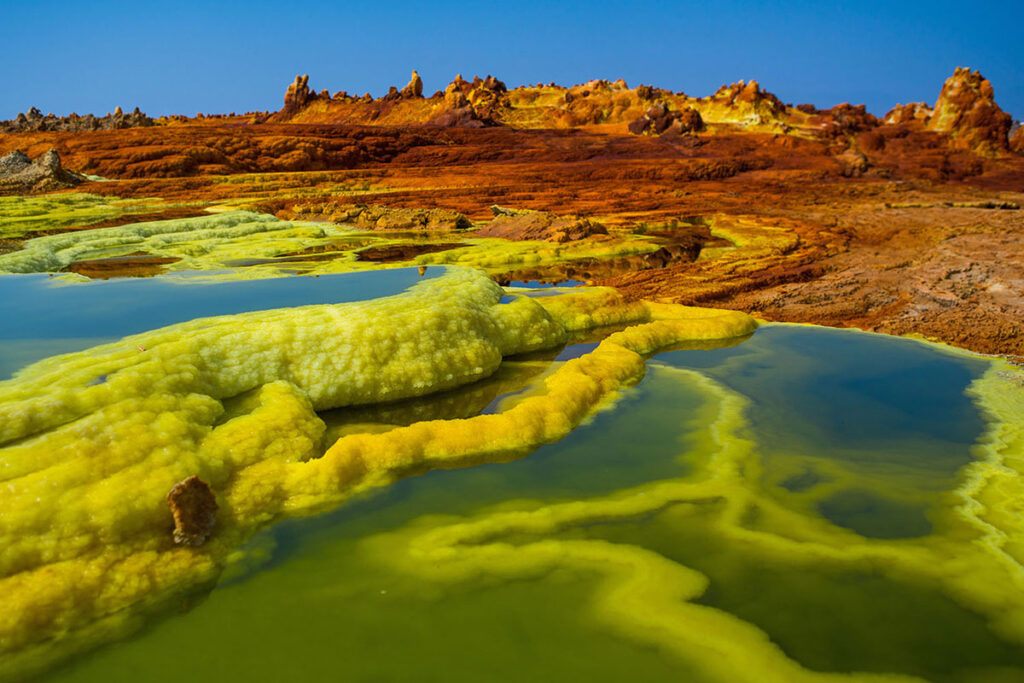
Danakil Depression – The Hottest Place on Earth and Africa’s Most Otherworldly Landscape of Acid Springs, Lava Lakes, Salt Caravans, and Ancient Human Origins
The Danakil Depression, located in northeastern Ethiopia near the borders of Eritrea and Djibouti, is one of the most extreme, geologically active, and visually surreal landscapes on the planet. Often described as the Earth’s hottest inhabited place, the region sits between 120 and 155 meters below sea level, making it one of the lowest points on Earth. As part of the Afar Triangle—a tectonic zone where three continental plates are pulling apart—the Danakil hosts dramatic features including the Dallol hydrothermal fields, the Erta Ale lava lake, vast salt plains, volcanic fissures, boiling springs, and multi-colored mineral deposits that look almost extraterrestrial.
Beyond its geological wonders, the Danakil Depression holds immense scientific, cultural, and historical significance. It is home to the Afar people, one of Africa’s oldest pastoral communities, and forms part of the region where some of the most important early human fossils—such as the famous Australopithecus afarensis skeleton “Lucy”—were discovered. This extraordinary combination of geology, anthropology, volcanology, and cultural heritage makes the Danakil Depression one of the most compelling destinations for scientists and adventurous travelers worldwide.
Location and Geological Overview
The Danakil Depression lies in the northeastern corner of Ethiopia within the Afar Region. It forms part of the Afar Triple Junction, one of the few places on Earth where three tectonic plates are actively diverging: the Arabian Plate, the Nubian Plate, and the Somali Plate. These plates are moving apart at a rate of approximately 2–3 mm per year, causing the land to stretch, thin, and sink. As a result, the Danakil is gradually forming a new ocean basin—an extraordinary geological process rarely visible on human timescales.
This tectonic activity gives rise to:
- Active volcanoes including Erta Ale, Gada Ale, and Alu-Dalafilla
- Hydrothermal fields rich in sulfur, iron, potash, and magnesium
- Rift valleys and tens of thousands of faults
- Salt flats formed by the evaporation of ancient seas
- Lava flows and black basalt fields
Few places on Earth allow visitors to stand directly above a continental rift tearing a continent apart. The Danakil is one of them.
Paleoanthropological Significance – Cradle of Humanity
The Danakil Depression lies within one of the world’s richest regions for human evolutionary discoveries. Just northwest of Danakil, in the Hadar area of the Afar Triangle, scientists discovered the 3.2-million-year-old fossil “Lucy” (Australopithecus afarensis), one of the most complete early hominin skeletons ever found. Numerous other hominin fossils—including Ardipithecus ramidus, Australopithecus deyiremeda, and Homo species—have been uncovered throughout the Afar region.
This makes the Danakil and its surrounding areas one of the most important archaeological landscapes on Earth, offering critical insight into the origins of early humans and the environments where our ancestors evolved.
Major Geological Attractions and Natural Wonders
1. Dallol Hydrothermal Field
The Dallol geothermal system is one of the most visually spectacular places on Earth. It features neon-yellow, green, orange, and white mineral formations created by volcanic heat interacting with hypersaline brines. The pools have extremely acidic pH levels—often below pH 1—and temperatures reaching up to 90°C. Minerals such as sulfur, iron oxide, potash, and manganese precipitate to form psychedelic terraces, chimneys, and salt domes.
Scientists consider Dallol one of the least hospitable environments known, and its hypersaline acidic pools host unique extremophile microorganisms relevant to astrobiology and the search for life in similar environments on Mars or Europa.
2. Erta Ale Volcano – One of the World’s Only Persistent Lava Lakes
The Erta Ale volcano is one of the most active volcanoes in Africa and home to one of the planet’s few permanent lava lakes. The volcano features a double caldera system, with the inner crater containing roiling molten lava that constantly churns, bubbles, and releases sulfurous gas. Night hikes to the crater rim offer one of the most awe-inspiring natural spectacles in the world—the fiery glow of liquid rock illuminating the desert night.
Erta Ale has been erupting continuously for decades, making it a crucial site for volcanologists studying magma movement and rift-related volcanic activity.
3. Salt Plains of Lake Assale
The salt flats surrounding Lake Assale (Karum) form an immense, shimmering white desert stretching to the horizon. These salt deposits were formed by the evaporation of ancient seas and continue to be an essential part of local livelihoods. For centuries, Afar tribesmen have extracted salt blocks using traditional tools and transported them by camel caravan—one of Ethiopia’s oldest cultural traditions.
4. Lake Afrera – A Hypersaline Wonder
Lake Afrera is a hypersaline lake surrounded by volcanic formations, fumaroles, and hot springs. Despite its harsh environment, the lake supports high-salinity ecosystems and provides high-quality salt for commercial harvesting. Visitors can explore the lake’s surreal shoreline, often encrusted with white salt crystals.
5. Black Lava Fields and Rift Fissures
The Danakil Depression contains vast expanses of black basalt, dried lava flows, and fissures created by volcanic eruptions. These landscapes form a stark contrast against the vivid geothermal areas and highlight the region’s dramatic geological evolution.
Climate – The Hottest Place on Earth
The Danakil Depression is famous for its extreme heat. Average temperatures range between 35–50°C, and in some areas, ground temperatures can exceed 60°C during peak heat. Annual rainfall is minimal, and evaporation is extremely high, contributing to the formation of thick salt deposits and mineral crusts.
This relentless heat drives many of the chemical processes that make the Danakil so visually unique and geologically active.
Biodiversity – Life in Extremes
Although the Danakil is one of the harshest environments on Earth, life here has adapted in remarkable ways.
Mammals
- African wild ass – one of the world’s most endangered equids
- Dorcas gazelles in the surrounding deserts
- Hamadrayas baboons along the cliffs
Birdlife
- Flamingos around acidic lakes
- Egyptian vultures
- Desert larks and other arid-adapted species
Microbial Life
Dallol hosts extremophiles capable of surviving in:
- Hypersaline waters
- Highly acidic pools
- High temperatures
- Heavy metal concentrations
These organisms are studied by NASA and international research teams to understand the limits of life on Earth and inform the search for extraterrestrial life.
Afar People and Cultural Heritage
The Danakil is home to the Afar people, one of the oldest pastoral cultures in Africa. Despite the extreme conditions, they have adapted to life in the desert through traditional herding practices, salt mining, and deep knowledge of the landscape. Their camel caravans, loaded with hand-cut salt blocks, are an iconic symbol of the region.
- Traditional salt trade connecting the Danakil to highland markets
- Afar clan structures and customary law
- Nomadic lifestyles adapted to extreme heat
- Cultural resilience in one of Earth’s harshest landscapes
Safety, Hazards, and Travel Requirements
Travel to the Danakil Depression requires careful planning and adherence to safety protocols. Key considerations include:
- Travel only with licensed local guides and tour operators
- Police escorts or local militia accompany all groups
- 4×4 vehicles are mandatory
- Visitors must carry large quantities of water and sun protection
- Ground around Dallol can be unstable and chemically hazardous
- Volcanic gases at Erta Ale can be harmful without masks
- Some border areas remain sensitive due to Ethiopia–Eritrea tensions
Despite the hazards, the region is generally safe when visited with experienced guides who know the terrain and local conditions.
Typical Itineraries
Most travelers explore the Danakil through organized tours departing from Mekele or the Afar region. Common itineraries include:
- 2-day tour – Dallol + salt flats
- 3-day tour – Erta Ale + Dallol + Lake Assale
- 4-day expedition – full Danakil including Afar villages, hot springs, and lava lake
Overnight stays typically involve camping under the stars, offering an unforgettable desert experience.
Photography Tips
The Danakil is one of the most photogenic landscapes on Earth. For the best results:
- Sunrise and sunset are ideal for photographing salt flats and Dallol’s mineral colors
- Long exposure is excellent for capturing the movement of molten lava
- Polarizing filters help with harsh desert glare
- Drone photography reveals the massive scale of volcanic formations (check local regulations)
Environmental Concerns
The Danakil Depression’s fragile geothermal crust can be damaged by irresponsible tourism. Concerns include:
- Foot traffic damaging delicate mineral formations
- Trash pollution in desert areas
- Unregulated salt mining impacting traditional systems
- Climate change affecting desert ecology
Sustainable, small-group tourism is essential to protect the region for future generations.
Scientific Importance and Research
The Danakil serves as a natural laboratory for studying:
- Volcanoes and lava lake dynamics
- Continental rifting and ocean basin formation
- Extreme microbial life
- Mineral deposition processes
- Human evolution and early hominin environments
Ethiopian geological agencies and international scientists regularly monitor volcanic activity through satellite thermal imaging, GPS, and InSAR deformation tracking.
Best Time to Visit
The most comfortable period for visiting the Danakil Depression is:
- November to February
Temperatures remain extreme but bearable, and visibility is excellent for photography and exploration.
Why Visit the Danakil Depression?
The Danakil Depression is a destination that defies imagination—a living testament to Earth’s geological power. With its acid springs, vivid mineral terraces, active lava lake, vast salt plains, and ancient human history, it offers an experience unlike anywhere else. This is a place where travelers witness the Earth in its most raw and elemental form, from molten rock to evaporating seas, all framed by the resilience and traditions of the Afar people.
Conclusion
The Danakil Depression is one of the most extreme, scientifically important, culturally rich, and visually surreal landscapes on Earth. It combines tectonic forces, volcanic wonders, hydrothermal marvels, ancient human origins, and unique cultural traditions into one extraordinary destination. For adventurous travelers, earth scientists, photographers, and cultural explorers, the Danakil offers a journey into a world few places can match—a world as close to another planet as you can find on Earth.