
Ngorongoro Conservation Area
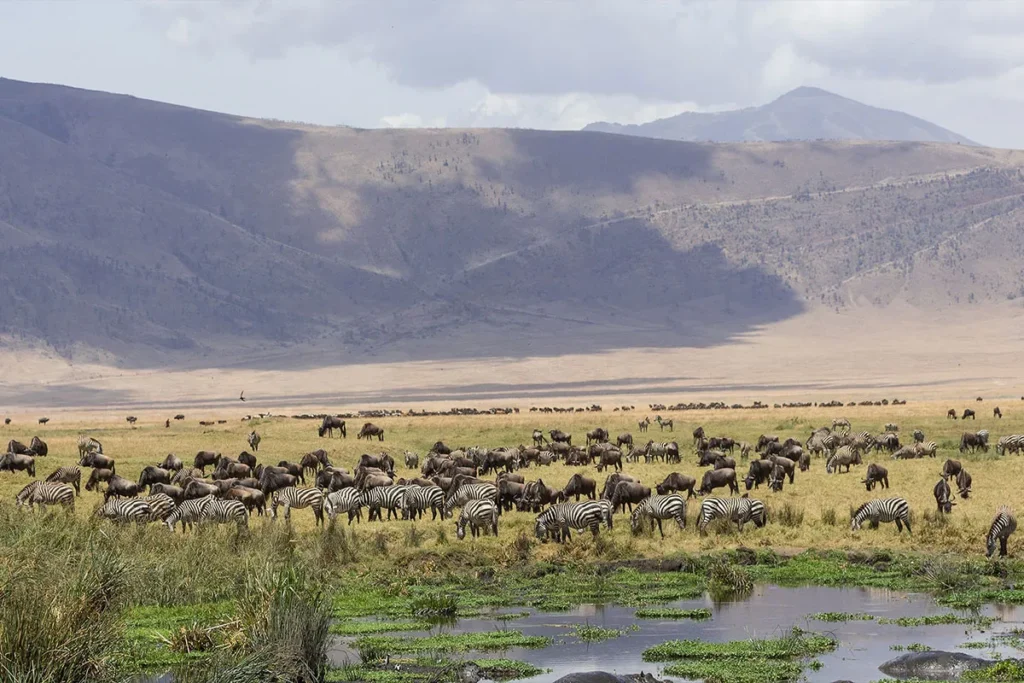
Ngorongoro Conservation Area, Tanzania – Crater Highlands, Big Five Safaris, Human Origins, Maasai Culture and a UNESCO World Heritage Wonder
The Ngorongoro Conservation Area (NCA) in northern Tanzania is one of the most extraordinary landscapes on Earth—a place where dramatic volcanic geology, thriving wildlife populations, deep human history and vibrant Maasai culture come together in a single protected area. Dominated by the colossal Ngorongoro Crater, the world’s largest intact volcanic caldera, and enriched by world-famous paleoanthropological sites such as Olduvai Gorge and the Laetoli Footprints, this UNESCO World Heritage Site stands at the crossroads of nature, culture and science. Its forests, grasslands, alkaline lakes, highland plains and crater-floor ecosystems support tens of thousands of large mammals year-round, including the Big Five, while the surrounding plains form crucial calving grounds for the Serengeti wildebeest migration. The Ngorongoro Conservation Area represents one of Africa’s most iconic safari destinations—an unforgettable combination of scenery, wildlife, archaeology and indigenous heritage.
Overview
Established in 1959, the Ngorongoro Conservation Area covers approximately 8,292 km² of volcanic highlands, Rift Valley escarpments, montane forests, savannas, short-grass plains and archaeological landscapes of global scientific value. Unlike conventional national parks, the NCA was designed as a multiple-use landscape, allowing wildlife conservation, tourism and traditional pastoralism to coexist under a unified management framework. At its heart lies the vast Ngorongoro Crater—about 19 km wide and more than 600 meters deep—whose enclosed ecosystem supports exceptional densities of large mammals, including black rhinoceroses, lions, buffaloes, elephants, hyenas and zebras. The surrounding highlands host other important volcanic features such as Empakaai Crater, Olmoti Crater, Mount Lemagrut and the calcareous Olduvai Gorge. Together, these features form one of the most ecologically and culturally significant conservation areas in Africa.
Location, Size and Key Facts
The Ngorongoro Conservation Area lies in northern Tanzania’s Arusha Region, about 180 kilometers west of Arusha town, forming the eastern boundary of the Serengeti ecosystem.
- Country: Tanzania
- Region: Arusha Region, northern Tanzania
- Coordinates: Approximately 3° S, 35° E
- Size: ~8,292 km²
- Established: 1959
- UNESCO World Heritage Status: Natural & Cultural (1979, expanded 2010)
- Flagship Feature: Ngorongoro Crater – world’s largest intact volcanic caldera
- Key Sites: Ngorongoro Crater, Empakaai Crater, Olmoti Crater, Olduvai Gorge, Ndutu Plains
- Management: Ngorongoro Conservation Area Authority (NCAA)
Geology – How the Crater Highlands Were Formed
The Ngorongoro Conservation Area sits on the eastern shoulder of the Great Rift Valley, one of the world’s most geologically active regions. Between 2.5 and 3 million years ago, immense stratovolcanoes rose in this region as rifting forces stretched and cracked the Earth’s crust. Ngorongoro Volcano, originally towering much higher than Mount Kilimanjaro today, erupted violently before collapsing inward to form the present-day crater—a near-circular caldera measuring about 19 km across and covering roughly 260 km².
The Crater Highlands include a chain of extinct and dormant volcanoes—Olmoti, Empakaai, Ketumbeine, Lemagrut and Ol Doinyo Lengai further north. Each has its own geological story. Empakaai Crater, for instance, holds a deep soda lake at its center, creating a dramatic amphitheater of sheer cliffs and emerald-green forests. Olmoti Crater features a grassy bowl whose streams feed the Munge River and influence hydrology on the Ngorongoro Crater floor. The region’s volcanic ash formed fertile soils that sustain rich grasses, influencing both wildlife ecology and early human settlement patterns.
Geography and Landscapes
The landscapes of Ngorongoro are varied and visually spectacular. Elevation ranges from 1,700 meters on the crater floor to over 3,600 meters on nearby peaks, producing distinct habitats in close proximity.
- Ngorongoro Crater: A vast, enclosed ecosystem with grassland plains, alkaline lakes, wetlands, and patches of woodland.
- Crater Rim: Cloaked in montane forest, with panoramic viewpoints overlooking the caldera.
- Short-Grass Plains: To the west and south, forming the seasonal birthing grounds for the Great Migration.
- Empakaai Crater: A volcanic caldera containing a soda lake frequented by flamingos.
- Olmoti Crater: A highland crater feeding streams flowing into the Ngorongoro floor.
- Olduvai Gorge: A deep, steep-side ravine of immense paleoanthropological significance.
- Highland Forests & Woodlands: Evergreen forests and acacia woodlands supporting diverse wildlife.
The diversity of these landscapes—compressed into a single conservation area—makes Ngorongoro one of the most ecologically rich and scenic destinations in Africa.
Climate
Ngorongoro’s climate is strongly influenced by altitude. The crater rim is cool and misty, while the crater floor is warmer but rarely hot. Visitors often encounter cold mornings, especially during the dry season, when temperatures drop significantly at higher altitudes.
- Long Rains: March to May – heavy rainfall, dramatic skies, lush scenery.
- Short Rains: November to December – brief showers, green vegetation.
- Dry Season: June to October – clear skies, cooler temperatures, reliable wildlife viewing.
The crater’s enclosed shape traps moisture, supporting permanent wetlands and grasslands that sustain wildlife even in dry months. The surrounding highlands receive more rainfall, feeding seasonal streams and springs.
Hydrology – Crater Lakes, Springs, Streams and Watersheds
Despite being a high-altitude volcanic landscape, Ngorongoro has several permanent water sources that anchor wildlife distribution.
- Lake Magadi (Makat): The crater’s central alkaline lake, often rimmed with flamingos.
- Munge Stream: Originates in Olmoti Crater, vital for the crater’s water balance.
- Lerai Spring & Lerai Forest: A groundwater-fed forest offering shade, fresh water and refuge for elephants, buffalo and forest birds.
- Ngoitokitok Spring: A perennial wetland attracting hippos, elephants and abundant birdlife.
- Seasonal Marshes: Support grazing animals and predators during the dry season.
The crater’s hydrology sustains year-round wildlife populations and shapes habitat diversity.
Ecosystems and Habitats
Ngorongoro’s ecosystems exhibit remarkable variation, dictated by elevation, volcanic soils, water availability and climate.
- Crater Grasslands: Rich, short grasses ideal for grazers such as wildebeest, zebras and gazelles.
- Lerai Forest: Evergreen forest with elephants, monkeys, bushbuck and many bird species.
- Montane Forest on the Rim: Dense canopy forests hosting leopards, hyraxes, hornbills and turacos.
- Highland Plains: Mixed grasslands and shrublands dotted with Maasai settlements and livestock.
- Short-Grass Serengeti Plains: Calving grounds for the Great Migration, with nutritious mineral-rich grasses.
- Alkaline Lakes and Marshes: Bird-rich aquatic ecosystems with flamingos, pelicans, herons and storks.
Vegetation
Vegetation changes dramatically across the NCA’s altitudinal gradient.
- Crater Floor: Dominated by short grasses, salt-tolerant plants and wetland vegetation.
- Rim Forests: Evergreen forests with wild olive, yellowwood, Hagenia and juniper.
- Empakaai: Forests and vegetation adapted to soda-lake environments.
- Ndutu Plains: Short grasses that support migratory herbivores during calving season.
The diverse plant life sustains herbivores and predators throughout the year and influences seasonal wildlife migrations.
Crater Micro-Habitats – A Complete Ecological Mosaic
Within the Ngorongoro Crater itself, numerous micro-habitats support distinct ecological niches:
- Lerai Forest: Cooler woodland for elephants and forest birds.
- Gorigor Swamp: Lush papyrus marsh attracting hippos and buffalo.
- Ngoitokitok Swamp: Permanent water attracting elephants, lions and birdlife.
- Central Grasslands: Prime grazing territory for wildebeest and zebras.
- Lake Magadi Shoreline: Flamingos and other waterbirds feed on algae.
- Crater Edge Slopes: Preferred areas for leopard, eland and hyrax.
The mixture of these habitats within one enclosed basin is what makes Ngorongoro such a productive wildlife area.
Wildlife of Ngorongoro Conservation Area
Mammals
Ngorongoro Crater is home to approximately 25,000 large mammals, making it one of the densest wildlife areas in Africa.
- Black Rhinoceros: Ngorongoro hosts one of the last breeding populations in East Africa.
- Lions: High densities, often observed hunting in broad daylight.
- Elephants: Mostly older bulls, known for impressive tusks.
- Buffalo: Abundant across crater grasslands and wetlands.
- Hyenas: Dominant predators in the crater, often seen hunting or scavenging.
- Zebras, Wildebeest, Gazelles: Constant grazer presence maintains ecological balance.
- Eland, Hartebeest & Waterbuck: Present in smaller numbers.
- Cheetah & Leopard: More frequently seen in highlands and Ndutu, less inside crater.
- Hippos: Common in Ngoitokitok Swamp and crater pools.
Birdlife
With over 500 recorded species, the NCA is a superb birdwatching destination.
- Flamingos on Lake Magadi
- Kori bustards, secretary birds & ostriches in grasslands
- Raptors such as crowned eagles, martial eagles & vultures
- Hornbills, turacos & sunbirds in rim forests
- Herons, pelicans & storks in crater wetlands
Reptiles, Amphibians and Aquatic Life
The crater’s wetlands and lakes support numerous amphibians and reptiles.
- Nile monitors
- Agama lizards
- Frogs & toads during rainy season
- Tilapia & catfish in seasonal pools
Paleoanthropology – Olduvai Gorge, Laetoli and Human Origins
The Ngorongoro Conservation Area contains some of the most important archaeological and paleoanthropological sites on the planet. Olduvai Gorge, often called the “Cradle of Mankind,” has produced fossil remains of early hominins including Homo habilis, Homo erectus and Paranthropus boisei, along with stone tools and fauna dating back more than 2 million years. Excavations led by Mary and Louis Leakey revolutionized the understanding of human evolution.
The nearby Laetoli site is home to the famous 3.6-million-year-old hominin footprints preserved in volcanic ash—evidence of early bipedal locomotion most likely attributed to Australopithecus afarensis. These discoveries highlight Ngorongoro’s significance not just as a wildlife sanctuary but also as a globally important scientific resource documenting the story of human ancestry.
Cultural and Indigenous Communities
The Maasai people have lived in and around the Ngorongoro highlands for centuries. Their semi-nomadic lifestyle, cattle-herding traditions, distinct red garments and deep cultural connection to the land make them an integral part of Ngorongoro’s identity. Historically, the NCA’s multiple-use model allowed pastoralism and wildlife to coexist, though recent population increases and land-use pressures have strained this relationship.
Today, Maasai communities face challenges related to grazing restrictions, relocation controversies and shifting conservation policies. Despite these tensions, Maasai villages remain important cultural landmarks, and responsible tourism can help support community livelihoods while preserving centuries-old traditions.
Conservation Importance
Ngorongoro is central to East African conservation for several reasons:
- It protects one of the densest wildlife assemblages in Africa.
- It safeguards key breeding sites for black rhinoceros.
- It provides dry-season refuge for herbivores migrating through the Serengeti.
- It conserves globally significant paleoanthropological heritage.
- It supports community-based conservation objectives.
By combining natural and cultural resources within a single protected area, Ngorongoro is a model for integrated landscape conservation.
Threats and Challenges
- Human population growth: Increasing pressures on land and resources.
- Land-use conflicts: Grazing restrictions and community relocation debates.
- Poaching risks: Particularly for rhinos.
- Tourism pressure: Vehicle congestion in the crater during peak season.
- Climate change: Shifting rainfall patterns affect vegetation and wildlife distribution.
Climate Change Impacts
Climate change presents complex challenges for Ngorongoro. Altered rainfall patterns may affect grassland productivity, influencing the timing and location of the Great Migration calving season. Reduced rainfall could shrink wetlands and affect water-dependent species, while intense rain events may damage crater slopes and increase erosion. Long-term monitoring is essential for understanding ecosystem changes and adjusting management strategies.
Great Migration Ecology – Ndutu and Calving Season
The southern plains of the NCA, particularly around Ndutu, play a vital role in the Serengeti wildebeest migration. Between December and March, more than 500,000 calves are born on mineral-rich short-grass plains. The abundance of nutritious grasses, produced by volcanic ash soils, supports lactating mothers and draws predators such as lions, hyenas and cheetahs in large numbers. This natural spectacle is one of the most dramatic events in Africa’s wildlife calendar.
Visitor Impact and Carrying Capacity
Ngorongoro Crater receives high numbers of safari vehicles daily, prompting careful management to prevent overuse. Regulations limit the number of vehicles on the crater floor at any one time, enforce strict driving routes and protect sensitive habitats from off-road pressures. Waste management, noise levels and visitor behavior are closely monitored to maintain the crater’s ecological integrity.
Research and Monitoring Programs
Scientific research within Ngorongoro spans wildlife ecology, human–wildlife conflict, vegetation dynamics, hydrology, archaeology and tourism impact studies. Programs focus on:
- Black rhino monitoring
- Lion and hyena population studies
- Grassland and wetland dynamics
- Heritage preservation at Olduvai and Laetoli
- Climate resilience and adaptive management
Tourism Activities
- Crater game drives: Exceptional wildlife viewing in a natural amphitheater.
- Highland trekking: Guided walks around Empakaai and Olmoti.
- Olduvai Gorge tours: Learn about human origins where key fossils were discovered.
- Birdwatching: Crater lakes, forests and plains offer unmatched diversity.
- Cultural visits: Visit Maasai bomas (responsibly operated).
Access and How to Get There
- By Road: About 3–4 hours from Arusha.
- By Air: Flights to Lake Manyara Airport and seasonal Ndutu airstrips.
- Safari Circuits: Commonly combined with Serengeti, Tarangire and Lake Manyara.
Permits and Regulations
- Conservation fees apply per person.
- Crater descent fee per vehicle.
- Limited descent times into crater.
- No off-road driving.
- Respect wildlife and maintain safe distances.
Accommodation
- Crater Rim Lodges: Luxury properties with panoramic views.
- Highland Tented Camps: Atmospheric and secluded.
- Ndutu Camps: Seasonal camps set near migration calving grounds.
- Karatu Lodges: Mid-range options near the NCA gates.
Best Time to Visit
- June–October: Dry season, excellent game viewing.
- November–March: Green season, migration calving near Ndutu.
- April–May: Fewer visitors, dramatic landscapes.
Why the Ngorongoro Conservation Area Is Unique
Ngorongoro is a masterpiece of African wilderness: a vast caldera brimming with wildlife, a cornerstone of human evolutionary research and a living homeland for the Maasai people. Its blend of crater ecosystems, Great Migration landscapes, ancient volcanoes, archaeological treasures and cultural heritage creates an unparalleled safari experience. Nowhere else on Earth captures the intersection of natural beauty, wildlife abundance and deep human history as powerfully as the Ngorongoro Conservation Area—making it one of the most extraordinary destinations in all of Africa.