
Kakum National Park
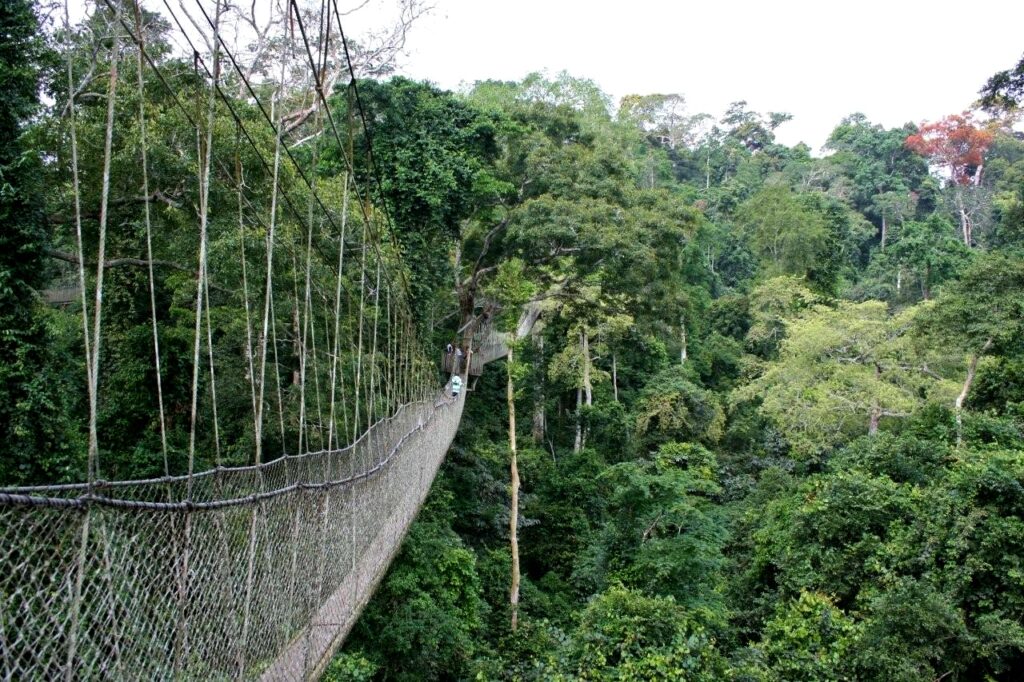
Kakum National Park – Ghana’s Premier Rainforest Destination of Canopy Walkways, Endangered Wildlife, and Upper Guinean Biodiversity
Kakum National Park is one of Africa’s most enchanting rainforest reserves and a crown jewel of Ghana’s protected areas. Situated in the lush Central Region of southern Ghana, this 375 km² sanctuary is famous worldwide for its breathtaking canopy walkway—a network of suspended bridges offering rare, elevated views of the rainforest canopy. However, Kakum is far more than its iconic walkway. It is a stronghold of the Upper Guinean Forest, one of the planet’s most threatened biodiversity hotspots, and home to rare wildlife including forest elephants, pangolins, primates, hornbills, and hundreds of butterfly species. Visitors experience a living, breathing rainforest ecosystem full of towering trees, medicinal plants, rich cultural heritage, and thriving wildlife.
Kakum’s accessibility, scientific importance, and long-term community partnership make it one of West Africa’s best managed parks. From educational tours and birdwatching expeditions to night walks and ecological research, the park provides unmatched opportunities to explore Ghana’s rainforest biodiversity. This comprehensive article highlights everything you need to know about Kakum National Park—its ecosystems, wildlife, cultural background, conservation challenges, tourism activities, access routes, and what makes it uniquely irreplaceable.
Overview of Kakum National Park
Established in 1992, Kakum National Park stands as a model of community-based conservation in Africa. Unlike many parks created under colonial administration, Kakum was designated following extensive advocacy by conservationists, scientists, and local communities who recognized the urgent need to protect Ghana’s rapidly shrinking forests. The park is co-managed by the Ghana Forestry Commission and the Wildlife Division, with support from NGOs, universities, and ecotourism operators.
Today, Kakum is one of the most visited nature reserves in West Africa, yet it remains remarkably well preserved. Revenue from ecotourism—especially the canopy walkway—funds ranger patrols, research, local employment, infrastructure maintenance, and community development projects. Kakum is frequently cited as a successful example of linking responsible tourism with wildlife conservation, education, and cultural protection.
Location and Size
Kakum National Park lies in Ghana’s Central Region, approximately 33 km north of the historic city of Cape Coast and around 170 km southwest of Accra. This strategic location makes it ideal for both domestic and international visitors arriving via Kotoka International Airport or through the region’s coastal tourism circuit.
Covering an estimated 375 km², Kakum forms part of the Upper Guinean Forest ecosystem, a conservation priority region stretching across West Africa. Its ecological significance is amplified by its adjacency to the Assin Attandanso Resource Reserve, creating a continuous forest block that shelters endangered wildlife and preserves crucial genetic diversity.
Geography and Geology
The geography of Kakum includes rolling hills, valleys, and low mountain ridges shaped by ancient Precambrian rocks—primarily granite, schist, and gneiss. The soils derived from these formations are deep, rich, and fertile, supporting dense rainforest growth and a multi-layered vegetation structure typical of tropical evergreen forests.
The park’s varied topography creates microclimates, allowing for an impressive mix of vegetation types. These environmental gradients are essential for supporting Kakum’s range of wildlife species, including primates that thrive in high canopy zones and amphibians that depend on shaded, moist forest floors.
Climate
Kakum has a warm, humid tropical climate characterized by high annual rainfall and relatively stable temperatures. The region receives approximately 1,500–1,700 mm of rainfall per year, with two pronounced rainy seasons: the major rains from March to July and the minor rains from September to November. These conditions sustain the park’s evergreen and semi-deciduous forests.
Temperatures typically range between 24°C and 32°C, with humidity frequently above 80%. This combination supports prolific plant growth, abundant insect populations, and year-round activity among mammals, birds, and amphibians. During the wet season, forest streams swell, waterfalls become more active, and mushrooms, orchids, and ferns flourish—creating an even more vibrant and photogenic forest landscape.
Hydrology and Water Systems
The hydrology of Kakum National Park is dominated by the Kakum River and numerous tributaries that flow across the reserve. The Kakum River serves as a critical water source for surrounding towns and rural settlements, including the major tourist city of Cape Coast. The forest regulates water flow, prevents soil erosion, and ensures year-round water quality, making it vital to both people and wildlife.
Other small streams form marshy areas, swamp forests, and riparian corridors that support amphibians, invertebrates, and aquatic plants. These water systems also attract forest elephants and duikers, especially during the dry season. The ecological services provided by Kakum’s hydrological network are indispensable for regional climate stability and local community livelihoods.
Ecosystems and Habitats
Kakum National Park contains multiple forest habitat types that collectively support an extraordinary degree of biological diversity. The park’s habitat mosaic includes old-growth forest, secondary regrowth, riverine vegetation, swamp forest, and transitional forest edges.
- Primary rainforest: Dense, multi-layered canopy with ancient trees reaching 40–50 meters, supporting rare primates and canopy-dwelling birds.
- Secondary forest: Regenerating vegetation that provides foraging grounds for mammals and birds.
- Riverine vegetation: Moist corridors ideal for amphibians, butterflies, and fruit-eating primates.
- Swamp forest: Seasonal wetland zones important for breeding frogs, insects, and waterbirds.
- Forest-edge transition zones: Rich in browse vegetation, attracting duikers, pangolins, and hornbills.
Because Kakum lies within the Upper Guinean biodiversity region, its ecosystems support species found nowhere else in Ghana, making it one of the country’s most ecologically valuable reserves.
Vegetation
The vegetation of Kakum is dominated by semi-deciduous tropical hardwoods, including species prized for timber such as Triplochiton, Celtis, Terminalia, Antiaris, Ceiba, and Mahogany (Khaya spp.). These hardwoods form dense canopy layers that provide habitat structure, food resources, nesting sites, and shade for countless animal species.
The forest understory is rich with lianas, vines, epiphytes, ferns, wild herbs, and orchids. Many of these plants have medicinal properties and feature prominently in traditional Ghanaian herbal medicine. Mushrooms and fungi thrive during the rainy season, contributing to nutrient cycling and ecosystem health. The diversity and density of vegetation create a complex forest architecture that supports everything from birds and monkeys to insects and amphibians.
Wildlife of Kakum National Park
Mammals
Kakum National Park provides one of the last safe havens for Ghana’s declining forest wildlife. Although dense vegetation makes sightings challenging, the park supports an impressive mammalian fauna.
- Forest elephants: A small but significant population survives here, playing an essential ecological role in seed dispersal.
- Pangolins: Both white-bellied and long-tailed pangolins occur, making Kakum vital for global conservation efforts.
- Primates: Lowe’s monkey, olive colobus, spot-nosed monkey, and black-and-white colobus are frequently recorded.
- Buffalos: Forest buffalo roam the deep forest and swamp edges.
- Duikers: Blue, red, and yellow-backed duikers are common in the understory.
- Nocturnal mammals: Civets, genets, bushbabies, and porcupines appear on night walks and camera traps.
The presence of these species underscores the park’s value as one of the most important wildlife refuges in southern Ghana.
Birds
With nearly 300 recorded species, Kakum is among the best birdwatching destinations in West Africa. The canopy walkway provides unmatched access to the upper forest layers where many rainforest birds live.
- White-breasted guineafowl: A rare Upper Guinean endemic.
- African grey parrot: Threatened by trapping but still present in Kakum.
- Hornbills: Black-casqued, brown-cheeked, and other species flourish in tall forests.
- Raptors: Long-tailed hawk, Cassin’s hawk-eagle, and African harrier-hawk.
- Forest specialists: Greenbuls, sunbirds, turacos, and bee-eaters thrive here.
Migratory species also pass through during certain seasons, adding to Kakum’s avifaunal diversity and making the park a hotspot for ornithologists and birding photographers.
Reptiles, Amphibians, and Invertebrates
Kakum’s humid environment supports a diverse assemblage of reptiles and amphibians, including chameleons, monitor lizards, forest snakes, tree frogs, and toads. Several species are endemic to West Africa and rely heavily on intact rainforest ecosystems.
Invertebrate diversity is exceptional—over 600 butterfly species, numerous beetle species, ants, spiders, moths, millipedes, and other arthropods flourish in the forest. Many of these invertebrates play critical ecological roles in pollination, decomposition, and food web dynamics.
Unique Features of Kakum National Park
- Canopy walkway: A world-famous structure made of seven suspended bridges offering panoramic views 30–40 meters above the ground.
- Upper Guinean biodiversity: Kakum protects rare and endangered wildlife unique to West Africa.
- Community partnerships: The park is a leading example of ecotourism-based conservation.
- Accessible rainforest: Easy to reach from major cities, making it ideal for short or extended visits.
- Research importance: The park is a hotspot for tropical ecology studies.
Cultural and Indigenous Communities
Surrounding Kakum are Akan-speaking communities with rich traditions deeply linked to the forest. Historically, the forest provided medicinal plants, materials for tools, and sacred sites for rituals. Today, these communities participate in guiding, craft production, cultural performances, and tourism services.
Community involvement remains central to Kakum’s success, reinforcing the idea that conservation thrives when local people benefit from protecting natural resources.
Conservation Importance
Kakum National Park is a critical conservation area protecting one of Ghana’s last intact rainforest ecosystems. It forms part of the Upper Guinean forest belt, a region with exceptionally high rates of endemism and global conservation importance. The park supports endangered species such as forest elephants, pangolins, and several primates whose populations have declined elsewhere due to habitat loss.
Conservation strategies involve anti-poaching patrols, community partnerships, habitat restoration, scientific monitoring, and environmental education. Kakum’s ecotourism-based funding model helps sustain long-term preservation efforts.
Threats and Challenges
Major threats include illegal hunting, encroachment, agricultural expansion, logging outside park boundaries, and habitat fragmentation. Human-wildlife conflict, particularly involving elephants, also poses challenges in buffer zones around the reserve.
To address these issues, the park works closely with communities, researchers, and government agencies to promote conservation awareness, sustainable livelihoods, and improved forest management practices.
Research and Monitoring
Kakum is a hub for scientific research on tropical ecology, mammal populations, bird conservation, botanical studies, and climate resilience. Collaborative research projects with the University of Cape Coast, international universities, and NGOs provide essential data for biodiversity management.
Monitoring techniques include camera traps, acoustic sensors, drone mapping, biodiversity inventories, and long-term vegetation plots, all contributing to improved conservation outcomes.
Tourism Activities
- Canopy walkway tours: A signature experience providing unmatched rainforest views.
- Guided forest hikes: Explore dense vegetation, streams, and wildlife-rich trails.
- Birdwatching excursions: Ideal for viewing canopy-dwelling species.
- Night walks: Opportunities to see civets, genets, owls, and nocturnal insects.
- Educational programs: Perfect for schools and research groups.
- Community cultural visits: Experience local crafts, dances, and traditional knowledge.
Access and Getting There
Kakum is easily accessible via paved roads from Cape Coast, Elmina, and Accra. Most visitors travel to the park by private car, taxi, or tour operator. At the main entrance, the visitor center provides information, trained guides, rest areas, souvenir shops, and educational displays.
Permits, Fees, and Rules
Entry fees support conservation and are required for all visitors. Additional charges apply for the canopy walkway, guided hikes, or special tours.
- Stay on designated trails.
- Do not remove plants or disturb wildlife.
- Keep noise levels low during forest walks.
- Follow guide instructions for safety.
- No littering or smoking inside the park.
Accommodation
Accommodation is available in surrounding communities and nearby towns such as Cape Coast, Elmina, and Abrafo. Options range from eco-lodges and guesthouses to mid-range hotels and luxury beach resorts. Some offer guided birding, night walks, and cultural tours that complement a Kakum visit.
Best Time to Visit
The best time to visit Kakum is during the dry seasons (December–March and July–August), when trails are easier to navigate and wildlife sightings increase along water sources. Birdwatching is excellent year-round, but the green season (April–June and September–November) offers lush, photogenic scenery and peak butterfly activity.
Why Kakum National Park Is Unique
Kakum National Park stands out as one of the most accessible, biologically diverse, and culturally significant rainforests in West Africa. Its canopy walkway is an international symbol of Ghanaian ecotourism, while its forests protect endangered wildlife, maintain water supplies, and preserve ancient cultural connections. Kakum blends science, culture, and conservation in a way few parks manage, making it a must-visit destination for nature lovers, researchers, students, and travellers seeking authentic rainforest adventure.
For those who want to experience the beauty and mystery of Ghana’s tropical forests—from soaring treetops to quiet forest floors—Kakum National Park offers a truly unforgettable journey into the heart of the Upper Guinean rainforest.